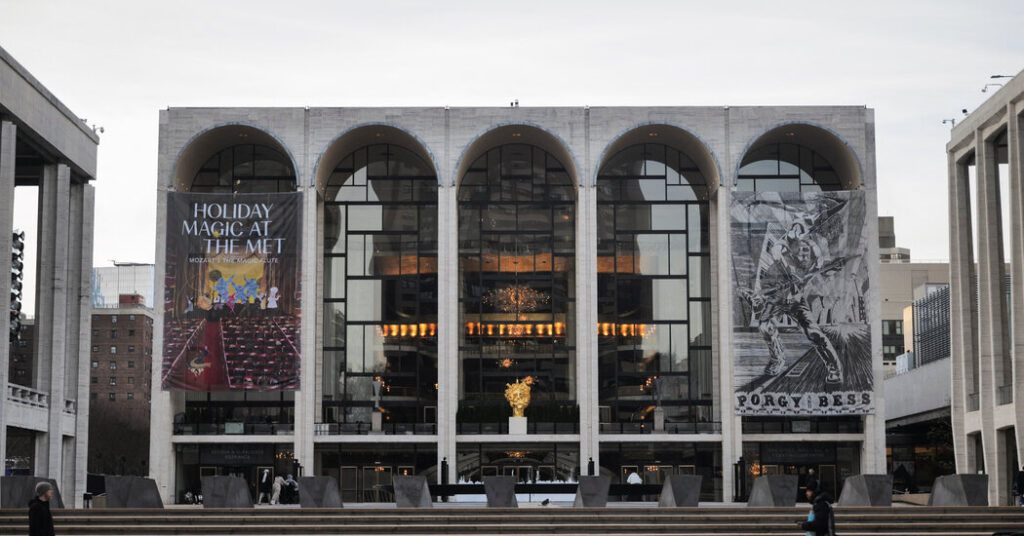
Over the past five years, the Metropolitan Opera has drained money from its endowment, entered a still-tentative $200 million deal with Saudi Arabia and cut back its performance schedule as it struggled to bring stability to an institution hammered by the coronavirus pandemic.
But in the latest sign of the persistent financial challenges facing the largest performing arts organization in the country, the Met announced on Tuesday that it would lay off workers, cut the salaries of its top-paid executives and postpone a new production from its coming season.
Peter Gelb, the Met’s general manager, said in an interview that he was forced to take these steps because of concerns about the deal with Saudi Arabia, under which the Saudis agreed to subsidize the Met in exchange for the company performing at the Royal Diriyah Opera House near Riyadh three weeks each winter.
Although Gelb said he remained confident that the deal would come through, his decision to impose the cuts now — midway through the Met’s fiscal year — suggested concern about the future of the Saudi arrangement. When the deal was announced in September, it had seemed like a lifeline for the company, which has an annual budget of $330 million, reflecting the Met’s history of big expenditures on elaborate stage sets and top-tier singers.
“I understand the Saudis have had to recalibrate their budgets because of their own economic concerns,” Gelb said. “I’ve been assured that it’s going to go forward. But we have been waiting for some time.”
Gelb said the Met was contemplating even more changes in an effort to overhaul its finances.
The company, he said, is considering selling the naming rights to its theater, following the lead of two other buildings in the complex: David Geffen Hall, home of the New York Philharmonic, and the David H. Koch Theater, home to New York City Ballet. The Met has retained CAA Sports, the sports branding arm of Creative Artists Agency, to suggest possible affiliations with corporations that might want their names affixed to the house.
Also under consideration is the sale of two Chagall murals, valued at a total of $55 million by Sotheby’s, that were commissioned in the 1960s to hang in the building’s Grand Tier. (As a condition, the buyer would have to agree to leave them in place, with a donation plaque.)
In the months ahead, Gelb said, the Met is likely to lease its 3,800-seat theater for pop artists when it would otherwise be dark. That has already begun: “The Last Ship,” a musical written by and starring Sting, will be presented at the Met for nine performances in June.
“We are being as entrepreneurial as possible,” Gelb said. “What is clear is that we have to come up with new business models. It’s true for all performing institutions, but the costs are so great for running an institution like the Met, that it is necessary to find new ways to fund it.”
The Met’s latest retrenchments come as many cultural organizations have been grappling with shrinking audiences, declining donor contributions and cuts in government funding. The cuts announced on Tuesday are expected to save $15 million this fiscal year and another $25 million the next.
The company’s decision to enter into a deal with Saudi Arabia became a point of tension because of the kingdom’s history of human rights abuses, including its implication in the 2018 killing of Jamal Khashoggi, a Saudi dissident who wrote for The Washington Post. But Gelb defended the arrangement, noting that the United States had sought closer relations with the Saudis in recent years, and presented it as a way to stabilize an opera company that has been in distress. The deal is expected to bring the Met as much as $200 million over eight years.
Paul Pacifico, a cultural official for the Saudi government who helped negotiate the deal with the Met, did not respond to a request for comment.
As part of the latest cuts, the Met will reduce its next season to 17 productions, from 18. (Before the pandemic, it programmed about 25 per season.) Gelb said that the company would postpone its new production of Mussorgsky’s “Khovanshchina,” which had premiered last year in Salzburg, Austria, directed by Simon McBurney and conducted by Esa-Pekka Salonen.
In addition, 22 people who hold administrative posts will be let go. There are a total of 284 administrative positions, and the Met’s payroll includes upward of 3,000 people. The 35 executives who make more than $150,000 a year will see graduated cuts in their pay of 4 percent to 15 percent, depending on their salaries. Among those affected is Gelb, who last year made nearly $1.4 million. Also included is Yannick Nézet-Séguin, the music director, who was paid about $2.05 million, both as the music director and for performances he conducted, for the fiscal year that ended in 2024, the latest year that disclosure forms are available.
Gelb said that the salary cuts were expected to be temporary, and that employees were told their full pay would be revived by August 2027, or sooner if the Met’s financial situation improved. He would not say if the remainder of the cuts would be rescinded if the deal with the Saudis came through.
“I have to show we can finance the Met going forward and at the same time demonstrate that we can cut the costs that we can cut without undermining our artistic results,” he said. “We have to do it.”
One move the Met is not considering, Gelb said, is tapping its endowment again. Since 2022, the company has drawn $120 million from its $217.5 million endowment, an unorthodox and risky move that arts executives said was a sign of the depth of the Met’s financial problems. As a rule, institutions should draw only the interest that is accumulated by an endowment.
Gelb said these cuts, as well as the hunt for new sources of revenue, were intended to put the Met on firmer financial footing.
“What we are trying to do,” he said, “is make sure we do not have a deficit.”
Adam Nagourney is the classical music and dance correspondent for The New York Times.
The post Despite Drastic Financial Steps, Met Opera Turns to Layoffs and Cuts appeared first on New York Times.