Years ago, I gave out stickers at my parents’ Diwali celebration, sheets of goofy-looking wild animals I had purchased impulsively at a pharmacy a few days earlier. One moment, the kids at the party played sweetly with ancient stuffies from when my siblings and I were little; the next, a short-lived but intense scuffle took place over who got the lion sticker or the zebra.
At the end of the night, my brother’s eldest, who was then around 7, affixed a glittery giraffe to my ancient iPhone’s plastic case. “You can look at this and know I’m thinking of you,” she said. I still have that case. It’s worthless as phone protection — it no longer fits any models in circulation — but in the currency of childhood affection, it’s too valuable to toss.
I grew up in a Desi family where all adults were aunties (or uncles), regardless of biological connections. I learned five different terms for “aunt” in Hindi (generally with the respectful “ji” appended): masi (mother’s sister), mami (mother’s brother’s wife), bhua (father’s sister), chachi (father’s younger brother’s wife) and tai (father’s older brother’s wife). The specificity of these terms points to how important (and hierarchical) South Asian family connections often are. They also caused me a minor calamity last Diwali, when I rushed writing names on envelopes containing cash for my cousins’ kids and accidentally wrote “Love, Maya Bhua” where I should have written “Maya Masi.” (I think we all agreed it was what was inside that counted, in this case $20.)
Without such precise labeling, “auntie” can be a purposefully, and delightfully, general term for an older woman in your community. Even if she is not a direct relative, even if you’re not sure you’re related, even if she is a friend your parents haven’t seen since the 1980s, your auntie gets respect and some measure of affection. In return she gives love and attention, not to mention gifts, money, food or sometimes eye rolls or lectures. While Mayor Zohran Mamdani of New York was excoriated during his campaign for calling his father’s cousin an aunt, a multicultural coalition of “Aunties for Zohran” went on to help him get elected.
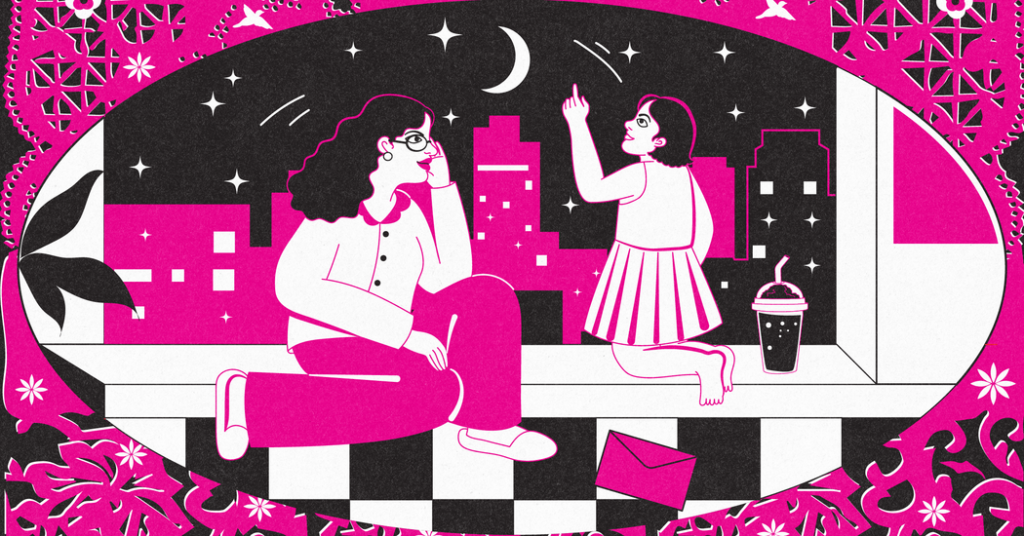
For me, auntiehood accumulates in small moments. Once, when I visited my sister’s city, I saw “Inside Out 2” with her 11-year-old, who drank a turquoise blue slushie bigger than her face. Afterward we giggled in my hotel room as she leaped between the beds. Then she climbed onto the windowsill in her pajamas and wrapped her arms around her knees, gazing at the buildings sparkling in the dark. I looked at her with that dorky expression aunties sometimes get, watching children growing into the vastness of the world.
We aunties aspire to teach, in ways that shift as kids grow. When my mother’s parents traveled the globe doing dental work in refugee camps, my nanima (maternal grandmother) often sent me postcards. Now when I travel, I sometimes send postcards to the children in my life. My brother’s youngest used to read them back to me when I visited (or, at least, she read back the one with glaring grammatical errors). Last time I visited my brother, my most recent postcards lay forgotten on a counter near the entrance. But his youngest asked me to show her how to knit. My phone is stickerless these days, but I know that his eldest, now a teenager, is thinking of me when I see she has texted me a “Parks and Rec” gif.
Inevitably I’m straddling cultures. The children of my close friends from immigrant families of color often call me “auntie,” or one of those Hindi equivalents, while the children of my white friends call me by my first name. I could not imagine doing this to my own aunties. When I was 30, I stayed with Asha Auntie, my mother’s best friend, and brought my then-boyfriend, a white man from southeastern Pennsylvania. It may have taken him two days to realize that her name was not Ashanti, but he did notice me defer to her authority — when she informed me that we would be sleeping separately under her roof, I slunk away from her steely gaze and into an empty guest room.
Families have long existed as messy assemblages of friends and relatives. But these days, expansive connections are undercelebrated, given that we live in a time when more than 40 percent of American adults are single, and people, including children, are so lonely that it’s a health hazard. Aunties help parents; when I visit my friends who are treading water in the wild currents of parenthood, I try to throw a life preserver. Once while visiting an old college friend in Manhattan, I played board games with her two children while she and her wife finished work calls and made dinner. The toddler announced in Spanish that her brother, who was 5, had mocos — boogers. Sure enough, he had a glistening snail trail below his nostrils. She looked at me with the cuddly charisma of a baby koala, meanwhile, and sneezed in my face. I knew I was going to get sick — and I did, laid out for more than two weeks — and it was worth it. Auntiehood is always worth it, despite the mocos at younger ages and the moodiness at older ones. To me, it’s about loving your community as a whole, even if you can’t quite remember how everyone is related.
Not that auntiehood should always be presumed, as I learned on a video call with an old friend who lives in Brooklyn. I suggested that his infant daughter, who was clambering on his lap and had recently started talking, call me “auntie.” “She doesn’t even call my sister ‘auntie,’” he mumbled. Fair enough. In Brooklyn, I’ll be going by “Maya.”
Maya L. Kapoor is a writer who lives in Northern California.
The post Anyone Can Be an Auntie. It’s a State of Mind. appeared first on New York Times.