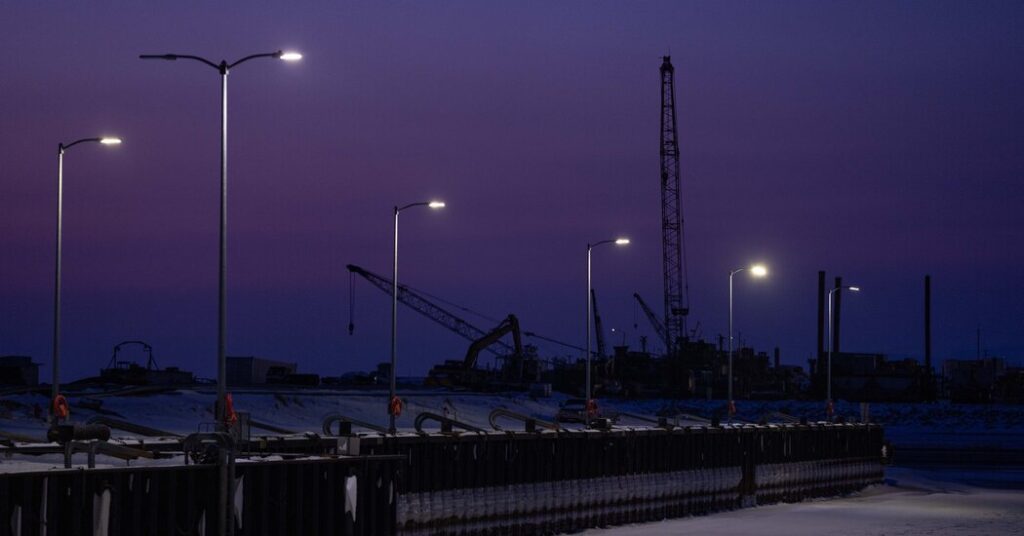
To the unimaginative eye, the view of Nome, Alaska, from Joy Baker’s well-heated S.U.V. looked like a whole lot of nothing: The early winter sun was sliding below the horizon barely four hours after it had risen, the gray water of the inner harbor had already frozen over, and the only stirring came from a flock of hearty seabirds diving for dinner just off shore.
But Ms. Baker has a vision that goes well beyond the subarctic calm: “More traffic, more services, more jobs. More of everything for people here.”
Ms. Baker is director of the Port of Nome and thus the local overseer for a $548-million-and-counting plan to expand the port, in one of America’s most remote cities on the Bering Sea. Nome is a quiet, frozen frontier town much of the year, known mostly for the Iditarod sled race, and reachable only by air except for a few summer months when the water thaws enough to allow boats through.
Soon, however, Nome’s existing dock will be turned into the country’s first deepwater Arctic port, a critical hub in President Trump’s ambitions to make the United States master of the far north and compete with other world powers for untapped natural resources and shipping corridors.
The president didn’t originate the decade-old plan to expand Nome’s existing port, but his Arctic ambitions, including his efforts to take over Greenland, are longstanding and widely known.
Mr. Trump’s aspirations for Nome were made clear near the end of his first term, when Congress authorized the port expansion with administration support. Last year, the project moved from paper to procurement as the Army Corps of Engineers awarded a $399.4 million construction contract for the first phase amid an administration-wide push to treat the Arctic and critical minerals as strategic priorities. This summer, crews will start demolishing the existing port.
The expansion should be complete, and Nome potentially remade, by 2033.
“It’s not actually like the current administration is trying to open the Arctic —Mother Nature did that,” said Ms. Baker, a gruff South Texan who moved to Alaska in 1987 and scoffs at ever returning to what Alaskans call, not always lovingly, the Lower 48. “I just see the current administration as just capitalizing in a way that will ensure our country is more self-sufficient. That can’t be a bad thing.”
Whether the port expansion will be good for Nome is a big question for many of the town’s 3,700 year-round residents and an itinerant population of contractors, health workers and dog mushing fans.
Port expansion, and the economic growth that follows, is expected to double or even triple the population, and some in Nome worry about what could happen without a solid strategy for long-term economic health.
“This is something of a boom-and-bust town,” said Jim West Jr., a longtime civic leader whose eclectic portfolio of businesses includes a gravel company, the local taxi service and the 125-year-old Board of Trade Saloon. “We need to make sure this isn’t just another economic cycle but something with lasting benefits for our children and grandchildren.”
Trump Administration: Live Updates
Updated
- Trump administration to appeal limits on interactions with Minnesota protesters.
- What to know about Trump’s ‘Board of Peace’ for Gaza: $1 billion seats, Russia and Belarus invited.
- Powell will attend the Supreme Court arguments on Trump’s effort to remove a Fed governor.
Nome’s boom began at the turn of the 20th century when prospectors immortalized as the Three Lucky Swedes found gold in nearby Anvil Creek. Their discovery briefly turned Nome into Alaska’s largest city, with more than 20,000 residents. A second kind of gold rush came in 2011, prompted by surging gold prices and consisting largely of offshore dredging, but ebbed almost as quickly as it began.
Today, the flat, treeless winter tundra around Nome is dotted with abandoned mining rigs, and the city is stuck in economic stagnation. Little is produced this close to the Arctic Circle, and everything must arrive either by plane or seasonal barge. Prices, in turn, would shock Lower 48 shoppers. On a recent visit, a gallon of gas cost $6.50, a gallon of milk went for $6.99 and one browning honeydew melon was priced at almost $12.
It’s hard to convince locals to stay and even harder to woo new year-round residents. The hospital and most construction companies bring in temporary workers and either build their own housing or provide housing subsidies that reduce supply and raise costs for year-round residents.
Civic leaders like Ms. Baker, a former Nome harbor master who came out of retirement to manage the expansion, believe the project will lead to financial sustainability. But that presumes city officials can figure out how to pay for it all. Under its deal with the state and federal governments, Nome must cover 10 percent of port construction costs and 100 percent of its own port-related infrastructure needs, such as roads, streetlights and sewer lines. The city does not know how much that will cost.
Beyond Nome City Hall, optimism about the port’s effect is the cautious sort.
Teriscovkya Smith, the principal at Nome-Beltz Middle High School, estimated that 80 percent of her students won’t go to college and hoped the expansion could bring vocational internships and quality entry-level jobs. So far, however, she hasn’t heard from anyone involved in the project.
“People who stay build careers, they buy houses, they pay property taxes,” said Ms. Smith, who fished in Alaska for 10 years before becoming a teacher. “There’s a real risk that we just waste an amazing opportunity.”
In October, Nome voters agreed to increase the local sales tax to 6 percent to avoid cuts to services such as pothole repair as well as hours at the town recreation center. The Nome school district balanced its budget last year by taking money from a fund set aside for teacher housing.
Seeing money go into the port when other services face cuts can rankle. “I see the point of this thing for some other people — for the military maybe, for big shipping companies, for cruise lines,” said Keith Reddaway, co-owner of Builders Industrial Supply, a hardware store a block from the port. “But I’m not sure I see the point for Nome.”
Tribal members also worry about what this all could mean for the subsistence lifestyle that dominates their 15 Alaska villages of the Bering Strait region. Around Nome, 86 percent of the population identifies as Indigenous.
The port expansion and a new nearby graphite mine, fast-tracked by Mr. Trump, could bring more noise, air and water pollution, damage fishing and affect migratory birds and whales. They’re scared that they will be forced to abandon their traditional homes and seasonal schedules. And they worry Nome, always a little gritty around the edges, will revert to its rougher early days.
“Outsiders bring in drugs,” said Shirley Martin, a member of the Yup’ik nation, whose village is across the Norton Sound. “People from the villages come through all the time to see family, go to the doctor, mail packages, just eat out. Will this still be a place where we feel comfortable?”
This is not the first time Nome has played a part in American security. During the Cold War, the U.S. military kept Air Force bases connected in case of a Soviet attack with an antenna installation atop nearby Anvil Mountain. Today, locals call the abandoned array “Nomehenge.”
Now, with sea ice thawing and the United States, Russia and China all eyeing Arctic shipping lanes and natural resources, Nome has emerged again as one of the most strategically important places in the Northern Hemisphere.
The expanded port won’t be a military base, but Nome is an hour’s flight from Russia. Deepening the port from 22 feet to 40 feet will allow every type of U.S. military vessel except aircraft carriers to dock in Nome.
“I’m a small-town police chief, and I’ve got intelligence officers from the Navy, the Coast Guard, the Air Force coming in here to sit with me,” said William Crockett, Nome’s retiring police chief. “Something big is coming.”
Anna Griffin the Pacific Northwest bureau chief for The Times, leading coverage of Washington, Idaho, Alaska, Montana and Oregon.
The post An Alaska Town Is Now Key to Trump’s Global Ambitions appeared first on New York Times.