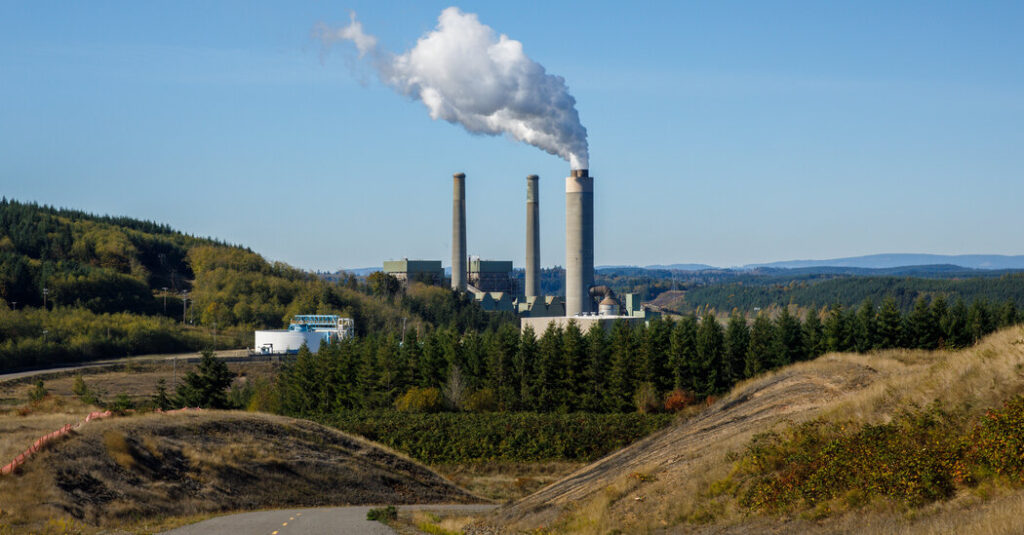
Last month, the last coal plant in Washington was preparing to shut its doors forever. Its acres-wide coal pile was all but gone.
After years of careful planning and negotiations, coal in Washington was dying a slow, quiet and mostly peaceful death.
But then the Department of Energy intervened, issuing an emergency order forcing the plant to stay open for another 90 days. It’s one of several orders from the Trump administration affecting five coal plants across the nation that Brad Plumer and I reported on last week. More such orders could be on the way.
The plant closure in Centralia, Wash., has been held up as an example of a model agreement to phase out fossil fuels in a way that balances the interests of the local community, workers, industry and environmentalists. It had been in the works since 2011.
Departing workers were scheduled to receive payments of around $50,000 each to help ease the transition into their next jobs. A state law prohibiting Washington utilities from buying power from coal took effect at the start of this year.
As Brad and I wrote last week, the Department of Energy has taken the extraordinary step of requiring coal plants across the country to remain open, despite some of the plants being in disrepair and what could ultimately amount to hundreds of millions of dollars in costs.
Today, we look more closely at that Centralia agreement from 2011. Why was it so special, and how did it come together?
The big compromise
Cast your mind back to 2011. Bruno Mars was on the radio. Coal was responsible for almost half of the electricity generated in the United States (Today it makes up less than 20 percent). The Sierra Club had started campaigning to close coal plants, but only one had actually agreed to shut down.
In Washington, one big plant in Centralia was the single largest source of the state’s greenhouse gas emissions.
The Centralia plant had reached a crossroads. In order to comply with state pollution standards, it would have to invest heavily in equipment upgrades. Environmentalists would have rather seen it close altogether.
But the plant was also an economic pillar of the town. Competing interests saw room to negotiate.
“We worked together, and by golly, it was something unusual,” said Bob Guenther, a former plant employee and a lobbyist for the International Brotherhood of Electrical Workers Local 77. “Look across the country and find another company that has sat down with the environmental community and the labor community and the government community to develop a plan for the long term.”
“It hasn’t happened,” he added.
The deal, codified in a state law, had something for everyone.
TransAlta, a Canadian company that owns the plant, agreed to shut down one coal-fired generator in 2020 and the other in 2025. The company declined an interview request.
In exchange, it was not required to install all of the expensive equipment upgrades to comply with the forthcoming regulations, and it was allowed to sign long-term power sales contracts with utilities.
The company also agreed to put $55 million in a fund for community support. Some of the money would go directly to workers — that’s the money that funded the $50,000 payments for departing employees this year.
About half of the $55 million went into a community investment fund. More went to educational opportunities for the spouses of employees. Guenther said the fund had recently offered $15,000 grants to employees who wanted to start small businesses.
“The agreement is testimony to the power of compromise,” wrote the editorial board of The Olympian, a Washington newspaper.
The aftermath
After the agreement, Washington passed many more environmental rules — but the Centralia agreement was exempted from some of those rules, including new emissions requirements.
As for the closures, they proceeded as planned. One unit closed in 2020. The other was ready to close at the end of last year.
TransAlta announced plans to transition the plant to natural gas in December.
Then the Trump administration’s emergency order threw everything into question. Beyond the immediate logistical implications of keeping a coal plant open, there were legal concerns about who has the authority to make decisions about power generation in the region.
“Folks have been scratching their heads, trying to figure out what this means,” said Lauren McCloy, utility and regulatory director of NW Energy Coalition, a nonprofit group that advocates for green power.
The state’s attorney general and environmental groups asked the Department of Energy to reconsider its orders.
Trump Administration: Live Updates
Updated
- Prosecutors subpoena Gov. Tim Walz and others in Minnesota over the response to an immigration crackdown.
- A few dozen European troops in Greenland triggered Trump.
- Judges seek to fill the government’s top prosecutor job in Virginia.
In the short term, the Trump administration’s moves have upended the longstanding Washington deal.
“We made a deal, and everyone got what they wanted, right?” said Robin Everett, deputy director of Beyond Coal for the Sierra Club, who was involved in the 2011 negotiations. “TransAlta got out of doing pollution controls, spending all that money, adhering to Washington state laws. The community got $55 million for a transition,” she said.
“But we still have a coal plant that’s operating,” she added.
TransAlta will now have to figure out how to comply with the order, which may mean restocking its coal pile and cajoling employees into staying a little longer. Given the new state ban on purchasing coal-generated power, it’s unclear who could buy power from the plant. And there are already questions about whether the plant should now be required to comply with environmental rules that were passed after 2011.
One thing did go as planned: The $50,000 checks for employees were still scheduled to go out in mid-January.
At last, scientists set up camp on the Thwaites glacier
After a series of weather delays threatened to derail their mission, scientists on Monday managed at last to set up camp on Antarctica’s remote and fast-melting Thwaites Glacier. For the next few weeks, they will be attempting a difficult but vital operation.
They aim to bore half a mile through the ice and place instruments in the warming ocean waters below, giving the world a rare, close-up look at how this gargantuan glacier is being corroded by the sea. Researchers fear that Thwaites’s thinning could someday trigger its total collapse, which would raise sea levels around the globe.
The break in the weather couldn’t have come soon enough. After crossing the southern seas and reaching Thwaites early this month, the researchers were unable to travel the last 19 miles to their planned research site because helicopters from their ship, the icebreaker Araon, couldn’t land on the cloud-swathed ice.
Now that the scientists and their roughly 17 tons of gear have been flown safely onto the glacier, they have no time to waste.
Read more. And follow our journey to Antarctica here.
Climate finance
How Wall Street turned its back on climate change
In January 2020, Larry Fink, the chief executive of BlackRock, the largest asset manager in the world, stunned the business world by declaring that he intended to use the trillions of dollars managed by his firm to address global warming.
“Every government, company, and shareholder must confront climate change,” Fink wrote, calling for “a fundamental reshaping of finance.”
Fink’s impassioned call to address climate change was the unofficial start of a movement. Nearly every major financial institution was soon pledging to reduce emissions, joining high-minded alliances designed to phase out fossil fuels and promising to support clean energy.
But six years later, many of those Wall Street institutions have walked back or abandoned their commitments. — David Gelles
One last thing
A century of Times reporting from Antarctica
“From late 1928 to early 1930,” Raymond Zhong writes, “Russell Owen filed near-daily dispatches from a landmark Antarctic expedition led by the U.S. Navy commander Richard E. Byrd. Owen chronicled hardships and triumphs, beauty and mundanity, all of it culminating when Commander Byrd became the first person to fly over the South Pole in November 1929.
Owen won a Pulitzer Prize for his coverage, and The Times christened him ‘the world’s first polar reporter.’ It was the beginning of what has become nearly a century of reporting by The Times from the frozen continent.”
More climate news from around the web:
-
More than 300,000 people have been displaced by flooding in Mozambique, The Associated Press reports. Government officials have said that 40 percent of Gaza Province in the country has been submerged by floodwater.
-
More than two-thirds of the U.S. is facing unusual dryness or drought, which is unusual for winter months, The Washington Post reports.
-
Bloomberg reports that automakers are planning to roll out six new electric S.U.V.s this year, all priced at or below $35,000.
Read past editions of the newsletter here.
If you’re enjoying what you’re reading, please consider recommending it to others. They can sign up here.
Follow The New York Times on Instagram, Threads, Facebook and TikTok at @nytimes.
Reach us at [email protected]. We read every message, and reply to many!
Claire Brown covers climate change for The Times and writes for the Climate Forward newsletter.
The post All Sides Agreed on Shutting a Coal Plant. Then Trump Stepped In. appeared first on New York Times.