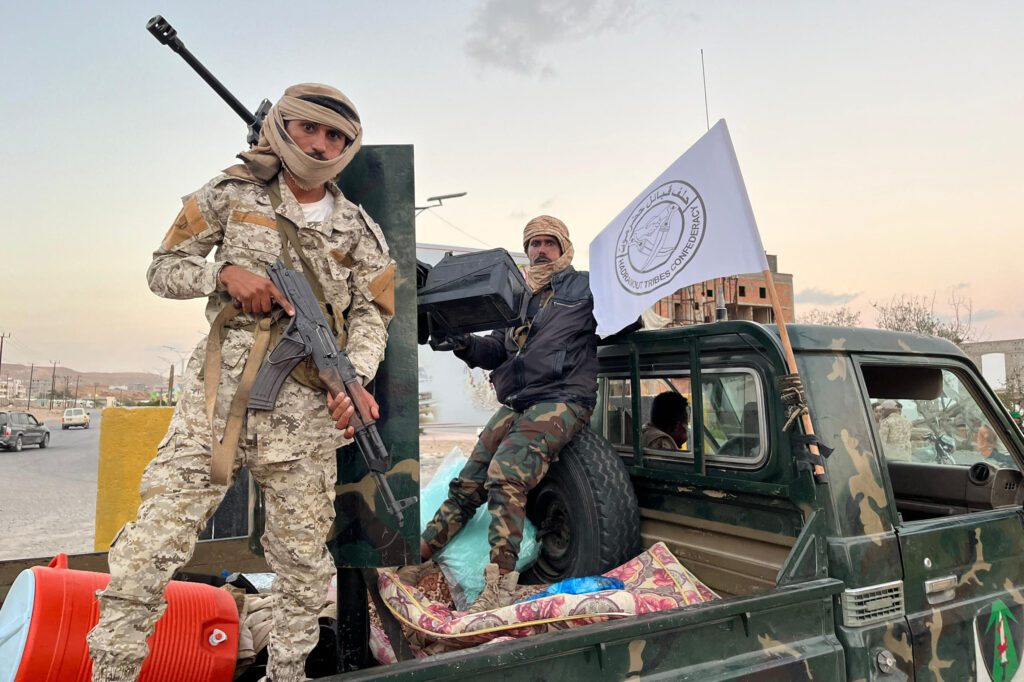
The long-simmering rivalry between Saudi Arabia and the United Arab Emirates that erupted across southern Yemen in recent weeks, pitting the once-allied nations against each other in a fight among proxies for land and power, threatens to upend other fragile states where the two countries hold sway.
Saudi Arabia, which props up the internationally recognized government in Yemen, intervened last month when UAE-backed separatists swept through and seized key territory, striking the rebel fighters and targeting an Emirati consignment Riyadh said contained weapons for the group. The UAE quickly withdrew its troops and the separatists’ leadership council promptly dissolved.
But the rupture between the two oil-rich monarchies is already rippling beyond Yemen as Saudi Arabia, alarmed by what it sees as aggressive military and foreign policy moves by its much smaller neighbor, works to counter the deep web of influence Abu Dhabi has spent years building in the Horn of Africa and around the Red Sea.
As part of that effort, Riyadh has blasted the UAE in unusual public statements, including a segment posted Sunday on X by state-owned Al Ekhbariya TV. “After three weeks, Abu Dhabi is still working against the Kingdom,” the channel said, adding a warning that Saudi Arabia “will not hesitate to take the steps and required procedures against whoever threatens its national security.”
Riyadh’s sudden, more assertive stance has countries in the region trying to navigate the rift. For years, Saudi Arabia and the UAE worked largely in tandem, backstopping other autocrats amid the Arab Spring uprisings and joining forces to counter the Iranian-backed Houthis in Yemen.
In recent days, however, Saudi Arabia has shored up other alliances to curtail its rival and is in talks with both Egypt and Somalia to expand security cooperation between the three countries, according to a senior Somali security official. Somalia’s federal government also said it was canceling its defense agreements with the UAE, which maintains commercial ports and military bases in at least three areas — Somaliland, Puntland and Jubaland — where the government in Mogadishu has little presence or influence.
At the same time, flights from the UAE — which analysts say are likely to be carrying supplies to Abu Dhabi’s proxies in places such as Chad, Libya and Sudan — have also recently been rerouted to avoid Egyptian, Saudi and Somali airspace, flight-tracking data shows.
“The flip-flop here is huge,” Liam Karr, Africa team lead for the critical threats project at the American Enterprise Institute, said of the UAE and Saudi positions.
In late December, it looked like the UAE and its allies in Yemen were going to control both the northern and southern sides of the Bab el-Mandeb strait — a narrow but crucial waterway connecting the Red Sea to the Gulf of Aden — as well as the Gulf of Aden itself, he said. But as Saudi Arabia takes the upper hand, “now, it’s looking like the opposite could be true,” said Karr.
The Emirati Foreign Ministry, when reached for comment, did not respond directly to questions about tensions with Saudi Arabia. The Ministry of Media in Riyadh and a spokesman for the Saudi Embassy in Washington also did not respond to a request for comment. Other senior officials declined to comment or failed to respond.
In the UAE, analysts and pundits have framed Saudi Arabia’s recent actions as a result of a big brother complex — a feeling they have been left behind while their neighbor, which has less territory and far fewer people, has taken an outsize role in the region and beyond.
In 2022, for example, the UAE overtook China as the top investor in Africa, according to fDi Markets, a global investment monitor owned by the Financial Times newspaper. The investments include everything from commercial port operations in Somalia and Djibouti to agricultural projectsin Ethiopia, Kenya and Uganda designed to secure the UAE’s food imports.
“The Saudis see the UAE as a challenge to their leadership in the gulf, probably the only challenge now and a credible challenge when it comes to the region at large,” said Abdulla Abdelkhaleq, a prominent Emirati academic.
Saudi Arabia probably felt that “something had to be done, and maybe the place to start is in Hadramawt,” he said, referring to the oil-rich region in Yemen that was a focus of the recent clashes.
A ‘complete fracture’
Disputes between Saudi Arabia and the UAE over everything from land to oil production are not new and have bubbled up periodically since the latter was founded out of a British protectorate in 1971.
But in 2014, when Crown Prince Mohammed bin Salman emerged as a power player in Saudi Arabia’s royal politics, UAE President Mohammed bin Zayed al-Nahyan “saw him as a younger version of himself,” said Kristian Coates Ulrichsen, a fellow for the Middle East at the Baker Institute. Over the next few years, the two leaders became close and “seemed to be reshaping the gulf,” Ulrichsen said.
The alliance to support fighters battling the Houthis, who seized control of Yemen’s capital, Sanaa, in 2014 and now rule over swaths of the northwest, was perhaps the most visible sign of the budding partnership. But soon, diverging interests, strategies and goals created new fissures between the two.
Saudi Arabia, in backing the internationally recognized government, sought to maintain Yemen’s territorial integrity. The UAE, which views political Islam as an existential threat, narrowed its focus on countering the country’s Islamist factions, including those within the anti-Houthi coalition.
As a result, the UAE ended up funding, arming and consolidating separatist forces in southern Yemen, helping underwrite in 2017 the formation of the Southern Transitional Council, headed by Aidarous al-Zubaidi, a longtime secessionist and former governor of Aden province.
With its own proxy fighters, the UAE began expanding its footprint, building airfields, outposts and other infrastructure in port cities or islands off the coast, sometimes without the consent of the Saudi-backed government and giving it enormous strategic advantage along some of the world’s most important maritime routes.
It’s a pattern that the UAE has repeated in countries such as Libya and Sudan, allying with non-state actors enabling it to gain footholds for investment, resources, security and political leverage, putting them at odds with Saudi Arabia’s more conservative approach of upholding traditional governments.
Andreas Krieg, an associate professor at King’s College London’s School of Security Studies, has described the UAE’s regional network as an “axis of secessionists.”
“Abu Dhabi is comfortable operating below the threshold of formal statecraft, building influence through a web of commercial vehicles, logistics access, security assistance, intermediaries and local armed partners,” he said.
But the STC’s rapid advance in Mahra and Hadramawt provinces put its forces on Yemen’s lengthy border with Saudi Arabia. The sweep prompted Saudi Arabia to pull the trigger on rolling back STC gains and openly addressing the UAE’s role — although an Emirati official described the accusation that Abu Dhabi directed the advance as “categorically false.”
The result has been a “complete fracture” of the Saudi-Emirati relationship in Yemen, said Khaled Alyemany, a former Yemeni foreign minister. “The Emirati disengagement was really shocking. In two days, they just vanished.”
In the immediate aftermath of the withdrawal, Alyemany said, the UAE appeared to refrain from engaging in any diplomacy, even as some STC leaders were summoned to Riyadh and the group’s members accused Saudi Arabia of holding them incommunicado. It seems like the Emiratis are sending a message to Saudi Arabia, he added: “It’s now your problem, deal with it.”
Riyadh also accused the UAE of smuggling Zubaidi, whom the government accused of treason, out of Yemen and to Somaliland via Mogadishu on Jan. 7. The alleged movement of Zubaidi through Somali territory is part of a broader pattern the government in Mogadishu sees as UAE violations of the country’s territory, Karr said.
Abu Dhabi maintains a deepwater port and accompanying airfield in Berbera in Somaliland, a breakaway region in Somalia’s north. In nearby Puntland, which is semiautonomous, the UAE invested in a port and built a military base in Bossaso, on the Gulf of Aden’s southern coast.
The base at Bossaso is a key logistics hub for the Emirates, analysts say, and hosts a hangar for drones used in UAE strikes against Islamic State militants in Puntland. Bossaso had also previously received several IL-76 cargo planes traveling to or from the UAE, but those have stopped in recent weeks, flight data shows.
“We know that some of the planes landing in Bossaso are providing support and supplies for RSF fighters in Sudan,” Justin Lynch, managing director of research and analytics firm Conflict Insights Group, said of the Rapid Support Forces, a paramilitary group fighting the Sudanese military.
The Emiratis have a long-standing relationship with RSF leader Mohamed Hamdan Dagalo, who sent thousands of mercenaries to fight on the UAE-backed side in Yemen. They also have previously invested in Sudanese gold mining and large agricultural projects, and clinched a $6 billion deal to develop a portin Sudan before the civil war erupted.
The UAE has denied arming the RSF paramilitary despite evidence documenting the presence of weapons purchased by the UAE in RSF stockpiles captured by the military.
Saudi Arabia has used Emirati support for the RSF, which the United States said has committed genocide in Sudan, to lob criticism at Abu Dhabi for “prolonging the conflict” and emphasize Riyadh’s preference for preserving state institutions.
But even as the rivalry has spilled over from Yemen, some said they see advantages in the two countries being clear about their limits and what type of interference they can tolerate in areas they view as being within their sphere of influence.
“Having the red lines being clarified by all parties is important,” said Bader al-Saif, assistant professor at Kuwait University and associate fellow at Chatham House. “I see in the long term a clarity of purpose.”
Abbie Cheeseman and Meg Kelly contributed to this report.
The post After Yemen rift, Saudi Arabia aims to oust UAE from wider region appeared first on Washington Post.