In today’s America, the less money a white voter has, the more likely they are to support Donald Trump.
Whites in the bottom 10 percent of America’s income distribution broke for the GOP nominee in 2024 by landslide margins. Those in the top 5 percent largely backed Democrat Kamala Harris, according to American National Election Studies data.
For most of the past century, the opposite pattern prevailed: In every presidential election from 1948 to 2012, poor whites voted to the left of rich ones.
But that changed in 2016. Eight years later, the new, negative correlation between income and Republicanism among whites became unprecedentedly strong, as Ohio State University political scientist Tom Wood has shown:

This development surely reflects Trump’s personal imprint on American life. Yet it was also made possible by long-term, structural shifts in our politics.
In the mid-20th century, Americans without college degrees voted sharply to the left of university graduates. But beginning in the late 1960s, this gap started to narrow before finally flipping in 2004. The relationship between socioeconomic status and partisanship in the United States therefore changed gradually — and then, with Trump’s populist rebrand of the GOP, all at once.

This realignment had many causes. An indispensable factor, however, was the rising salience of “culture war” issues.
Over the past 50 years, debates over immigration, crime, abortion, religion, race, and gender became increasingly prominent in American politics. As this happened, voters began sorting themselves less on the basis of their economic attitudes and more on that of their cultural ones. And since college-educated voters lean left on most social issues — while less educated voters lean right — this eroded the lower classes’ traditional attachment to the Democratic Party (and the upper classes’ historic ties to the GOP).
Liberals often lament these developments — and not without reason. Some consequences of cultural polarization seem perverse. Many poor Americans today 1) express progressive views on health care and social welfare, 2) say that economic issues are their top concern, and 3) nonetheless vote for the party hellbent on cutting their Medicaid and food stamp benefits.
And of course, Democrats’ flagging support with working-class voters has enabled Trump’s electoral success — thereby imperiling American democracy.
For these reasons, the question of why the culture war gained such political prominence has long preoccupied Democrats. Some progressives blame their party’s alleged abandonment of economic populism: By embracing “neooliberal” stances on trade and regulation, Democrats narrowed the gap between the parties on economic issues, thereby making their divisions on social matters more conspicuous.
Some moderates, meanwhile, suggest that the party made cultural controversies more salient by moving too far to the left in such debates. Others argue that the right’s radicalization has made the culture war’s primacy inevitable; it is hard to keep fiscal policy in the foreground when agents from Immigration and Customs Enforcement are brutalizing US citizens and the president is demonizing all Somali-American-owned businesses.
But recent research points to another (potentially complementary) explanation for the decline of materialist voting: Americans’ at-home entertainment options have gotten too good.
Key takeaways
• In recent decades, culture war issues have become increasingly salient in American politics, triggering a realignment of the major party coalitions.
• A new study suggests that the rise of cable television fueled these trends: Facing heightened competition, news broadcasters realized that social issues were better at attracting viewers’ attention than economic ones.
• Digital media has made the attention economy even more competitive — and thus, culture war controversies even more prominent.
How cable changed TV news
At least, this is my takeaway from “The Business of the Culture War,” a new paper from a pair of economics graduate students at MIT and Harvard University, Shakked Noy and Akaash Rao, respectively.
Their study’s basic story is simple: As the television business grew more competitive, news broadcasts began emphasizing culture war controversies, fueling a realignment of American politics in the process.
Noy and Rao note that, from the mid-1950s to mid-1980s, the three big networks — CBS, NBC, and ABC — dominated American television. Although cable TV existed, it had yet to fully penetrate American households and alternate channels were limited. Amid such scant competition, the major networks didn’t worry too much about maximizing the entertainment value of their news broadcasts. Each had a nearly captive audience, who could be force-fed briefings on current affairs most evenings. The networks therefore viewed their news divisions as vehicles for earning prestige as much as revenue. And this led them to favor “hard” economic coverage over “soft” cultural stories.
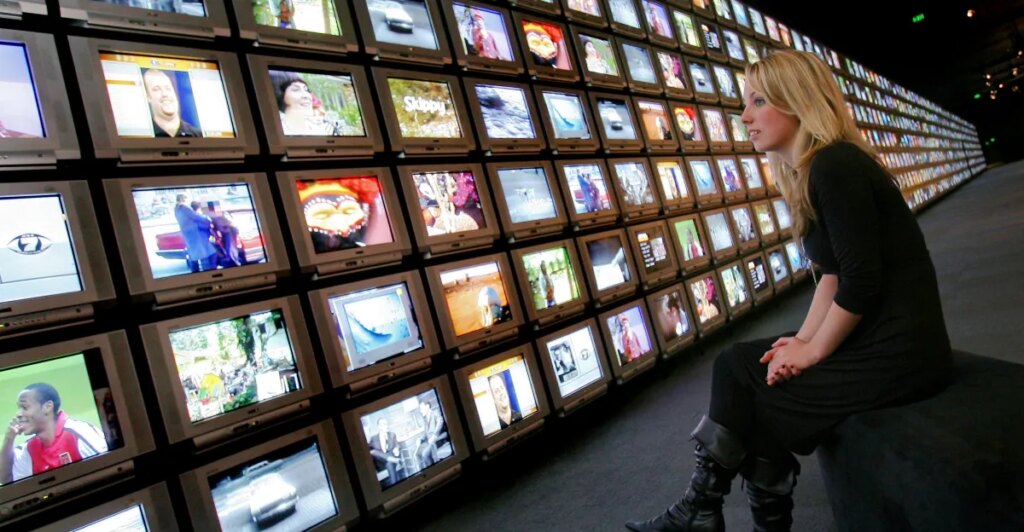
As coaxial cables brought an ever-expanding array of channels into American homes, however, the TV business started to change. By 1997, three 24-hour cable news networks were competing for viewers’ attention — against not merely each other, but upward of 40 other stations. Critically, Fox News, CNN, and MSNBC couldn’t afford to treat their news broadcasts as “loss leaders” like the networks had; news was their entire business. And these competitive pressures led all three to emphasize cultural issues over economic ones.
Of course, the notion that cable news spotlights social controversies is hardly new (one can find that thesis eloquently elaborated in the 2013 cinematic masterpiece, Anchorman 2). But Noy and Rao prove it empirically.
Analyzing recordings and transcripts from the past six decades of TV news, they show that cable networks dedicate a large majority of their issue-based coverage to cultural issues, even as broadcast news networks had historically favored economic topics.
This editorial tendency appears to have been rational. Drawing on smart TV data that records when households change channels or turn off their televisions, Noy and Rao show that cultural topics are better at retaining viewers: When a network switches from an entirely cultural segment to a fully economic one, viewership falls by an average of 2.2 percent — about one-sixth of the click-away penalty associated with cutting to a commercial.
Notably, economic coverage was actually more effective at preventing a viewer from switching to a different news network. But households that ping-pong between CNN and Fox News comprise a small minority of the TV audience. And cultural topics are much more likely to retain the attention of viewers deciding between watching the news and flipping on a basketball game, reality show, video game console, or any other diversion.
In the 2010s, as such at-home entertainment options proliferated, broadcast news began emphasizing cultural topics over economic ones for the first time, in an apparent concession to competitive pressures.

Cable news changes voters’ priorities
Of course, it isn’t self-evident that cable news networks’ editorial decisions drive voter behavior. After all, only a small minority of the electorate watches such channels. And Americans still overwhelmingly say the economic issues are their top concern.
But Noy and Rao present evidence that cable news causes voters — and thus, politicians — to put a greater premium on social issues.
To isolate the impact of cable news channels, the researchers exploit a quirk in Americans’ viewing habits: All else equal, we tend to watch channels with low numbers (e.g., channel 15) more than those with high numbers (e.g., channel 56). And since the channel number assigned to cable networks varies randomly across markets, one can gauge the broadcasters’ political influence by comparing areas where MSNBC and Fox News are assigned low numbers to those where they’re assigned high ones.
When Noy and Rao do this, they find that — controlling for a jurisdiction’s demographics and partisanship — voters are more likely to tell Gallup that a social issue is the nation’s “most important problem” if they live in places with high levels of cable-news exposure.
And this appears to cause politicians in such areas to emphasize culture war issues: In constituencies where voters watch more cable news, the study finds that campaign ads are more likely to focus on social issues.
Digital media is likely also biased toward social issues
Noy and Rao’s paper is concerned with cable news, not digital media. But their findings suggest that online publications and influencers — whose audiences are perpetually a couple clicks away from virtually every movie, television show, book, and genre of pornography in existence — would have even stronger incentives to foreground culture war controversies.
In today’s historically competitive market for human attention, news purveyors face strong incentives to emphasize whichever issues are most captivating for casual viewers. Noy and Rao’s study strongly indicate that questions of identity, gender roles, and immigration tend to fit the bill better than debates over fiscal or regulatory policy. And most days, a perusal of TikTok, X, or Bluesky would seem to reinforce that impression.
The economy is still politically important
None of this means that economic issues no longer matter. To the contrary, Noy and Rao’s study actually indicates that candidates whose ads focus on bread-and-butter issues perform better than those whose ads center cultural topics. For voters in general — and swing voters in particular — material concerns remain paramount.
Yet whether a given voter has more faith in Democrats or Republicans to manage the economy depends, to a historically great degree, on their culture war allegiances. This helps explain why working-class white voters favored Trump — while college-educated ones backed Kamala Harris — even as both blocs deemed inflation the nation’s top problem in 2024.
Parties’ decisions matter (but they don’t happen in a vacuum)
Even if shifting media dynamics have helped fuel the culture war, party positioning has surely also contributed. Democrats can plausibly reduce the salience of social issues by embracing more moderate stances on them — or by more effectively representing and advancing working people’s material interests — or both.
But any effort to repolarize politics around economic issues will face strong headwinds. As influencers, video games, and AI slop proliferates, political media will face ever-stronger incentives to lean into attention-maximizing topics — and thus, culture war controversies.
The post A very simple explanation for why politics is broken appeared first on Vox.