Hours before the official start of the World Economic Forum on Monday evening, a line of more than four dozen people snaked onto the sidewalk in front of the AI House, a nonprofit convened in the name of providing a “multi-stakeholder platform for visionary dialogue and collaboration on key questions shaping the next frontier.”
A couple of doors down, an even longer line of attendees jostled for space inside a forum on artificial intelligence and cybersecurity hosted by Axios, the American news operation. People took selfies while swapping tips on how to score invites to the glitziest parties thrown by global technology companies.
And just down the block, a rented storefront outfitted as the gathering place for the Alliance for Global Good-Gender Equity and Equality sat mostly empty. The initiative was launched by the Indian government two years ago to bolster women’s health and education. Here at Davos, its place was mostly unnoticed. People passed by hurriedly, en route to neon-tinted cocktails served up by a cryptocurrency firm or a pulsating lounge experience paid for by an A.I. company.
On a small stretch of a promenade, the main street threading the village of Davos in the Swiss Alps, was a visual distillation of what has come of the World Economic Forum, a conference long touted as the central gathering place of the global elite.
The high-minded panel discussions about climate change, caring for refugees and the future of health care were there to be heard in lesser venues. But the action was dominated by technology giants and their euphoria over the lucrative potential of the moment.
“I’m a very bullish character,” said Daniel Newman, chief executive of the Futurum Group, a consultancy based in Austin, Texas, that advises major tech companies on new ventures. “This is an exponential time, and the world is changing.”
Later that night, Mr. Newman would join with two partner organizations to host what was billed as an “A.I. and Exploration Salon,” where a crowd of entrepreneurs drawn from Silicon Valley to France hoisted margaritas and danced to house music. Then came a performance from a “mentalist” who gathered random numbers from the crowd and somehow multiplied and subtracted them to yield the digits representing the day’s date.
When Mr. Newman took the stage, he used that trick to advertise the transformative potential of A.I.
“Great technology can feel like magic,” he said. “This is the fastest technological gigacycle in history.”
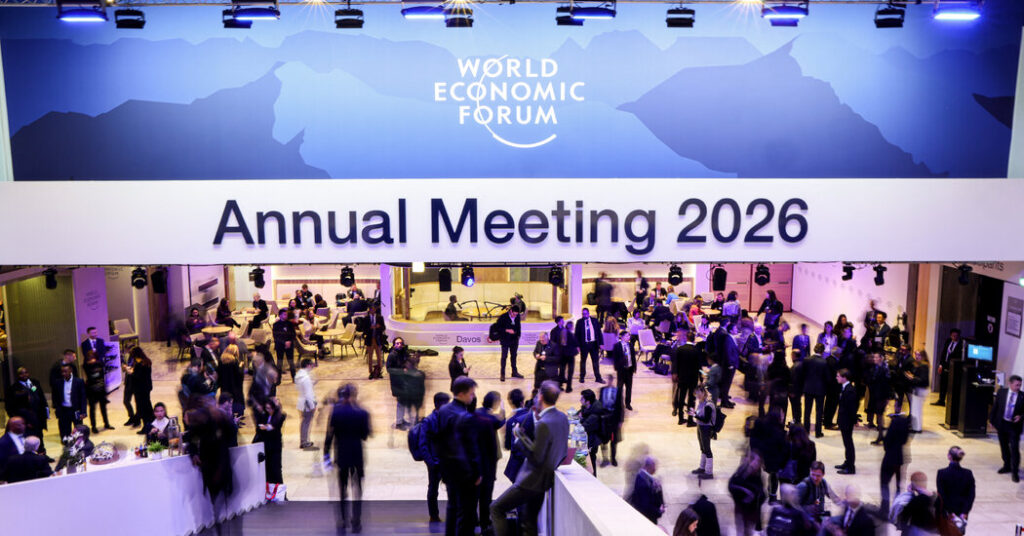
At this, the 56th Davos event, conversation featured complaints about the traffic crawling through the narrow streets, a perennial lament as visiting heads of state commandeer seemingly every Land Rover between here and Uzbekistan. But this year the traffic has been worsened by the fact that the forum has attracted the largest crowd in its history, some 3,000 people from 130 countries.
Anticipation was intently focused on the looming arrival of President Trump, who was expected on Wednesday. Security had already been tightened, and the sidewalks were as crowded as midtown Manhattan during rush hour. Davos, always a logistical torment, was certain to become more so.
The conventional wisdom had it that Mr. Trump was entering hostile territory: a conference devoted to multilateral cooperation held in Europe, just as he advances threats to seize Greenland from Denmark, a fellow member of the North Atlantic alliance.
There was clearly some truth to that expectation. As Christine Lagarde, president of the European Central Bank, entered the Congress Center on Tuesday morning, I asked her whether she anticipated that Europe would stay firm in opposing Mr. Trump’s threatened incursion, including the use of punitive tariffs.
“Yes,” she said. “I’m a central banker, not a policymaker, but I certainly hope so.”
On Tuesday morning, the European Commission president Ursula von der Leyen used a keynote address to urge the Trump administration not to proceed with tariffs in pursuit of its claims on Greenland.
“Our response will be unflinching, united and proportional,” she said.
At a modest gathering held in a repurposed storefront a 15-minute walk from the center of the action on Monday evening, a group of European diplomats and activists held a conversation billed “Trans-Atlantic relations in the era of Trump. Can we keep the E.U.-U.S. bond?”
Most of the participants described an imperative to oppose Mr. Trump on Greenland. They described the confrontation as a historical test of the continent’s true principles.
“This is about guarding, holding on to human values,” said Sandrine Dixson-Declève, the global ambassador for the Club of Rome, a think tank focused on sustainability and economic inequality. She described the current moment as feeling much like the 1930s, which culminated in the Holocaust. “I have my grandfather’s voice in my head,” she said. “‘Do not forget history.’”
A member of Poland’s parliament, Aleksandra Uznańska-Wiśniewska, accused the White House of trying to impose an unjust peace on Ukraine, with money outweighing any concern for human rights.
“The vision of Trump is to end the conflict as soon as possible, to reestablish business as usual with Russia,” she said.
But these sorts of conversations were tucked away. The dominant spectacle was the largest storefronts on the promenade decked out as headquarters and hospitality centers for some of the world’s largest consulting companies and technology brands: Meta, Salesforce, Tata. Qatar and the United Arab Emirates occupied massive retail spaces, advertising their openness for business.
The prime spot on the promenade, an old church near the conference center, had been reconfigured into USA House, a venue sponsored by McKinsey and Microsoft, among others, that was billed as spotlighting “enduring themes associated with American leadership, including innovation, opportunity, collaboration and democratic values.”
Draped in red, white and blue banners adorned with bald eagles, USA House sat across the street from Palantir, an American data analytics company that Mr. Trump has relied on to increase surveillance for Homeland Security and the Pentagon.
At a media briefing on Tuesday, the U.S. Treasury secretary Scott Bessent said that he planned to meet with non-American chief executives to urge them to remain calm in the face of tensions surrounding Greenland.
“Take a deep breath and let this play out,” Mr. Bessent said. “Do not listen to the media hysteria.”
The crowds thronging the USA House contributed to the sense that Davos has been refashioned, or perhaps just reinforced. Though critics have long accused the World Economic Forum of serving up a performance of earnest inquiry and compassion while really conducting a business conference, this year the pretenses are mostly gone.
Karen Harris, managing director of the Macro Trends Group at Bain & Company, has been attending the forum since 2018. As she surveyed the offerings this year, she detected a shift away from the traditional conceit that members of nongovernmental organizations are supposed to gather in Davos to advise world leaders on how to elevate humanity.
“That doesn’t feel like the agenda anymore,” she said “Certainly the agenda and who’s heroicized feels different.”
As she spoke, word was circulating that Mr. Trump planned to convene chief executives for a large meeting on Wednesday, a source of intrigue and scheduling anxiety.
Those engaged in artificial intelligence expressed certainty that he would be greeted not as a rogue threat to the global order but as a provider of enormous opportunities to make money.
“Most of these C.E.O.s are focused on nurturing values for their shareholders,” said Mr. Newman, the Futurum Group chief executive. “They have grown bullish that he’ll move policy, cut through the red tape.”
The tech executives he works with once talked about diversity, equity and inclusion along with climate sustainability. Not anymore. They have adopted the guise of the American president.
“Part of being a great C.E.O. is being a chameleon,” Mr. Newman explained. “Trump is the most influential voice in the world right now. These C.E.O.s are pleased to be in an environment that’s largely right for business.”
Jordyn Holman contributed reporting.
Peter S. Goodman is a reporter who covers the global economy. He writes about the intersection of economics and geopolitics, with particular emphasis on the consequences for people and their lives and livelihoods.
The post A.I., Big Tech and Trump Shine Most Brightly at the Davos Spectacle appeared first on New York Times.