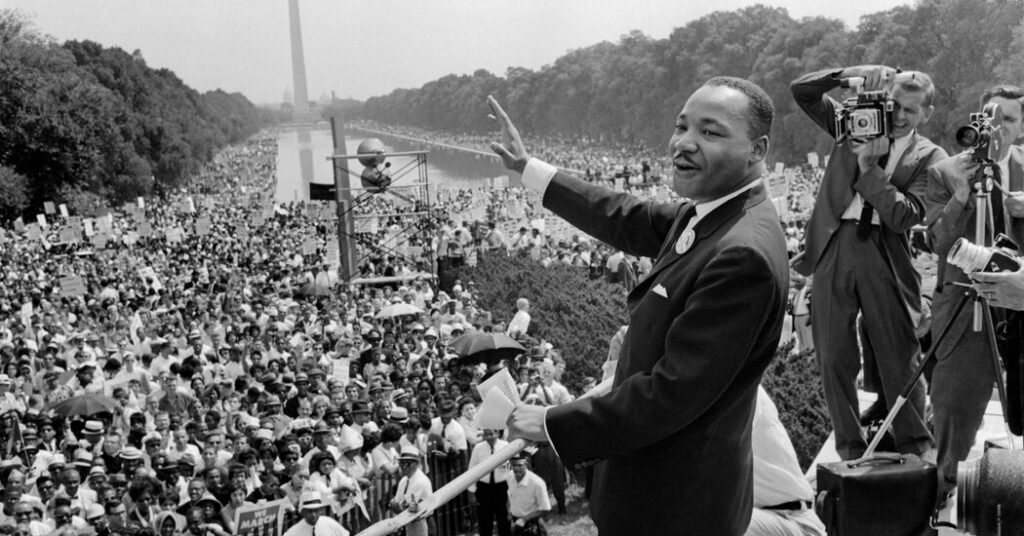
The third Monday of January each year is Martin Luther King’s Birthday, the holiday honoring the legacy of the U.S. civil rights leader.
The federal government has observed it since 1986, 18 years after the Rev. Dr. Martin Luther King Jr. was assassinated at age 39.
Here is a brief guide to the day.
What is M.L.K. Day?
The day, which falls close to Dr. King’s birthday on Jan. 15, commemorates his work in the pursuit of equal rights.
A powerful orator and leader, Dr. King was an instrumental figure in the civil rights movement, which called for an end to racial segregation and discrimination in the United States.
An advocate of nonviolent protest, Dr. King also championed the rights of women, of L.G.B.T.Q. persons and of workers. He criticized income inequality and the involvement of the United States in the Vietnam War.
Parades, commemorative services and festivals across the country honor Dr. King. In 1994, President Bill Clinton signed legislation designating it as a day of service on which Americans are encouraged to volunteer in their communities.
How did it become a holiday?
In 1983, President Ronald Reagan signed legislation to create the federal holiday, 15 years after Dr. King was killed. It was first observed three years later.
The holiday was the result of a prolonged campaign to honor Dr. King at a national level. It was first suggested four days after his assassination, but stalled for years in Congress.
Its proponents, led by Coretta Scott King, Dr. King’s widow, gathered petitions and lobbied lawmakers to support the bill. Representative John Conyers Jr., a Democrat of Michigan, who first introduced a bill, repeatedly reintroduced it with the backing of the Congressional Black Caucus until it passed.
The bill made it to a vote in 1979, but failed because of opposition from Republican lawmakers. Its opponents argued that the holiday would be too expensive and noted that Dr. King had never held elected office.
President Jimmy Carter supported the bill in 1979. The musician Stevie Wonder, a prominent supporter, made it the focus of his hit 1980 song, “Happy Birthday.”
Bipartisan lawmakers in Congress passed the bill in 1983, though several Republicans continued to oppose it. Some states declined to celebrate it for years or used names that distanced it from Dr. King.
All states now observe the holiday, though Alabama and Mississippi combine it with a day celebrating Robert E. Lee, the Confederate general. Critics of that merging have decried it for pairing two men with starkly different visions for the nation.
How is the day celebrated?
Many cities and towns across the United States will host services, parades and exhibitions in honor of Dr. King.
The Ebenezer Baptist Church in Atlanta, where Dr. King preached, will host a commemorative service that will also be livestreamed.
The King Center in Atlanta, led by Dr. King’s daughter, Bernice King, runs programming each year, including summits and teach-ins at schools.
What will be different in 2026?
AmeriCorps, an agency that typically led the annual day of service, has been in disarray since the Trump administration moved to dismantle it last year. Judges later ordered the reinstatement of its programs in 24 Democratic-led states and the return of some staff.
The Trump administration last month cut free entrance to national parks on Martin Luther King’s Birthday and Juneteeth, part of a broader pattern of the White House moves to minimize Black history.
In response, Gov. Gavin Newsom of California said that state parks there would offer free entry this year.
“Dr. King’s legacy deserves to be honored, not erased,” Mr. Newsom said in a news release.
In an address this month, Bernice King said that her father’s message has a renewed urgency today.
“My father warned us, ‘We must learn to live together as brothers or together we will be forced to perish as fools,’” she said. “His words were not poetic. They were prophetic.”
Isabella Kwai is a Times reporter based in London, covering breaking news and other trends.
The post What to Know About M.L.K. Day appeared first on New York Times.