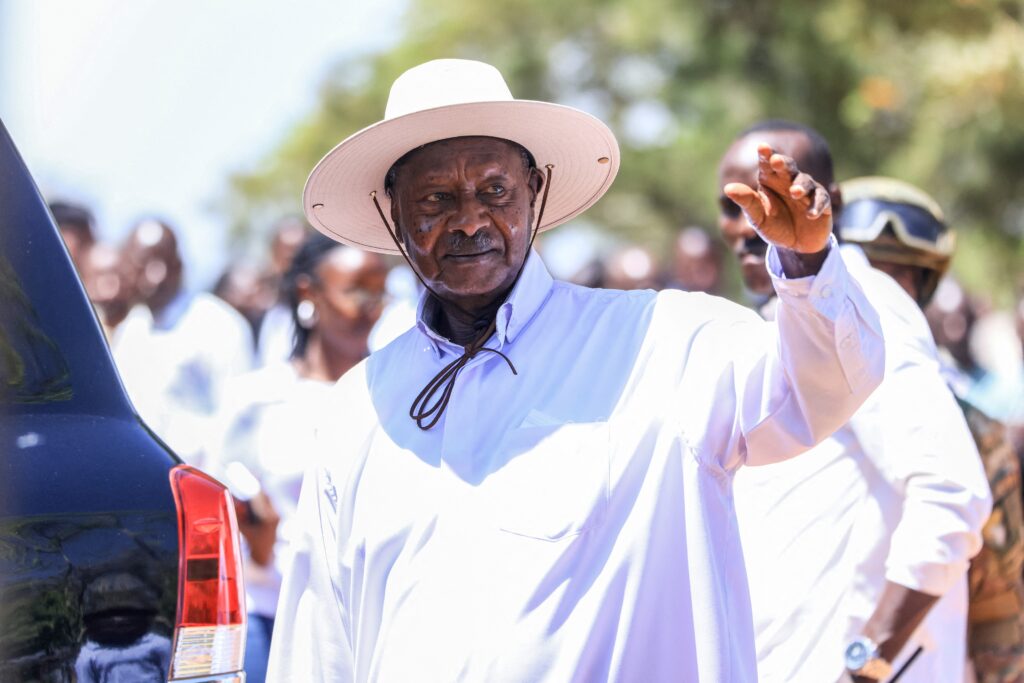
When Ugandan President Yoweri Museveni took power in January 1986, after decades of civil war and chaos, he promised fundamental change. “The problem of Africa in general and Uganda in particular is not the people, but leaders who want to overstay in power,” Museveni said in his inaugural speech.
Forty years later, Museveni was declared the winner over the weekend of an election marred by violence, an internet blackout and the intimidation of the opposition. The 81-year-old incumbent, Africa’s third longest-serving leader, has forgotten the sage words of the 41-year-old rebel commander he once was.
The country’s election officials claimed dubiously that Museveni won with 71.7 percent of the vote and that his principal challenger, popular musician-turned-politician Bobi Wine, garnered just shy of 25 percent.
Wine posted online videos showing what he alleged were examples of ballot stuffing and other shenanigans. But his complaints will likely not be heard, since Museveni controls all levers of power and state media. Wine himself said he was forced to flee his home after it was surrounded by soldiers.
Africa is a demographic time bomb. The world’s youngest continent is dominated by a series of octogenarian, and one nonagenarian, “Big Men” leaders who continue clinging to powerby brutality and fear. Last October, Cameroon’s often-absent President Paul Biya was declared the winner of an election for a new seven-year term at age 92. That same month, Ivory Coast’s President Alassane Ouattara was declared the winner of a fourth term at age 83 after disqualifying his main opponents from running.
Change is inevitable, if only because the old Big Men are literally a dying breed. In Museveni’s case, he appears to be trying to stage manage his exit by grooming his erratic son as his successor. But that would just be swapping one form of ruthless authoritarianism for a younger model.
A transition to a better, more representative, more democratic leadership — in Uganda and elsewhere — will require help from the international donor community, which props up Africa’s authoritarians with foreign assistance.
The Trump administration, which has put democracy promotion on the back burner, is following a familiar pattern. In August, Secretary of State Marco Rubio had a telephone call with Museveniand “thanked Uganda for providing a model of regional stability.” Rubio praised him for providing troops to peacekeeping efforts and agreeing to take third-country immigrants deported from the United States who refuse to return to their home countries.
While other continents face challenges of demographic decline, Africa has a growing young population. Seventy percent of sub-Saharan Africans are under 30. The median age in Uganda is 17.8. Real stability for the future rests with the young.
The post Uganda’s Big Man ‘wins’ again, but Africa remains ripe for change appeared first on Washington Post.