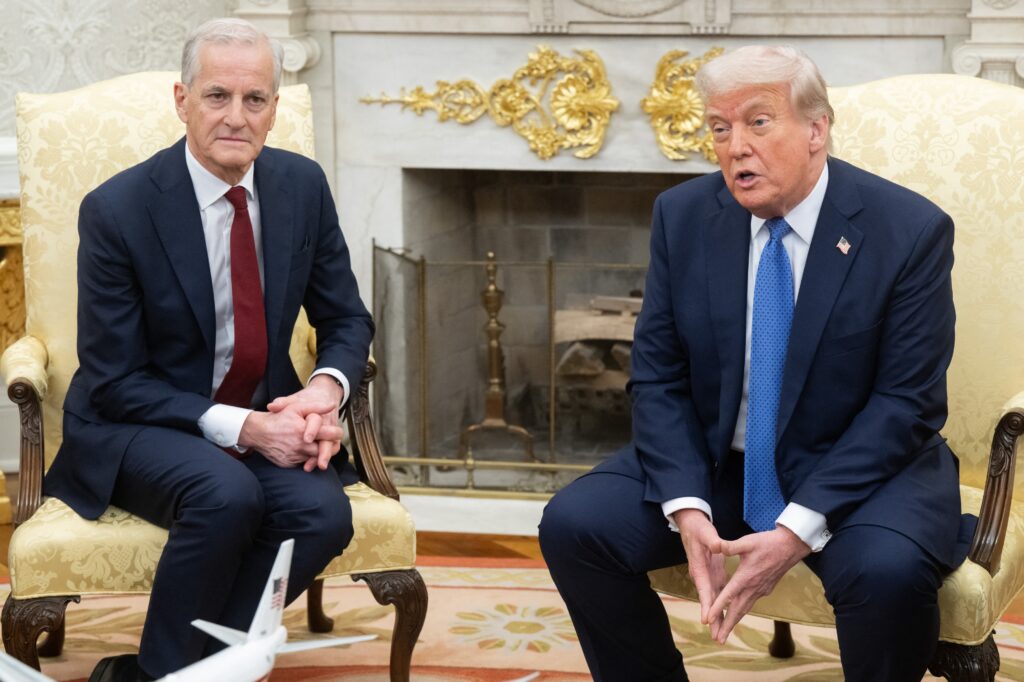
BRUSSELS — In a message to Norway’s prime minister, President Donald Trump linked his insistence on taking over Greenland to his grievance over not receiving the Nobel Peace Prize — adding a new twist to Trump’s stoking of a trade war that’s shaking the transatlantic alliance.
In the weekend text to Norwegian Prime Minister Jonas Gahr Store, Trump wrote that he no longer needed to “think purely of Peace” after he didn’t win the peace prize last year — an award that the president has openly coveted and is bestowed by the Nobel Committee in Norway.
Trump then repeated his ambition for the U.S. to take “complete and total control of Greenland” — an autonomous territory of Denmark — and he questioned the “ownership” of the territory by Denmark, a NATO ally. The White House did not immediately respond to a request for comment.
Store confirmed Trump’s leaked message in a statement Monday. He said Trump was responding to a text that Store had sent on behalf of Norway and Finland, conveying opposition to U.S. tariffs against European nations rejecting the takeover of Greenland. “We pointed to the need to de-escalate and proposed a telephone conversation,” Store said.
The attempt to defuse tensions seems not to have worked. Trump’s reply came shortly after.
“Considering your Country decided not to give me the Nobel Peace Prize for having stopped 8 Wars PLUS, I no longer feel an obligation to think purely of Peace, although it will always be predominant, but can now think about what is good and proper for the United States of America,” Trump wrote in the text, which was first reported by PBS.
Store said he made his support for Greenland and Denmark clear, and that he has repeatedly explained to Trump that it is up to the Nobel Committee — not the Norwegian government — to award the annual peace prize.
Trump’s bid to buy or seize Greenland — effectively a demand to grab a NATO ally’s territory against its will — and to unleash a trade war that European leaders have strained to avoid, has sparked the greatest transatlantic crisis in generations.
U.K. Prime Minister Keir Starmer said Monday that it would be “completely wrong” for Trump to slap tariffs on European nations rebuffing his plan to take Greenland — even as he sought to preserve the relationship with the United States, which has underpinned Europe’s security and economic interests for more than eight decades
The British leader’s comments added to a chorus of European pushback. French President Emmanuel Macron has likened Trump’s declaration to a form of “intimidation,” and Swedish Prime Minister Ulf Kristersson described it as blackmail. Even Italian Prime Minister Giorgia Meloni, a conservative ally of Trump in ideology and politics, called it a “mistake.”
In remarks to reporters, Starmer denounced economic coercion against allies as the wrong approach to resolving disagreements. He described tariffs as harmful to British workers and businesses. “A trade war over Greenland is no one’s interest,” Starmer said, calling for discussions between Greenland, Europe and the United States.
Still, he declined to say whether he would support calls within the European Union, of which the U.K. is no longer a member, for retaliation against Washington.
Trump has said controlling Greenland is necessary for national security reasons — a point disputed by allies and some members of Congress who rebutted the president’s claim that the Arctic territory faces imminent security risks from Russia and China. Trump’s unwillingness, so far, to back down risks driving a deeper wedge in the Western alliance or, some fear, causing an irreparable break.
After a year of trying to win Trump over with the language of flattery and transaction, European policymakers are weighing options to fire back. The continent’s top leaders still stress they would much rather avoid an escalation. But Trump’s threats provoked such indignation on the continent that lawmakers and politicians are warning this is Europe’s moment to show its teeth, or be eaten.
“Appeasement has failed,” wrote Javi López, a lawmaker from Spain and vice president of the European Parliament. “Europe can only protect its sovereignty (from Ukraine to Greenland) by reducing dependencies, strengthening its deterrence, and using without limits its most powerful tool: access to the world’s largest single market.”
If efforts to find an off-ramp fail, the E.U.’s arsenal of tools includes imposing tariffs on a list of more than $100 billion worth of American goods, which E.U. officials prepared last year but suspended to sign a trade deal with Trump.
Another option would be triggering an instrument often dubbed the bloc’s trade “bazooka,” which would allow for targeting American services in Europe — a major profit center for U.S. tech giants. While the E.U. enjoys a trade surplus with the U.S. on goods, American companies benefit from a surplus of more than $125 billion in services, according to 2023 European data.
European Union leaders have warned that Russia stands to benefit from the rift at NATO. On Monday, the Kremlin spokesman, Dmitry Peskov, appeared to stir the pot by telling reporters that by taking action on Greenland, Trump stood to make history one way or another.
Peskov said there was “a lot of disturbing information” recently and that he would not comment about “our plans regarding Denmark and Greenland.”
Aside from “whether this is good or bad, whether it complies with international law or not,” he added, “there are international experts who believe that by resolving the issue of Greenland’s accession, Trump will go down in history, not only in U.S. history, but also in world history. It is difficult to disagree with these experts.”
Russia, preoccupied with its war in Ukraine, has largely stood by while Trump ordered military strikes on Venezuela and seized Moscow’s longtime ally President Nicolás Maduro. That has left Russian President Vladimir Putin’s credibility on the world stage diminished as Trump flexes his muscles among friends and foes alike.
Ambassadors of the E.U.’s 27 nations debated the possibility of retaliation against Washington during a closed-door meeting in Brussels on Sunday, although there was a broad preference to try to de-escalate — as they have done after Trump’s previous rounds of tariffs.
Trump’s latest tariff announcement landed on Truth Social on Saturday, just as E.U. leaders were in Paraguay signing a free-trade deal with South America and boasting they can help maintain global open markets despite U.S. protectionism.
This week, European leaders are headed to the World Economic Forum in Davos, hoping that face-to-face meetings with Trump will talk him down from the intensifying confrontation. The president has declared the new tariffs on eight countries would start Feb. 1 unless they acquiesce to his plan to acquire Greenland.
Those European nations — Britain, Denmark, France, Finland, Germany, the Netherlands, Norway and Sweden — recently sent troops to Greenland in small numbers for joint exercises with the Danish military. European leaders cast the deployment as a sign of NATO’s commitment to protecting the Arctic in response to Trump’s warnings that Arctic security was at risk.
Because the E.U. operates as a single trading bloc, the imposition of tariffs on some of its 27 nations could affect all of them, European officials said.
Leaders of Denmark and Greenland have said repeatedly that they welcome deeper U.S. economic and security involvement, but that the vast island territory — which Trump covets for its strategic Arctic location and natural resources — is not for sale.
“Blackmail between friends is obviously unacceptable,” French Finance Minister Roland Lescure said in Berlin on Monday. If the U.S. tariff threats come to fruition, Lescure added, “we Europeans must remain united and coordinated in our response and, above all, be prepared to make full use of the European Union’s instruments.”
France has pushed for Europe to take a harder line against Trump, while many of its E.U. neighbors preferred restraint. On Monday, however, German Finance Minister Lars Klingbeil echoed the sentiment, saying the E.U. should consider using the “toolbox for responding to economic blackmail.”
“It is always clear that we are ready to find solutions,” Klingbeil added. “We are constantly experiencing new antagonism, which President Trump is seeking. And here we Europeans must make it clear that the limit has been reached.”
Hendrix reported from London. Beatriz Ríos in Brussels, Kate Brady in Berlin, Stefano Pitrelli in Rome and Natalia Abakumova in Riga, Latvia, contributed to this report.
The post Trump ties Greenland takeover bid to Nobel Prize in text to Norway leader appeared first on Washington Post.