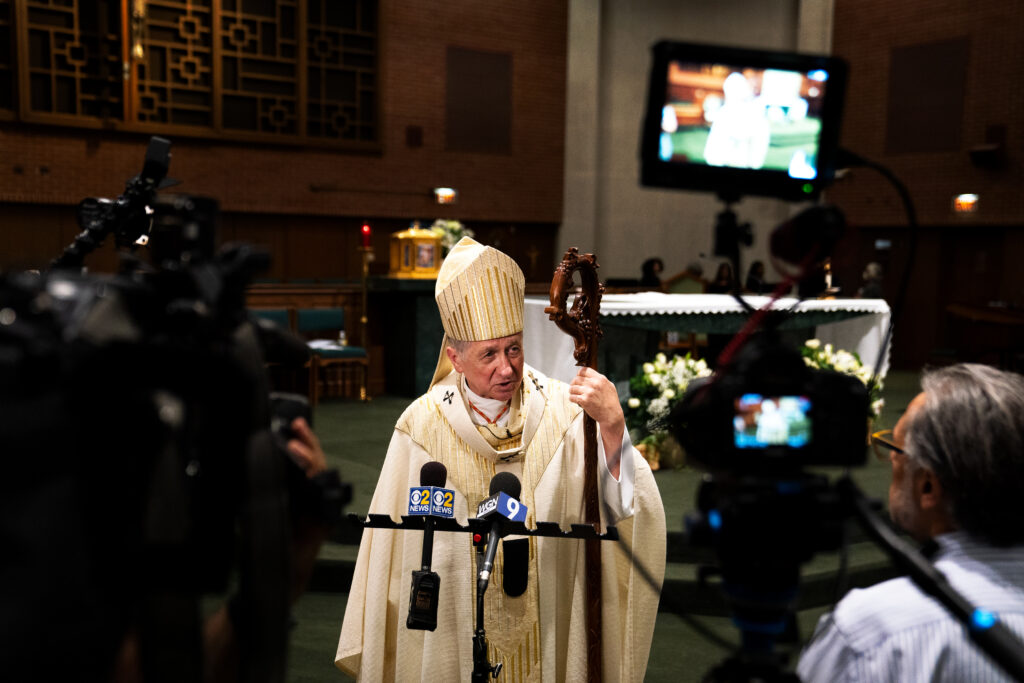
Echoing concerns of Pope Leo XIV over a new era of unilateralism and warfare, the three highest-ranking U.S. Catholic archbishops on Monday said “the moral foundation for America’s actions in the world” has been thrown into question by a resurgence in the use or threat of military force, including in Venezuela and Greenland.
The archbishops, Cardinals Blase Cupich of Chicago, Robert McElroy of D.C. and Joseph Tobin of Newark, in a statement released Monday, amplified comments by Leo, the first U.S.-born pontiff, who earlier this month lamented the demise of multilateralism.
“In 2026 the United States has entered into the most profound and searing debate about the moral foundation for America’s actions in the world since the end of the Cold War,” the archbishops wrote. “The events in Venezuela, Ukraine and Greenland have raised basic questions about the use of military force and the meaning of peace.”
In a speech earlier this month to ambassadors to the Holy See that is effectively the pope’s annual foreign policy address, Leo said: “A diplomacy that promotes dialogue and seeks consensus among all parties is being replaced by a diplomacy based on force, by either individuals or groups of allies. War is back in vogue and a zeal for war is spreading,” Leo said. “The principle established after the Second World War, which prohibited nations from using force to violate the borders of others, has been completely undermined.”
The three archbishops addressed the same global trends, and also mentioned Ukraine, where Russia’s full-scale invasion is about to enter its fifth year, but they centered their statement on the present-day United States. They did not name President Donald Trump, though Trump’s policies were clearly a reference point.
There are other U.S. cardinals who are retired or work in Rome, but Cupich, McElroy and Tobin are the only three U.S. cardinals who currently lead American dioceses. They are in a small but powerful segment of more progressive U.S. bishops who aim, along with Leo, to continue much of the agenda laid out by Pope Francis, his Argentine-born predecessor.
The criticisms from Leo and his allies, may be harder for Americans to dismiss than those of Francis who often appeared to espouse a world view rooted in the Global South that was fundamentally more skeptical of American might. As a Chicago native, Leo carries less ideological baggage, observers say, and his words may be more likely to be interpreted in a strictly moral context.
“With Francis there was a genetic element of anti- Americanism, anti-yankee sentiment,” said Massimo Faggioli, a professor in ecclesiology at Trinity College Dublin. “Obviously this is not [the case with] Leo and U.S. cardinals.”
The hierarchy of the church in the United States is by no means monolithic, or skewed toward liberals.
The cardinals said they did not intend their message to be partisan, but rather were seeking, with Leo, at a combustible moment to turn attention to core Catholic teachings. One such teaching, McElroy told The Washington Post, is that “war should not be a normal instrument of foreign policy — it should not be used for the aggrandizement of a particular country’s wealth.”
Also, he said, humanitarian assistance is the obligation of every nation. Those are linchpins of Catholic teaching, McElroy said.
The Trump administration has imposed drastic cuts to humanitarian assistance and other international aid. Before foreign aid was slashed under the current administration, it had ranged in the past two decades from between 0.7 percent to 1.4 percent of the total U.S. federal budget, according to U.S. government figures.
The questions, debates and changes, McElroy said, aren’t just happening in the United States.
The cardinals said they felt driven to issue the statement not only because of Leo’s comments but following a gathering earlier this month of all the world’s cardinals in Rome.
“We heard the voices of a number of cardinals expressing alarm at the situation — from military action, to cuts in foreign aid to some of the things that are being debated,” Cupich told The Post.
McElroy, however, was more direct: “Many cardinals spoke to us with alarm about positions the U.S. was taking in international affairs.”
In their statement, the three U.S. archbishops called for a U.S. foreign policy that complies with the teachings of the church. “As pastors and citizens, we embrace this vision for the establishment of a truly moral foreign policy for our nation,” they wrote. But they also warned that the country seemed increasingly incapable of civil discourse.
“Our nation’s debate on the moral foundation for American policy is beset by polarization, partisanship, and narrow economic and social interests,” they wrote. “Pope Leo has given us the prism through which to raise it to a much higher level.”
Several watchers of U.S. Church diplomacy said Leo’s annual address to the Vatican diplomatic corps showed he is sketching his path forward.
“The Holy See is today a clear counterpoint to the foreign policy vision of Trump,” said Marco Politi, a Rome-based author of several books on the Vatican. “It represents multilateralism versus the vision of Big Bosses dividing the globe in property-like zones of influence.”
Shaun Casey, who was director of the U.S. State Department’s Office of Religion and Global Affairs — an office eliminated during the first Trump Administration — said people all over the world were looking to Leo and Catholic leaders for direction.
“There are thousands of Catholic leaders reading [Leo’s] speech from last week and talking to their Catholic networks, and the Catholic Church has networks everywhere,” Casey said. “I think he’s playing the long game here, because he is a relative teen as popes go. He knows there are only three years left. He’s not going to come out with guns blazing.”
Leo has said he does not want to worsen political division and polarization, and has refrained from the sharper, more confrontational tone of his predecessor in references to Trump and American conservatives. But Leo in his first months gradually has grown more pointed in his criticism, even though he has largely sidestepped criticizing Trump by name.
In September, Leo expressed “concern” over the tough talk by Trump and Defense Secretary Pete Hegseth at a hastily called meeting of America’s top military brass at Marine Corps Base Quantico in Virginia.
The pope has also decried the “inhuman” treatment of migrants in the United States. And in a rare, near-unanimous statement, the U.S. Conference of Catholic Bishops (USCCB) in November voted to condemn the Trump administration’s crackdown on undocumented immigrants as an attack on “God-given human dignity,” and advocated for “meaningful reform of our nation’s immigration laws.”
The statement by the group also said the bishops “oppose the indiscriminate mass deportation of people. We pray for an end to dehumanizing rhetoric and violence, whether directed at immigrants or at law enforcement.”
On Christmas Eve, the pope’s No. 2, Cardinal Pietro Parolin, held an urgent meeting with the U.S. ambassador to the Holy See over U.S. plans in Venezuela. That came after Leo repeatedly argued in public against the use the force there.
Catholic bishops as a body are “very slow and divided at this time,” and “no one is looking for it to be proactive,” Casey said. It is more dominated by conservative and center-right bishops.
Last week, Trump met with USCCB President Paul Coakley, archbishop of Oklahoma City. Details of what they discussed were not released, but a couple of days later DHS issued an interim final rule reducing wait times for religious worker visas. A significant number of priests serving in the United States are foreign workers.
Photos from the meeting show Coakley standing beside Trump, who was seated at his desk, both men grinning broadly.
Faiola reported from Rome.
The post Top Catholic cardinals say U.S. foreign policy raises moral questions appeared first on Washington Post.