Heidy Sánchez took her 17-month-old daughter to a routine check-in last April with Immigration and Customs Enforcement in Tampa, Fla. During the appointment, federal authorities told her that she was being detained and that her husband should pick up their daughter, who was still breastfeeding.
Two days later, Ms. Sánchez, 44, who worked as a home health aide, was deported.
Ms. Sánchez’s story quickly spread across social media, in part because she is Cuban, a group that had long been treated differently than other immigrants, even when they entered the country illegally.
That has changed under President Trump.
He has repatriated more than 1,600 Cubans in 2025, according to the Cuban government. That is about double the number of Cubans who were repatriated in 2024. And in the years that Mr. Trump has been president, he has sent more Cubans back than his three predecessors.
Those numbers are greater for Cubans who were deported by land into Mexico. Some of them had been in the United States for decades and built families and businesses, but were removed because of an old criminal conviction — say, from Miami’s infamous cocaine cowboys days in the late 1970s and early 1980s.
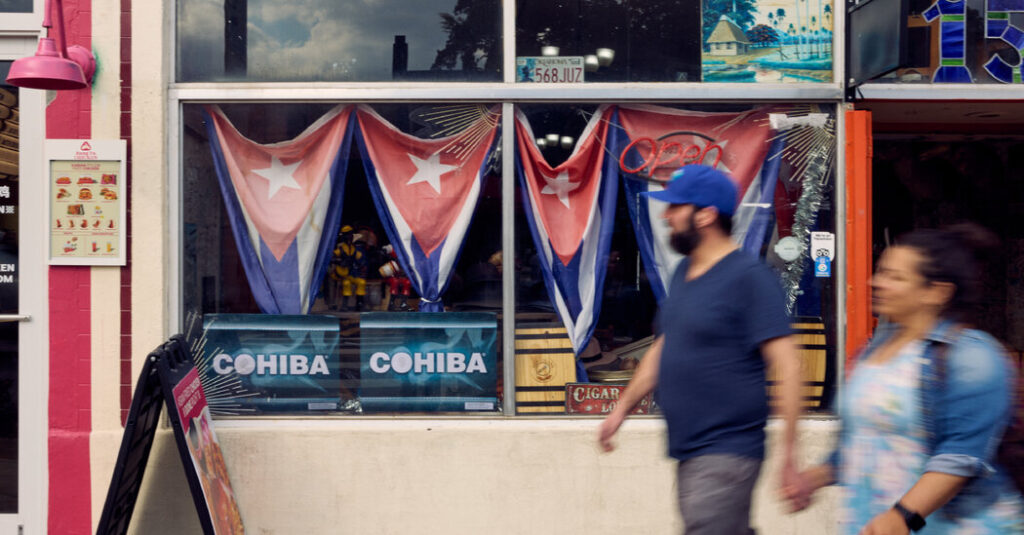
Nowhere has the shock of treating Cubans like other migrants been felt more than in Florida, which was shaped in modern times by exiles of the 1959 Cuban Revolution.
Families, businesses and communities that once felt removed from or immune to immigration enforcement now must face it head-on. Some Floridians worry that these deportations could stain the state’s proud Cuban identity, turning older immigrants against newer ones.
Under Mr. Trump, many other countries saw similar increases in repatriation. The difference is that Cubans had not previously been targeted as aggressively for removal. Regular deportation flights to Cuba began in 2017, under President Barack Obama, paused during the coronavirus pandemic and restarted in 2023.
Many Cubans have also been detained for weeks or months in a facility in the Florida Everglades known as “Alligator Alcatraz.” At another nearby detention facility, Cuban detainees protested last June by writing “SOS Cuba” on their shirts and spelling out “SOS” with their bodies in the recreation yard.
Legal immigration has also been all but cut out. Mr. Trump enacted a travel ban on 19 countries, including Cuba, and ended a family reunification program. U.S. officials are rejecting visa applications, which can take years to complete. Last month, the Trump administration paused all Cuban immigration cases, including pending naturalization, residency and asylum applications.
“It’s the most sweeping rollback of Cuban migration channels since the Cold War,” said María José Espinosa, the executive director of the Center for Engagement and Advocacy in the Americas, a nonprofit strategy organization based in Washington.
Polls suggest that most Cuban American registered voters, who tend to be Republican, continue to support Mr. Trump, said Michael J. Bustamante, an associate history professor and director of Cuban studies at the University of Miami who studies Cuban American political culture. But he said that he had noticed “a growing amount of unease” throughout the community.
As a senator, Secretary of State Marco Rubio, the Trump administration’s most prominent Cuban American, often criticized Cuban immigrants who received government benefits like food stamps and Medicaid, and frequently returned to the island. Over the summer, Mr. Rubio said in a video commemorating huge anti-Communist protests in 2021 that many Cubans had found it “easier” to “abandon” the island than stay and fight the regime.
Immigration enforcement in South Florida has not involved a mass federal operation, as in Los Angeles or Chicago, and previous administrations had made changes that started to erode Cubans’ immigration privileges. Still, Mr. Trump’s anti-immigration campaign has shaken some Cubans unused to feeling at risk in the United States.
“I am scared of everything,” said Javier González, a 36-year-old salesman in the heavily Cuban city of Hialeah, northwest of Miami.
Mr. González and his family crossed the United States-Mexico border in February 2022, fleeing what he described as a threat to his life in Cuba, where he was a political dissident.
Mr. González and his wife, like hundreds of thousands of recent Cubans migrants, were released under what is known as conditional parole. That does not allow them to apply for residency under the Cuban Adjustment Act, a law that Congress passed in 1966, and leaves them vulnerable to deportation.
But Mr. González and his wife legally obtained Social Security numbers, work permits and driver’s licenses. He applied for political asylum and has a pending court date in 2028. He found work as an HVAC technician. Mr. Trump’s campaign promise to deport criminals seemed sound to him.
Then early last year, ICE officers, during regular check-ins in South Florida, started detaining Cubans with conditional parole. Now, to avoid immigration sweeps, Mr. González said he avoided unnecessary car rides and local Hispanic supermarkets. He cannot fathom the repression he might face in Cuba were he to return as a former dissident.
“Sometimes I tell myself, ‘Why do you have to feel as if you were a criminal when you are an upstanding person?’” Mr. González said. But, he added, “They can grab you and do whatever they want.”
Some older Cuban American immigrants are angry over the turnabout in circumstances. Alicia Peláez, 78, arrived in the United States as an unaccompanied minor in 1960, under Operation Pedro Pan, a secret program run by the Catholic Church with help from the State Department that resettled some 14,000 young Cubans.
“We were welcomed into the country,” said Ms. Peláez, who is a registered Republican, but has not voted that way in recent elections. “Now, it’s the complete opposite.”
Ms. Sánchez, who was separated from her baby and husband, remains in Havana, with a pending visa interview that will determine whether she can apply for a waiver to return to Florida.
She came to the United States through the border, presented herself to request asylum, and waited in Mexico. But she missed a hearing because of safety reasons, which resulted in a deportation order and nine months of detention. In the end, she was released in the United States because Cuba at the time did not accept her repatriation.
Once in Florida, Ms. Sánchez studied and became a nursing assistant. She met and married her husband, an American citizen, who petitioned for her residency. She underwent fertility treatments and had their daughter. Three months before her deportation, they had bought a house.
After being returned to Cuba, Ms. Sánchez said she was so upset that she had to see a psychiatrist. Her daughter, in Tampa, was no longer her cheery self.
“She didn’t laugh anymore, which really worried us,” Ms. Sánchez said.
Her husband and daughter visited Ms. Sánchez over Christmas, which lifted their spirits, she said. But she did not know how she would handle more months of separation.
Her daughter, she said, “is our joy, our happiness, our life.”
Patricia Mazzei is the lead reporter for The Times in Miami, covering Florida and Puerto Rico.
The post To Their Shock, Cubans in Florida Are Being Deported in Record Numbers appeared first on New York Times.