When I first started wearing suits, I had cuffs on my trousers. I had cuffs on my khakis, wide-wale corduroys and everything else except jeans. Recently, at the tailor, I asked for cuffs. The salesperson frowned. I gave in and went with plain bottoms, but the whole thing looks and feels incomplete. So what’s the deal? Do we cuff or not cuff? — Mark, Philadelphia
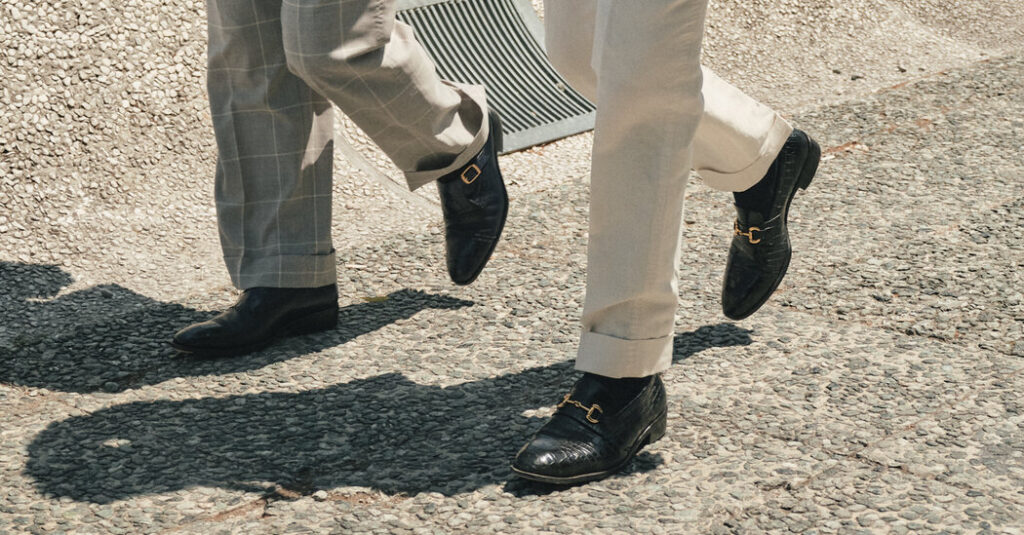
This is a question Hamlet would have understood. To cuff or not to cuff one’s pants is, for men and women, both a practical and a philosophical question. If cuffing was once simply something you did to show a certain adult finish (or, in the case of James Dean and his jeans, to rebel against it), it exists these days in the more complicated realm of personal taste.
To understand how that happened, it helps to understand some history.
Cuffs were invented, or at least popularized, in the 1890s by King Edward VII, who reportedly wanted a solution to the problem of wearing his pants in rainy English weather, which made the bottoms all muddy. (In England cuffs are called “turnups”; “cuffs” refer to the turnups at the end of the sleeves.) By the turn of the century and the golden age of men’s wear, they were de rigueur in most suits. That was in part because they provided an elegant trouser counterpoint to the jacket lapel, and because, by adding some weight to the hem, they made pants hang better, keeping the drape straight.
Though cuffs briefly disappeared during World War II because of fabric rationing, they returned in the 1950s with the rise of the company man. As suits became slimmer, however, cuffs fell out of favor. In this case, all that weight at the hem ruined the line.
And though they rallied in the 1980s with the Masters of the Universe, cuffs, along with the Windsor knot, became, like most dressing choices, simply one option among many. According to Jacob Gallagher, our men’s fashion reporter, “I don’t see them on the runways or from brands much.”
So how do you know if they are right for you?
“I don’t think cuffs ever truly go out of style,” said Maxwell Osborne, a founder of the label Public School, but as he also pointed out, “It’s really a pant by pant decision.”
“Right now, my favorite trousers are high-waisted with double pleats and a cuff,” Mr. Osborne said. “The cuff adds weight and intention and completes the silhouette. A slimmer khaki or cleaner, straight cuts may not need a cuff at all, while a wider leg or more tailored trousers can look better and more balanced with one.” Pleated pants often work better with cuffs, while flat-front styles tend to be uncuffed.
Also, he said, it’s important to consider the shoe. Ideally, trouser cuffs should break on the shoe or sit just atop it, not puddle all over it.
Cuffs also change the optical illusion of the leg: The shorter and heavier they are (if they show some ankle, for example), the shorter your leg looks.
And they indicate at least a modicum of effort, which may be why Mike Amiri, the founder of a namesake fashion line, is an anti-cuffer. When asked for his feedback, he simply said: “No cuff. It looks more effortless to just let it be.” This is also why preppy style often involves no cuffs, allowing the hems on khakis to become slightly frayed. It’s part of the whole not-trying-too-hard thing.
In other words, if you want to communicate respect and care with your clothes, both in a professional and social setting, consider the cuff. If your aim is to suggest nonchalance and a focus on higher things, no cuffs may be the way to go.
Either way, there is one thing everyone agrees on: Tuxedos should definitely be a cuff-free zone.
Your Style Questions, Answered
Every week on Open Thread, Vanessa will answer a reader’s fashion-related question, which you can send to her anytime via email or X. Questions are edited and condensed.
Vanessa Friedman has been the fashion director and chief fashion critic for The Times since 2014.
The post To Cuff or Not to Cuff? That Is the Ultimate Pants Question. appeared first on New York Times.