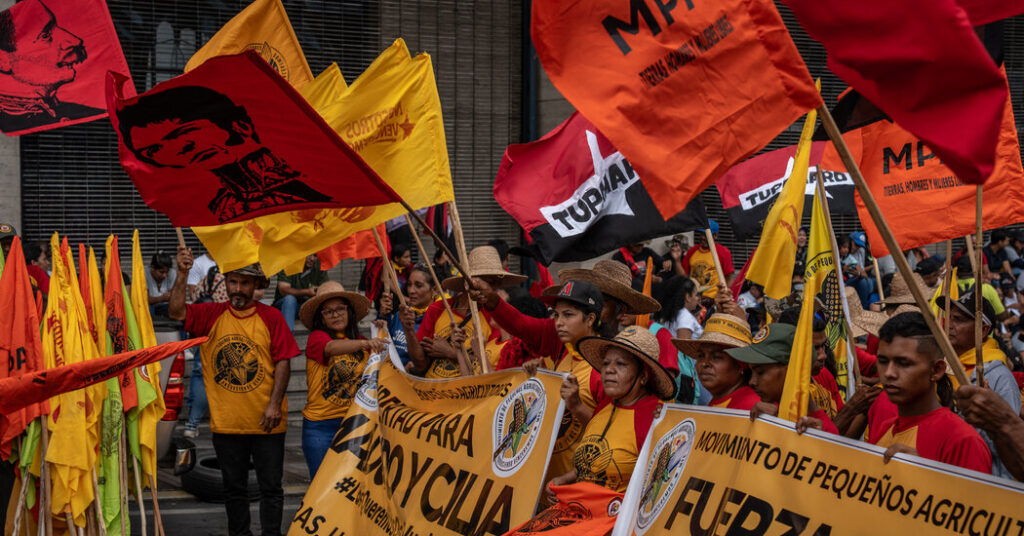
For nearly three decades, Venezuelans have been fed an ideology of “Chavismo,” with its goal of harnessing oil wealth to transform the country, empower the poor and stand up to the United States and its imperial ambitions.
Yet on Thursday, the director of the C.I.A. was in Caracas to meet with Venezuela’s interim president to discuss greater bilateral collaboration, as Washington starts to take its cut of the country’s vast oil wealth.
Ever since the United States invaded to snatch President Nicolás Maduro this month, Venezuelans have been struggling to come to terms with their government’s new alliance with Washington.
As Mr. Maduro awaits trial in the United States, his inner circle continues to run Venezuela. It is made up of self-described Chavistas, but their ideological credentials are now being questioned by die-hard believers who remain loyal to former President Hugo Chávez’s approach of blending socialism, nationalism, state control of key industries and anti-imperialism (read: anti-Americanism).
“At this point, we should have cut off the oil, we shouldn’t have sold any oil to the United States. Zero oil, zero oil!” said one 63-year-old Venezuelan, Beatriz, who asked that only her first name be used as the government cracks down on dissent. “It’s the only way President Nicolás Maduro — the legitimate president of the Bolivarian Republic of Venezuela — will return to our country.”
In the days after Mr. Maduro was seized, Beatriz took to the streets to chant anti-American slogans. The crowd of hundreds around her in downtown Caracas chanted in unison, demanding that President Trump return their former leader.
“Devuélvenos a Nico!” they cried.
But the combative, anti-American crowds that first came out after Mr. Maduro’s capture appear to have been tamed in the past week. The government’s new message: Get on board, we are doing business with the United States.
When Venezuela’s interim president, Delcy Rodríguez, gave her first State of the Union address last week, she maintained a delicate balance between anti-American rhetoric and the new reality.
“They attacked, assaulted, killed, invaded and kidnapped President Maduro and the first lady,” Ms. Rodríguez said Thursday. “There is a stain on relations between the United States and Venezuela.”
She then whipsawed, urging legislators to approve a bill to open oil fields to new investments. “Let us not be afraid of diplomacy,” she said.
Ms. Rodríguez is now offering a newer groupthink to replace the anti-Americanism her government once stoked: “Dudar es traicionar,” or “Doubt is treason.”
The slogan appeared last year as the specter of U.S. invasion neared. Now it is printed on hats and jackets handed out by the government and angrily whispered among Venezuelans when anyone registers outrage about the government’s alliance with Washington — the enemy they had once been told was preventing Venezuela from achieving prosperity.
While Mr. Maduro has long blamed the United States for the economic collapse that ripped through the country beginning in 2013, leading to children dying from hunger and hospitals running out of basic supplies, Washington’s sanctions on Venezuela’s economy did not begin until 2017 during the first Trump administration. Before then, sanctions had largely targeted Venezuelan officials and barred Washington from selling arms to the country.
Instead, economic mismanagement, corruption and a fall in the price of oil — which had buttressed Mr. Chávez’s socialism — led to internal discontent by the time Mr. Maduro took power in 2013, leading to the migration of nearly eight million Venezuelans. Many who fled were the most economically vulnerable citizens, the very working-class Venezuelans Mr. Chávez had vowed to empower.
While Venezuelans tightened their belts, Mr. Maduro’s government became a virtual kleptocracy, analysts said. The president made sure to buy the loyalty of the armed forces. Venezuela now has some 2,000 admirals and generals with all the perks and high pay that entails (the United States has several hundred to service a much larger population).
“The cracks of Chavismo were already starting to form when Maduro took power, but now how do those hard-core Chavistas jibe with the events of the past few weeks?” asked Alejandro Velasco, an associate professor of history at New York University.
“Under Chávez the goal was not power for power’s sake, it was to deploy national resources to empower those who had been left behind,” Mr. Velasco said. “But with Maduro — who no longer had access to the wealth when oil prices collapsed — the goal became power for power itself.”
He said that while Mr. Chávez had started to co-opt state institutions to remake them in his image, he had allowed free and fair elections during his tenure. Mr. Maduro was accused of rigging them.
Some Chavistas want officials to be held accountable for how easily the United States was able to invade Venezuela’s country’s airspace this month. While ordinary citizens went hungry, the government continued to buy weapons, boasting late last year that Venezuela was well protected against foreign invasion. Yet it took only about two hours to capture Mr. Maduro.
But many Chavistas are painfully aware that their country’s arsenal can be used against them. Fighting a superpower is one thing, squashing internal unrest another. Venezuelans have seen their armed forces do it repeatedly for over a decade.
As Ms. Rodríguez’s government continues to work with Washington, some Chavistas suspect her allies may have been in cahoots with Mr. Trump.
“A betrayal! Whoever did it will pay for it before God and before our people,” one protester, Victor, said at another anti-American rally in Caracas this month. He, too, asked that his last name be withheld for fear of retribution.
But forefront on his mind, as for many other Venezuelans, was the fate of the oil wealth that has long held the promise of feeding and clothing their families, and lifting their economic fortunes.
Being a vassal state is not an option for them.
“The United States wants to seize the wealth we have here,” Victor said. “But we are a people who truly fight for their homeland. And we do not want to be slaves.”
Maria Abi-Habib is an investigative correspondent reporting on Latin America and is based in Mexico City.
The post Splits Emerge Among Venezuelans as Revolutionary Dream Fades appeared first on New York Times.