On a spring evening in 1971, police officers arrived at the newsroom of The Stanford Daily, a student newspaper. They were looking for photographs to identify protesters at a violent demonstration a few days before, and they had a search warrant.
The officers rummaged through file cabinets, desk drawers and waste baskets, some containing reporters’ notes of confidential communications.
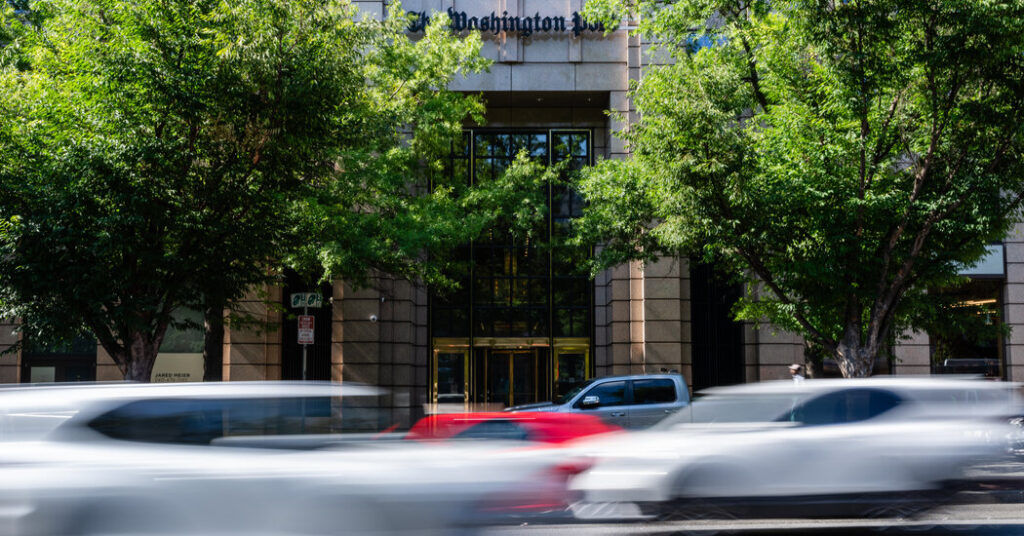
The experience was intrusive, unsettling and an assault on journalistic independence, said Felicity Barringer, who was the paper’s editor in chief at the time. “It feels like being burglarized,” she said in an interview after a Washington Post reporter’s home was searched by the F.B.I. last week.
The Stanford search turned up no photographs that had not already been published. But it was a turning point in the annals of press freedom, leading to a closely divided Supreme Court decision rejecting constitutional protections against newsroom searches. That ruling was met by bipartisan outrage and gave rise to a 1980 federal law meant to shield reporters’ work from search warrants in all but the most exceptional circumstances.
Last week’s search of the home of Hannah Natanson, the Post reporter, may be another turning point. On the sketchy information available so far, it may be hard to square with the 1980 law.
The law forbids searches and seizures unless life or limb is at risk or there is probable cause to think the reporter had committed a crime connected to the materials sought. That crime, moreover, cannot be merely receiving, having or withholding the materials, though there are exceptions for crimes relating to classified information and child sexual abuse material.
The Justice Department’s justification for seeking the warrant to search Ms. Natanson’s home is sealed. In a social media post, Attorney General Pam Bondi said the search concerned information provided to Ms. Natanson by a Pentagon contractor, and The Post reported that neither it nor she was a focus of the investigation. Agents seized Ms. Natanson’s two laptops, phone and Garmin watch.
Ms. Barringer, a former New York Times reporter, noted that Ms. Natanson covers the federal work force and has written about her many hundreds of confidential sources.
“Do you honestly think that they’re not going to look at her source list?” Ms. Barringer said. “Of course they are.”
Newsroom searches are quite rare, said Gabe Rottman, a lawyer with the Reporters Committee for Freedom of the Press, and searches of journalists’ homes rarer yet. The search of Ms. Natanson’s home, he said, was “the first time that a reporter’s home has been raided in connection with a national security media leak case.”
A month after the 1971 raid, The Stanford Daily, along with Ms. Barringer and several other students, sued James Zurcher, the chief of police of Palo Alto, Calif., and other defendants, saying the search had violated the First and Fourth Amendments. They won before Judge Robert Peckham of the Federal District Court in San Francisco, who ruled that subpoenas rather than search warrants were the right way to seek information from journalists.
The Ninth Circuit affirmed that ruling, and the paper’s lawyers wanted that to be the end of the matter.
.css-1mxer6r{max-width:600px;width:calc(100% – 40px);margin:1.5rem auto 1.75rem;height:auto;margin-left:auto;margin-right:auto;font-family:nyt-franklin;color:var(–color-content-secondary,#363636);border-top:1px solid var(–color-stroke-quaternary,#DFDFDF);border-bottom:1px solid var(–color-stroke-quaternary,#DFDFDF);padding-top:20px;padding-bottom:20px;}@media only screen and (min-width:1024px){.css-1mxer6r{width:600px;}}.css-1medn6k{font-family:nyt-franklin,helvetica,arial,sans-serif;font-weight:500;font-size:1.0625rem;line-height:1.5rem;}@media only screen and (max-width:480px){.css-1medn6k{font-size:1rem;line-height:1.375rem;}}.css-1f84s5v{font-weight:700;font-size:1.0625rem;}@media only screen and (max-width:480px){.css-1f84s5v{font-size:1rem;}}.css-1f84s5v a{color:var(–color-signal-editorial,#326891);-webkit-text-decoration:underline;text-decoration:underline;}.css-1f84s5v a:hover{-webkit-text-decoration:none;text-decoration:none;}.css-1hvpcve{font-size:17px;font-weight:300;line-height:25px;}.css-1hvpcve em{font-style:italic;}.css-1hvpcve strong{font-weight:bold;}.css-1hvpcve a{font-weight:500;color:var(–color-content-secondary,#363636);}.css-214jt4{margin-top:15px;margin-bottom:9px;}@media only screen and (max-width:480px){.css-214jt4{font-size:14px;margin-top:15px;margin-bottom:10px;}}.css-214jt4 a{color:var(–color-signal-editorial,#326891);-webkit-text-decoration:underline;text-decoration:underline;font-weight:500;font-size:16px;}@media only screen and (max-width:480px){.css-214jt4 a{font-size:13px;}}.css-214jt4 a:hover{-webkit-text-decoration:none;text-decoration:none;}.css-1mxer6r{max-width:600px;width:calc(100% – 40px);margin:1.5rem auto 1.75rem;height:auto;margin-left:auto;margin-right:auto;font-family:nyt-franklin;color:var(–color-content-secondary,#363636);border-top:1px solid var(–color-stroke-quaternary,#DFDFDF);border-bottom:1px solid var(–color-stroke-quaternary,#DFDFDF);padding-top:20px;padding-bottom:20px;}@media only screen and (min-width:1024px){.css-1mxer6r{width:600px;}}.css-1medn6k{font-family:nyt-franklin,helvetica,arial,sans-serif;font-weight:500;font-size:1.0625rem;line-height:1.5rem;}@media only screen and (max-width:480px){.css-1medn6k{font-size:1rem;line-height:1.375rem;}}.css-1f84s5v{font-weight:700;font-size:1.0625rem;}@media only screen and (max-width:480px){.css-1f84s5v{font-size:1rem;}}.css-1f84s5v a{color:var(–color-signal-editorial,#326891);-webkit-text-decoration:underline;text-decoration:underline;}.css-1f84s5v a:hover{-webkit-text-decoration:none;text-decoration:none;}.css-1hvpcve{font-size:17px;font-weight:300;line-height:25px;}.css-1hvpcve em{font-style:italic;}.css-1hvpcve strong{font-weight:bold;}.css-1hvpcve a{font-weight:500;color:var(–color-content-secondary,#363636);}.css-214jt4{margin-top:15px;margin-bottom:9px;}@media only screen and (max-width:480px){.css-214jt4{font-size:14px;margin-top:15px;margin-bottom:10px;}}.css-214jt4 a{color:var(–color-signal-editorial,#326891);-webkit-text-decoration:underline;text-decoration:underline;font-weight:500;font-size:16px;}@media only screen and (max-width:480px){.css-214jt4 a{font-size:13px;}}.css-214jt4 a:hover{-webkit-text-decoration:none;text-decoration:none;}
Got a news tip about the courts? If you have information to share about the Supreme Court or other federal courts, please contact us.
See how to send a secure message at nytimes.com/tips
“We were hoping it wouldn’t go to the Supreme Court,” said Robert H. Mnookin, now a law professor at Harvard, “but we were worried if they granted that it might go the other way.”
It did. By a 5-to-3 vote in 1978 in Zurcher v. Stanford Daily, the court rejected the paper’s arguments.
“It was at the time criticized as a crabbed, narrow view of the First Amendment, which is probably true,” said RonNell Andersen Jones, a law professor at the University of Utah.
“But everything about that case and its aftermath shows how much more press-protective and sensitive to the role of news gathering in a democracy we were a half century ago, on all fronts — the court, the press, the Congress, the public, even the local officials involved in the search,” she said. “The underlying tone of the moment was entirely different than today.”
The majority opinion was written by Justice Byron R. White, by one measure the least press-friendly member of the Supreme Court in its history. But even he insisted that judges must scrutinize warrant applications “with particular exactitude when First Amendment interests would be endangered by the search.”
He added the court’s ruling rejecting constitutional protections against newsroom searches “does not prevent or advise against” a legislative response.
It did not take long for lawmakers in both parties to accept that invitation.
Among those who spoke out in support of legislation to undo the decision were Senator Robert Dole, the Kansas Republican who would go on to be the party’s presidential nominee in 1996.
“Many Americans today justifiably feel that their rights have been threatened by the Stanford Daily decision,” Mr. Dole told a Senate subcommittee the month after it was issued.
The resulting law, the Privacy Protection Act of 1980, strictly limits the use of search warrants but is subject to untested exceptions. It allows lawsuits seeking money for violations of the law but not the suppression of evidence.
Writing in 1978, Justice White said he trusted law enforcement not to abuse its power and the news media to fight back if abuses occurred. “The press is not only an important, critical and valuable asset to society,” he wrote, “but it is not easily intimidated — nor should it be.”
Those were different times, and it would be hard to imagine language like that in a Supreme Court opinion today. In a study published in 2021 in The North Carolina Law Review, Professor Jones and Sonja R. West, a law professor at the University of Georgia, noted the shift.
“A generation ago, the court actively taught the public that the press was a check on government, a trustworthy source of accurate coverage, an entity to be specially protected from regulation and an institution with specific constitutional freedoms,” they wrote. “Today, in contrast, it almost never speaks of the press, press freedom or press functions, and when it does, it is in an overwhelmingly less positive manner.”
In a follow-up study published last week in The Iowa Law Review, the professors found that hostility to the news media has grown among the conservative justices while the liberal justices have gone silent.
“The issues of news gathering and press freedom ⎯ which once were solidly part of left-leaning justices’ canon of liberal concerns ⎯ have seemingly been abandoned,” they wrote.
Adam Liptak covers the Supreme Court and writes Sidebar, a column on legal developments. A graduate of Yale Law School, he practiced law for 14 years before joining The Times in 2002.
The post Search of Reporter’s Home Tests Law With Roots in a Campus Paper’s Suit appeared first on New York Times.