There’s endless debate among cosmologists about what really makes up the emptiness of outer space, though many believe that mysterious stuff that we now call dark matter and dark energy represent a significant portion.
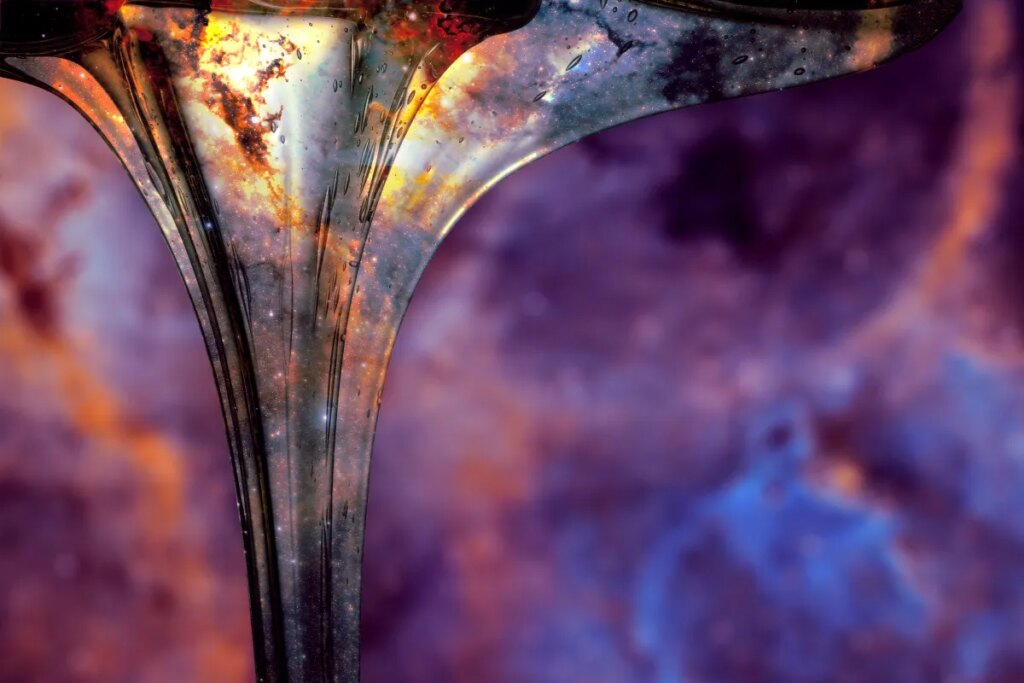
In a new yet-to-be-peer-reviewed paper flagged by Live Science, a researcher at the Indian Institute of Technology in Jodhpur named Muhammad Ghulam Khuwajah Khan proposes an intriguing theory: that space is something akin to a viscous fluid, like a slow-moving honey. If borne out — a significant “if,” to be clear — the model could go a long way to explaining certain discrepancies that have rankled scientists about the universe.
Currently, astronomers generally embrace the Lambda Cold Dark Matter Model — often shortened to the ΛCDM model — to explain mathematically how the Big Bang Theory occurred, how dark matter keeps galaxies together, and how dark energy is driving the expansion of the universe. The energy density of space is known as the cosmological constant, written as the Greek letter Lambda or Λ, and is considered an unchanging quality.
But recent data captured by the The Dark Energy Spectroscopic Instrument (DESI) survey in Arizona and the Dark Energy Survey in Chile suggests that scientists may need to update the ΛCDM model of the universe; astronomers picked up discrepancies between telescopic observations and the ΛCDM model that seems to point towards the idea that dark energy, long thought to be an immutable throughout space time, has instead weakened as the universe has accelerated and grown older.
Khan’s theory, an attempt to reconcile this mismatch, posits that we should instead mathematically treat outer space as a viscous, stretchy fluid that can contain a quality he calls “spatial phonons,” or vibrations emitted by atoms — which create waves of tension in space.
The theory is that dark energy pushes space to expand, but these phonons subtly push back, meaning the universe’s expasion isn’t uniform; layering this idea over the dark energy observations picked by DESI resolves the discrepancy noticed by astronomers that deviates from the ΛCDM model.
It’s an intriguing idea that keeps the idea of dark energy as a cosmological constant that pushes the expansion of the universe, while introducing a theoretical wrinkle that can explain weird observations that seem to violate it.
But more data from these dark energy surveys will be needed to see if this theory can hold up or confine this wacky idea to the dustbins of history. We’ll be watching.
More on space: Asteroid Behaving Strangely
The post Outer Space Is a Viscous Fluid, New Paper Claims appeared first on Futurism.