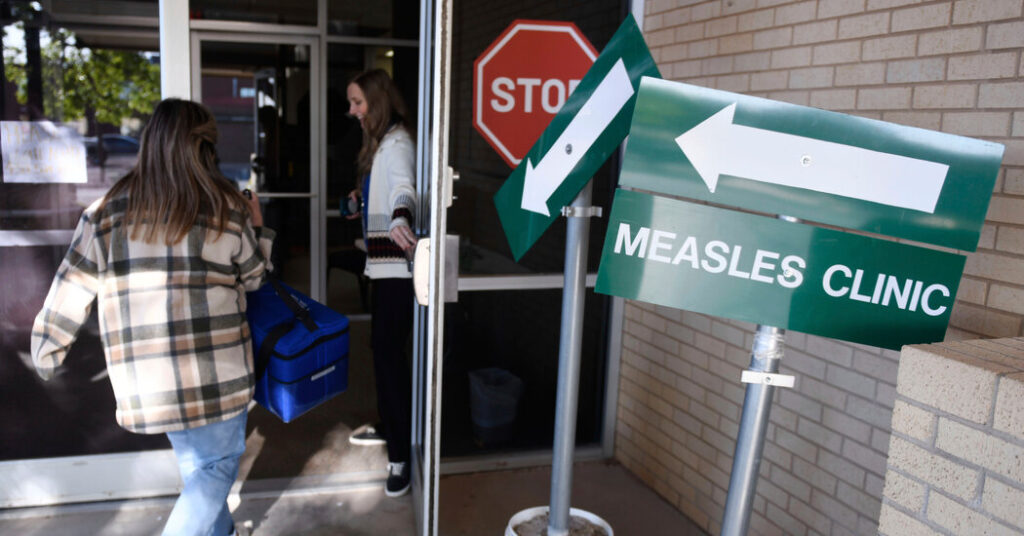
On inauguration day a year ago, a small town in Gaines County, on the western edge of Texas, reported a cluster of measles cases.
“There’s a feeling this is going to be more and more common,” an infectious disease expert told The New York Times at the time.
That feeling turned out to be right. Within a few weeks, the case count had jumped to 24. Then to more than a hundred. And over the 12 months that followed, measles sickened more than 2,200 people across 45 states, making 2025 the worst year for measles in the United States in more than two decades.
More than 150 children — most of whom were unvaccinated — were hospitalized. Two unvaccinated children and one adult died from measles complications, the first such deaths in the country in a decade. A year after the first cases in Texas, the virus continues to circulate, with outbreaks at the Utah-Arizona border and in South Carolina.
Now, an international panel of experts must determine whether this resurgence will cost the United States its elimination status, a designation given to countries that have not had continuous spread of measles for more than a year. It’s a public health victory that the country achieved in 2000 after a nearly 40-year campaign to promote the vaccine and has maintained every year since.
“There is a measles problem in the United States,” said Noel Brewer, who heads the national committee that reviews measles data later used to determine the United States’ elimination status. “But it’s unclear whether it meets the official definition of the U.S. having lost elimination.”
Proving that the Texas outbreak that began last January is the source of the current ones in Utah and Arizona or South Carolina is more complicated than officials had expected.
“This is really the key piece of data in assessing the U.S. elimination status — not just cases for 12 months, but ongoing chains of transmission for 12 months,” Dr. Sara Oliver, a scientist at the Centers for Disease Control and Prevention, told state officials last week, according to a recording of the call obtained by The Times.
“Although measles has been circulating in the U.S. throughout 2025, it isn’t clear yet whether these outbreaks are linked,” she said.
To make that connection, scientists need genetic sequences of the measles virus from each location, as well as information about how the virus first traveled from one place to another. But many cases go unreported, and many people known to be infected are reluctant to disclose details of their travel and illness, officials have said.
The C.D.C. is working with state and local health departments to trace contacts of infected people, collect samples for genetic testing and determine the best methods to analyze the data, Dr. Oliver said. The agency will share the data with an independent group of experts in the country. The Pan American Health Organization, which will make the final determination, has invited the United States to present its data on April 13.
Last year, the organization revoked Canada’s measles elimination status because of an outbreak that began in October 2024.
Andrew Nixon, a spokesman for the Department of Health and Human Services, said that no epidemiological link had yet been established between the Texas outbreaks and those in other states.
“However, it is important to note that C.D.C. continues to investigate chains of measles transmissions in 2025 to understand how the virus may be spreading in the United States and across jurisdictions,” he added.
It’s unclear when that work might be complete, in part because the agency has not had to wrestle with these questions in years.
“Until this year, it’s been usually pretty routine,” said Paul Rota, a microbiologist who recently retired after helping the C.D.C. respond to measles outbreaks for more than 30 years. “There was never any doubt about whether the U.S. had maintained elimination of measles.”
Public health officials in Utah said that early genetic analyses had suggested that the strain circulating in their state is distinct from the one in Texas. And during interviews with state public health investigators, none of the people who became ill during the Utah measles outbreak mentioned travel to Texas or contact with people from Texas who had measles, said Charla Haley, a spokeswoman for the Utah Department of Health and Human Services. However, a number of people gave “very limited information,” she said.
“We can’t completely rule out any linkage,” she added.
Health officials in Utah and Arizona have reported more than 350 cases since the outbreak there began in August, including dozens of infections reported in the last three weeks. The origins of the outbreak in South Carolina — which began in October 2025 and has been rapidly growing in recent weeks, infecting a total of 558 people — is also unclear: A spokesman for the state health department said they were unaware of anyone who had traveled to a place with an active outbreak.
Losing elimination status does not necessarily mean that travel restrictions or penalties will be put in place. But many public health experts — including many who were a part of the initial effort to get measles eliminated — said the loss would be an embarrassing statement about public health in the country.
The path to again rein in the highly contagious virus, which would require a substantial bump in vaccination rates, appears fraught now that federal health officials have repeatedly cast doubt on the safety of vaccines, said Dr. Richard Besser, president of the Robert Wood Johnson Foundation and former acting director of the C.D.C.
“Back in 2000 when we eliminated measles, we didn’t have the same politicization around vaccines,” he said. “It will become very hard, if not impossible, to achieve the levels of vaccination against measles that are required to keep it from spreading around.”
Teddy Rosenbluth is a Times reporter covering health news, with a special focus on medical misinformation.
The post One Year After Texas Measles Outbreak Began, Experts Consider Another Grim Milestone appeared first on New York Times.