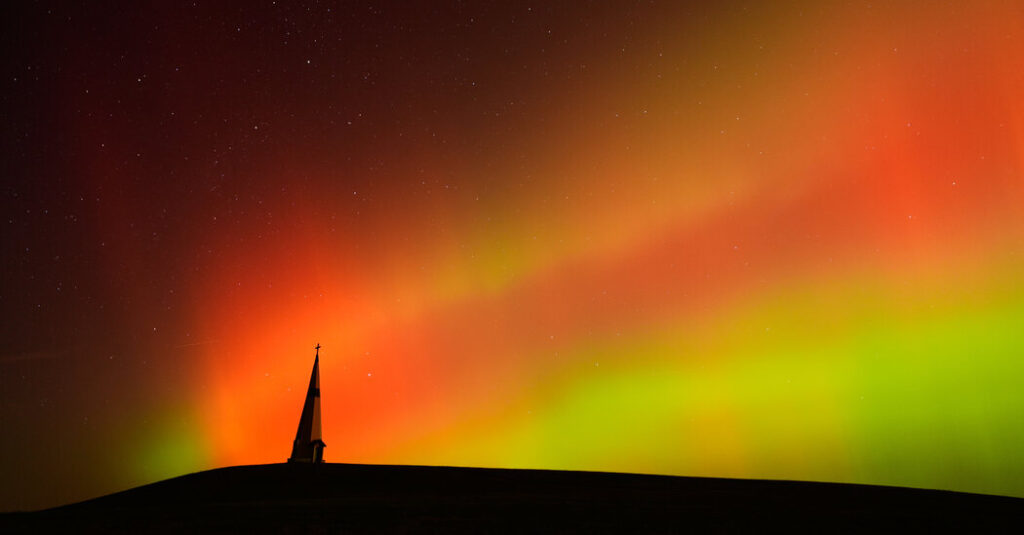
The northern lights could be visible much farther south than usual Monday night with the arrival of a powerful geomagnetic storm.
Where could I see them?
In the United States, the lights, or aurora borealis, could be visible from New York to Washington State, and as far south as Alabama to Northern California.
Across the Atlantic, forecasters expect the lights to be visible from northern parts of Britain, including Scotland, Northern Ireland and northern England, with a chance of sightings farther south. Cloud cover and rain, however, are expected to limit visibility.
In the Southern Hemisphere, the lights could be visible across southern parts of New Zealand and parts of Australia, though the Met Office in Britain said the short hours of darkness this time of year would limit visibility in those areas.
The aurora is best viewed close to sunset or just before sunrise, and away from city lights.
What’s causing the display?
Geomagnetic storms occur when eruptions from the sun — known as coronal mass ejections — send charged particles toward Earth that interact with the planet’s magnetic field. When these particles collide with gases in the atmosphere, they glow, creating the northern (and southern) lights.
Scientists at the Space Weather Prediction Center, part of the National Oceanic and Atmospheric Administration, issued a “severe” watch — Level 4 out of 5 — for a geomagnetic storm from Monday night into Tuesday. A Level 4, or G4, storm has the potential to disrupt the electrical grid on the ground.
Shawn Dahl, a service coordinator at the center, said the coronal mass ejection was expected to reach Earth late Monday evening, “escalate rapidly” to a G4 level by early Tuesday morning, and then gradually weaken to G1 levels by Wednesday.
“This is very rare,” Mr. Dahl said. “We don’t get a G4-level activity very often during the solar cycle.” The strength of this storm, Mr. Dahl said, meant it could be visible farther south, including in the Tennessee Valley area and across the central Plains.
The colors of the aurora depend on which gases are struck by solar particles. Oxygen produces green or red light, while nitrogen creates shades of blue and purple.
What areas will have the clearest skies to view the lights?
David Roth, a meteorologist with the Weather Prediction Center, said that much of the United States could have clear skies Monday night.
“At least half of the lower 48 should be able to see it,” he said. “The clearest places are Nevada, Utah, most of Colorado, Kansas, southern Missouri, Tennessee, Kentucky, southwest Virginia, Alabama and Florida.”
Many of the Mid-Atlantic states — excluding Pennsylvania — as well as southern New England were expected to remain “more or less clear” overnight, he said.
In California, valley fog could interfere with visibility, Mr. Roth said, though skies from the north of Sacramento were expected to remain clear.
The northern tier of the United States, especially areas of the Great Lakes and parts of the Midwest, he said, is likely to be under cloud cover Monday night.
Nazaneen Ghaffar is a Times reporter on the Weather team.
The post Northern Lights Could Be Visible Across Much of the U.S. Tonight appeared first on New York Times.