The democracy movement in the Southeast Asian country of Myanmar has for decades found powerful champions in the Republican Party.
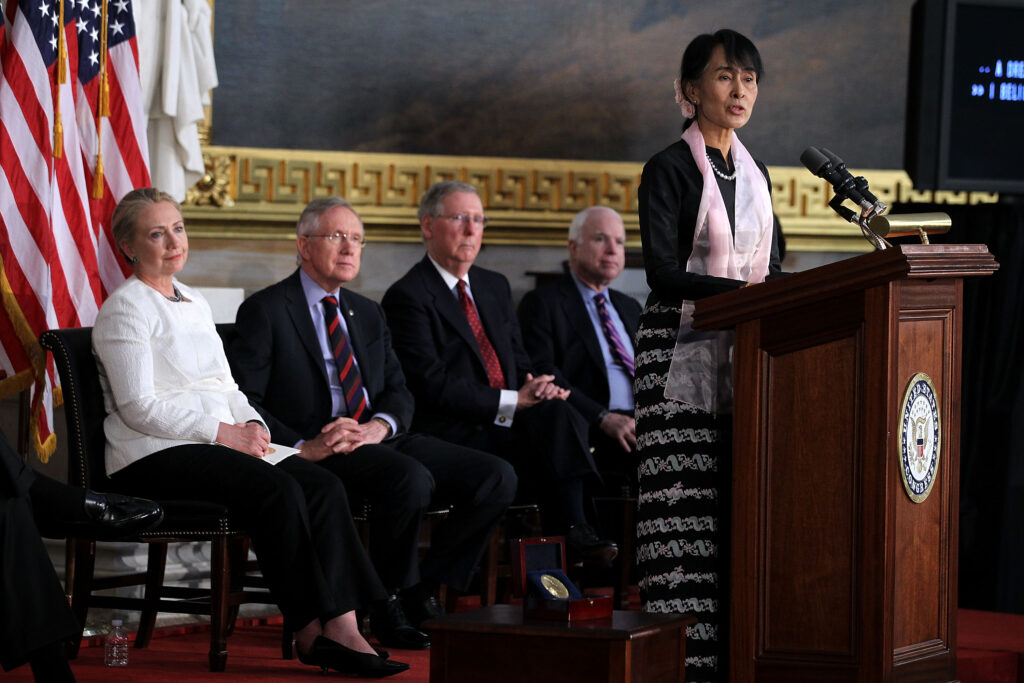
President George W. Bush introduced, then expanded, wide-ranging sanctions on the repressive military that has governed Myanmar on and off since independence in 1948. Former Senate Republican leader Mitch McConnell (Kentucky) repeatedly led legislation that funneled funding to pro-democracy groups. The late Sen. John McCain (R-Arizona) was among the first world leaders to meet Myanmar’s civilian leader Aung San Suu Kyi in 2011 after she was released from house arrest.
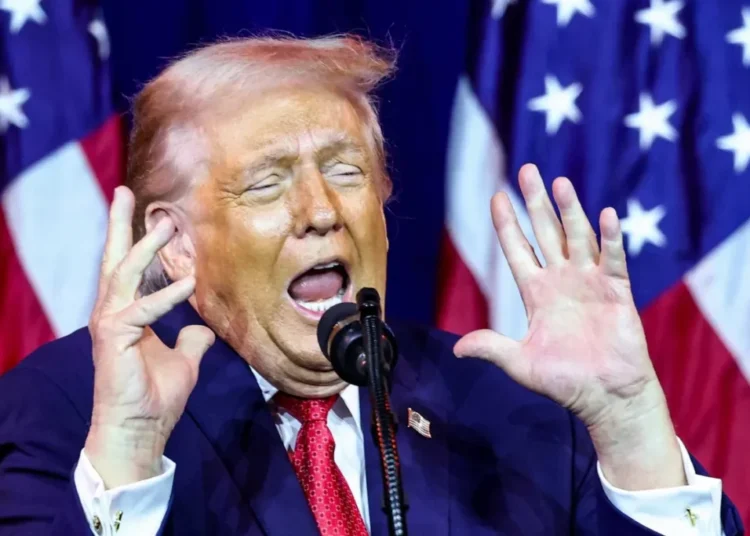
As President Donald Trump upends American foreign policy, however, this long-standing support is crumbling, leaving Myanmar more vulnerable to the influence of U.S. rivals like China at a crucial juncture, former officials, advocates and analysts involved in Myanmar policy say.
“It’s very sad because we’re losing our champion in democracy, in human rights, and on the flip side, we have [China] paying more attention to Myanmar than ever before,” said Min Zin, who leads the Institute for Strategy and Policy-Myanmar, a Thailand-based think tank.
For five years, Myanmar’s military has waged a violent war against opponents, imprisoning democratically elected leaders like Aung San Suu Kyi and killing civilians in indiscriminate aerial attacks and scorched-earthcampaigns, conflict monitoring groups say. It has also escalated persecution of ethnic and religious minorities, including large numbers of Christians and Muslims in the country’s borderlands, according to the U.S. Commission on International Religious Freedom.
With China’s support, the military is now attempting to stage an election. Two rounds of voting have already taken place and the third, final, round is set for Jan. 25.
Election watchdog groups, as well as the European Union and the United Kingdom, have dismissed the military-run polls as illegitimate. Volker Türk, the U.N. high commissioner for human rights, called them “unfathomable.”
But in November, Homeland Security Secretary Kristi L. Noem cited “plans for free and fair elections” as a reason for ending temporary protected status for about 4,000 Myanmar nationals in the United States. Myanmar’s junta cheered the decision.
U.S. diplomats during the Biden administration lobbied Japan, South Korea and other Asian governments to reject military-run elections in Myanmar, current and former U.S. officials said, speaking on the condition of anonymity because they had not been authorized to discuss private conversations. But when Trump returned to power last year, he ordered the State Department to stop commenting on the integrity of elections abroad.
In a statement marking Myanmar’s independence on Jan. 3, Secretary of State Marco Rubio called on the military to “engage in dialogue” but did not address the election.
A State Department spokesperson did not respond to queries on whether Noem’s remarks indicated a shift in U.S. policy, saying only that the department was “following developments” in Myanmar.
Legislators and advocates who helmed “the Myanmar cause” have lost influence in Washington, said Min Zin. “We all of a sudden do not have any ‘who’ in the United States. If I go to D.C. tomorrow, I don’t know who I am going to talk to, frankly,” he said.
When Kim Aris, Aung San Suu Kyi’s son, traveled to Washington last summer to meet with staff on the Asia department of the National Security Council, he arrived to discover they had been laid off, he said. He lobbied his mother’s case to McConnell, Aris said, “but again, it’s hard to know what, if anything, he can do.”
McConnell, who has said he will not seek reelection, did not respond to requests for comment.
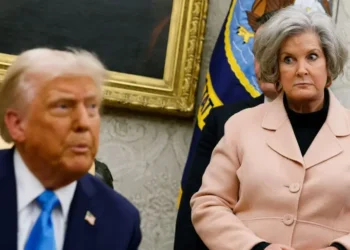
In another sign of Washington’s disinterest, the head of the U.S. Embassy in Myanmar, Susan Stevenson, was instructed to leave the country last week, days before the election is set to conclude. There’s no replacement planned, U.S. officials said.
“We have watched, over this last year, 30 years of U.S. programming around Burma destroyed,” said Simon Billenness, director of the D.C.-based Campaign for a New Myanmar, using an older name for the country. The growing concern, he added, is that the Trump administration may go further by lifting sanctions that cover the junta’s ability to access international banking systems.
“On Burma now,” Billenness said, “all bets are off.”
Ending support
Myanmar spent decades in self-imposed isolation until 2011, when elections ushered in a period of liberalization. This was blighted by the military’s persecution of ethnic Rohingya Muslims, which the U.S. has said amounts to genocide. In 2021, the military ousted a democratically elected government, sparking a civil war.
The U.S. had been the biggest backer of a pro-democracy movement that formed in opposition to military rule. This included, for example, sending millions of dollars each year to a self-proclaimed government in exile, called the National Unity Government, to provide health care to people in Myanmar, and arranging safe houses in the country for activists being persecuted by the regime.
“The assistance to the NUG was enormously important. … We wanted to show that democracy was better at delivering social services than a dictatorship. But that’s all gone,” said a former U.S. official in Myanmar.
The vast majority of U.S. funding for pro-democracy initiatives in Myanmar disappeared with Trump’s dismantling of the U.S. Agency for International Development and reductions in federal government operations, U.S. officials and recipient groups say.
Some Myanmar advocates have tried to make the case to the administration that U.S. involvement doesn’t have to center on promoting democracy.
Adam Castillo, an American businessman in Myanmar who describes himself as “MAGA through and through,” met officials in Vice President JD Vance’s office last summer. He raised the prospect of Myanmar’s massive rare earths deposits, China’s strategic interests in the country, as well as the opportunity for Trump to further his peacemaking image by intervening in the conflict, he said.
Instead of focusing on pro-democracy groups, he suggested, the U.S. could extend support to the powerful ethnic rebels in Myanmar’s borderlands.
But the response from the administration was cold, Castillo said. “They didn’t want to touch it,” he added. “Because it’s not priority and because it’s a mess, it’s too complex.”
A ‘disturbing’ silence
Aung San Suu Kyi’s National League of Democracy, which swept the 2015 and 2020 elections, has been barred from participating in the ongoing polls, where most candidates are instead from a military-backed party.
Citizens in military-controlled areas have been coerced to vote by local officials, according to the U.N., while others in rebel-held territory are not voting at all. The military has jailed anti-election activists, while continuing to bomb civilian structures throughout the voting period, including schools and hospitals, independent medical providers say.
Rubio’s lack of comment on the election was a “disturbing” omission, said Billenness from the Campaign for a New Myanmar. And it has raised anxiety about how the U.S. will respond when voting concludes, especially as China, Russia, Belarus and other nondemocratic countries promote the credibility of these elections and press other governments to engage with the regime.
Deng Xijun, China’s special envoy for Asian affairs, in December led a delegation of Chinese officials to observe the voting. “From China’s perspective, it is successful,” he said in the Global New Light of Myanmar, a military-run newspaper.
Billenness and other pro-democracy advocates in the U.S. are also concerned Trump may not renew an executive order, set to expire next month, imposing sanctions on the Myanmar military.
There are still some sympathetic voices in the GOP: Rep. Bill Huizenga (R-Michigan) last week introduced legislation to restore temporary protected status to Myanmar nationals and called the election a “rigged farce.”
Sean Turnell, an Australian economist and former adviser to Aung San Suu Kyi who was imprisoned for nearly two years by the military following the coup, said he thinks there’s “muscle memory within the Republican Party about Burma” that can be reinvigorated.
But those on the ground in Myanmar say they are not holding their breaths.
Tay Zar San, a prominent democracy activist who has so far evaded capture, shocked the regime in December when he organized an anti-election rally in downtown Mandalay. For security reasons, a video he posted online showed only a few people marching with him. But in reality, he said, there had been hundreds of supporters cheering him on.
“We didn’t start this revolution because of international support, and we will continue without it,” Tay Zar San, 38, said over a video call from central Myanmar, where he’s been on the run from the junta’s forces. “People are still together with us,” he said. “That’s what we need.”
The post Long-standing GOP support for democracy in Myanmar crumbles under Trump appeared first on Washington Post.