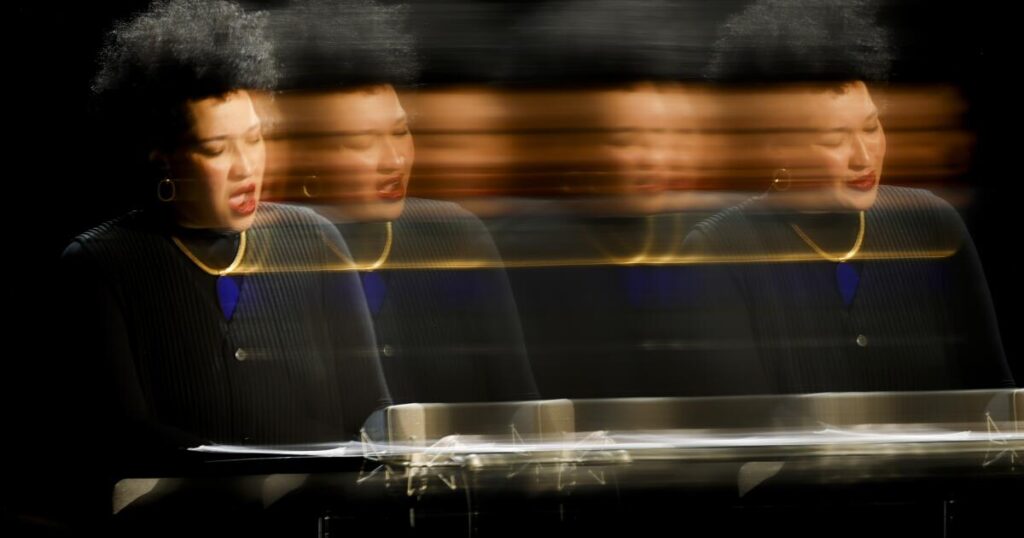
The art of the so-called art song is a thriving business. Singers galore are monthly recording songs from the rich 19th century classical repertory, while composers are busy making new ones. But what was once known as the Lieder recital — the German title for songs in a genre once dominated by Schubert, Schumann, Hugo Wolf and Richard Strauss — has approached its sell-by date.
The smart shopper will already note signs of staleness and mold in the old practice of a singer in stiff white tie and tails or gaudy gown, standing, arm propped on piano, of the second banana accompanist. Attention here was meant to be drawn not to the singer but the marvels of song, as you followed the text in your program book. The recital acted like a religious experience in which a rarefied atmosphere befits radiance.
A new generation of singers, however, has been strikingly upending the song recital, turning to songs from a wide variety of sources old, new and genre fluid. Singers think thematically and theatrically. Pianists become welcoming creative partners. Other musicians, stage directors, choreographers and dancers may be invited in.
“From Ordinary Things,” which had its premiere as part of CAP UCLA’s series at the Nimoy Theater on Thursday night, is the latest project of one of the least ordinary and most compelling singers of this new generation, Julia Bullock. A rivetingly theatrical soprano, Bullock, in collaboration with percussionist/composer Tyshawn Sorey and director Peter Sellars, has developed a full-scale operatic evening, “Perle Noir: Meditations for Joséphine,” about the chanteuse Josephine Baker and slated next for Australia’s Adelaide Festival in March. Another project has been Bullock’s riveting staging, with dance, of Olivier Messiaen’s mystical, Amazonian, sex-love-death song cycle, “Harawi,” which came to the Wallis in October 2024.
Conor Hanick, a partner of Bullock’s in the experimental collective American Modern Opera Company (AMOC), was the pianist for “Harawi” and is again for “From Ordinary Things.” They are further joined by the equally versatile cellist, Seth Parker Woods. The title comes from the last line of “Shelter,” a song by André Previn with a text by Toni Morrison. “In this soft place/Under your wings/I will find shelter/From ordinary things.”
That leaves us Bullock with extraordinary things, and her program is surprising in all things. She begins in shock, singing unaccompanied, on a dark stage in a darkened hall, performers illuminated by powerful spotlights.
Stark, discomforting amplification diminishes intimacy and the luxurious richness of Bullock’s soprano, which easily fills a room on its own, suggests quiet terror, the lonely state of Nina Simone’s “Images.” The unaccompanied solo about a woman who “thinks her body has no glory” gets it from Bullock. That progresses without a break into the first song, “Nahandove,” from Ravel’s “Songs of Madagascar,” with piano and cello but not the flute in Ravel’s original setting. Here beauty is celebrated with voluptuous rapture, setting the mood for “Oh, Yemanja,” a mythic, watery mother’s prayer from Tania León’s opera “Scourge of Hyacinths.”
A highlight was to have been a pair of songs by León, with texts by Kevin Young, written for the recital, but they were apparently not yet ready. A line from one of them is “All light wrong?” With the program and song texts only available to downloadon the cellphone, the audience was left in the dark without texts and, with amplification obscuring diction, not knowing what’s what.
Another Young line — “are my chief complaints” — suited the blowsy loudspeakers that messed up balances, which extended to a performance of George Walker’s rarely heard Sonata for Cello, that ends the first half, for no apparent reason other than it gives the spotlight to the instrumentalists and it is a score that begs to be heard.
Parker has been a glowing advocate of the early work, written in 1957, by the late composer whose music is only in the past few years beginning to find its way to the public thanks to the efforts of reviving neglected Black composers. The sonata does not have the vibrant complexity of Walker’s commanding later works, but it is tight, strong, accessible and with an inspired slow movement that it would be hard to get enough of.
The strange second half brought fewer complaints. An intermission bought time to familiarize oneself with text squeezed onto the cellphone screen. Amplification proved less objectionable. Bullock announced that while putting the program together she had come across songs by Robert Owens, a little-known American composer who lived in Munich, Germany, and died in 2017 and who wrote songs in the style of Richard Strauss to texts by the 19th century poet Joseph von Eichendorff. If not a find, a curiosity.
From there to the avant-garde. “Ultimate Rose” from Salvatore Sciarrino’s 1981 opera, “Vanitas,” turns early music, along with vocal and cello production, marvelously inside out. More Nina Simone, the harsh “Four Women,” then Previn. Along with “Shelter,” Bullock sang a song he wrote with Dory Previn (“It’s Good to Have You Near Again”) and arrangements he made of standards (The Gershwins’ “Love Walked In” and Rogers’ and Hart’s “Nobody’s Heart Belongs to Me”) for his album with Leontyne Price. The encore was Massenet’s “Elégie.”
Each song seems to exist for reasons of its own. Each song creates a different dynamic among the three performers. You listen, left in the dark, wondering but also in wonder, as Bullock asks you a question why each song mattered as much as it did.
You go home and read the texts and find there are no ordinary things.
The post Julia Bullock’s song recital, ‘From Ordinary Things,’ is anything but ordinary appeared first on Los Angeles Times.