The arrival of thousands of federal immigration agents has altered life in Minneapolis and St. Paul in ways large and small, including in the corridors of hospitals serving the Twin Cities.
The sheer presence of the agents, sometimes in uniform, sometimes in plainclothes, has been enough to unnerve health care workers, who were already straining under conditions some have compared with those of the coronavirus pandemic.
In interviews, nurses, doctors and other health care workers said the crisis conditions brought on by the Trump administration’s immigration crackdown are wearing down overworked and understaffed medical institutions, and deteriorating patients’ trust in what are supposed to be safe havens.
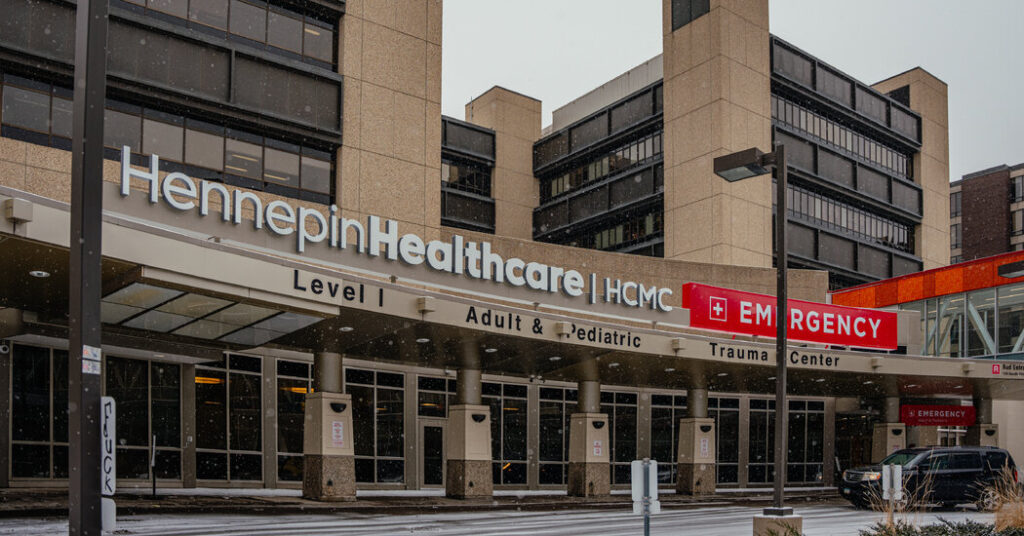
“Any medical center or hospital is supposed to be a place of healing,” said Dr. Brian Muthyala, a physician at the hospital systems Hennepin Healthcare and M Health Fairview. “It is a place where people go when they are at their most vulnerable, when they are hurt or scared or in need of care, and any presence that disrupts that environment is harmful.”
Officials with the Homeland Security Department said that they do not conduct operations in hospitals. “We go in if there is an active danger to public safety,” said Tricia McLaughlin, an agency spokeswoman.
Health care workers, however, describe a different reality, saying agents have broken hospital protocol, refused to provide documentation and, in some cases, gotten into shouting matches with doctors and nurses.
Over his 20 years as an emergency medicine physician, Dr. Robert LeFevere said, he had encountered law enforcement officers coming in with shooting victims and other patients.
“But federal agents barging into patient care areas trying to question or detain patients — I’ve never seen anything like that before,” said Dr. LeFevere, who works at Regions Hospital, a few blocks from the State Capitol in St. Paul.
Health officials for three of the state’s major health systems, which oversee medical centers and clinics where agents have been spotted, declined to comment on federal activity in their hospitals, but stressed that they do not help enforce immigration laws and that federal officers are expected to follow the law and medical facilities’ safety protocols.
Federal immigration officers, like all law enforcement agents, are allowed to enter hospitals, clinics and other medical institutions if they are accompanying a patient in their custody and cannot be restricted from accessing public areas. But hospital officials said they do not allow immigration officers into private spaces, such as patient rooms and care units, without judicial warrants and that security officers escort them and limit their searches to the terms of those warrants.
“To be clear: We do not allow ICE to circulate in our facilities,” said Aimée Jordan, a spokeswoman with Fairview Health Services and M Health Fairview, which oversees about 10 hospitals in Minnesota. “Our clinics and hospitals remain places where people can seek care without fear. Even in uncertain times — especially in uncertain times — that commitment does not change.”
Tensions have been building since December, when federal agents began fanning out across Minnesota. That unease has increased in recent days after an Immigration and Customs Enforcement agent, Jonathan Ross, shot and killed Renee Good, 37, on Jan 7. The Trump administration has deployed more agents since.
Hospitals have no system in place to track how frequently federal immigration officers enter medical care facilities. But nurses, doctors and local elected officials confirmed that federal agents had increasingly been seen in at least four hospitals in Minneapolis, Saint Paul and surrounding suburbs.
One health official said that over the past week, agents had brought in about two dozen patients to M Health Fairview Southdale Hospital, which is the closest medical center to the Bishop Henry Whipple Federal Building, a multiagency facility that includes a holding area for immigrant detainees. Whipple, located near the Minneapolis-St. Paul International Airport, has become a key spot for clashes between protesters and federal agents.
Two nurses, who spoke on condition of anonymity because they were not authorized to discuss patient care, described witnessing a confrontation between health care workers and federal agents last weekend that devolved into a screaming match in a hallway at Hennepin Healthcare System in Minneapolis.
A crowd of nurses and physicians, many in scrubs and medical gear, tried to stop the agents from shackling a severely injured man to his bedside, they said. Acquaintances in the patient’s neighborhood said they knew little about the man, except that he was a roofer and did not have family in the United States.
Hennepin County lawyers have filed a legal petition on behalf of the patient contesting his confinement by ICE, according to documents filed in a Federal District Court in Minnesota. Jeanette Boerner, the director of Adult Representation Services at Hennepin County, declined to comment on the specifics of the pending litigation.
D.H.S. officials and a lawyer representing the agency did not immediately respond to requests for comment on the episode or the man’s immigration case. Homeland security officials have until Tuesday to respond to the man’s legal petition.
The patient remains in the hospital, and agents have been rotating in and out of the facility as they keep watch at his side, according to three health care workers who asked not to be named because they did not have permission from their employer to speak on the issue.
About 10 miles to the east, in St. Paul, Dr. LeFevere said there had been at least two instances at Regions Hospital when federal agents entered the emergency department, once through the ambulance bay and another through a back entrance reserved for law enforcement.
In both cases, it appeared that the agents had been trailing people with whom they had interacted with on the streets, but the individuals were not in their custody, Dr. LeFevere said. The agents became argumentative when health care workers requested to see their warrants, but they eventually left the hospital, he said.
Dr. Loren Cobb, a psychiatry resident physician at the University of Minnesota and M Health Fairview, said she has been receiving texts and emails alerting health care workers that federal agents have been attempting to enter facilities on their grounds, including a children’s hospital. In at least one instance, the agents entered with someone in their custody, but in another, they were searching for a patient, she said. Staff and health teams have been reminded to follow proper hospital protocols, including not give away patient information.
“I am just worried it is going to escalate even more,” she said, adding that sometimes it is only herself and a handful of doctors on staff who are responsible for overseeing entire floors. “What happens if they inappropriately try to push forward? What comes next?”
For many doctors and nurses, federal immigration officers’ mission can, and often has, collided with their own ethical vows, they said. The Hippocratic oath, taken by doctors, and the Nightingale Pledge, by nurses, guide health care workers to provide patients with treatment and support, regardless of who they are, what they did or where they came from. The Health Insurance Portability and Accountability Act, or HIPPA, establishes strict national standards to protect patients’ privacy and health information.
Jeffrey Lunde, who serves as a Hennepin County commissioner and chairman of the hospital board of the Hennepin Healthcare System, said there were recent instances at Hennepin Healthcare in which hospital staff had asked federal agents to produce documentation as to why they were present in a private area or in a patient’s private room. Agents were not able to provide it.
“And that is where things get murky and difficult,” he said.
Nurses, doctors and other health care professionals across the Twin Cities had prepared for precisely such situations as they watched immigration crackdowns unfold in other cities over the past six months.
Jamey Sharp, a health care worker who is also a community organizer with the nonprofit Unidos MN, said his organization had trained more than 300 health care workers since March on patient privacy and knowing their rights. The group, which advocates social justice, said it had also helped to connect health care workers through Signal chat groups in hopes of tracking the activity of federal agents inside their facilities and ensure that rules were being followed.
But the reality has gone beyond the scope of their training. Many said they have been shocked, both by the actions of agents inside their hospitals, as well as the injuries that have required treatment as a result of confrontations on the streets. Some health care workers are holding news conferences to denounce the tactics. Dozens flooded a Hennepin Healthcare board meeting this month demanding that local officials provide stronger oversight in their facilities.
Health officials say they are limited in how they can respond. Though hospital staff are obligated to protect the rights of their patients, federal officers can argue that the people they are monitoring or questioning inside hospitals are a danger to society. Who prevails in that back and forth has largely been untested in the courts.
The tension is unfolding at the same time that Homeland Security Department officials are also reviewing the citizenship and legal status of staff at some area hospitals and across the country.
Doctors and nurses say the presence and actions of immigration officials are already having an impact.
Aisha Gomez, a Democratic state lawmaker who represents parts of South Minneapolis, said she is worried about deleterious effect.
“I am deeply concerned about the chilling effect it is having on people seeking the care,” Ms. Gomez said.
Jazmine Ulloa is a national reporter covering immigration for The Times.
The post Inside Minnesota Hospitals, ICE Agents Unnerve Staff appeared first on New York Times.