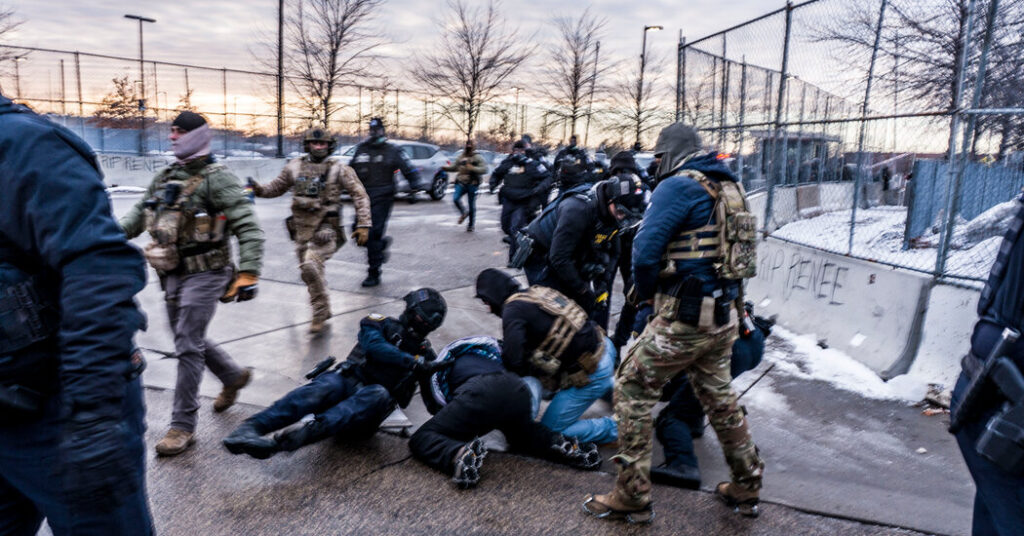
Late last Wednesday night, I was standing on a street corner in the Hawthorne neighborhood in North Minneapolis, when I witnessed an extraordinary confrontation. A federal agent marched up a narrow residential sidewalk, flanked by modest bungalows, kitted out in gear fit for the battle of Falluja: full body armor, camouflage fatigues and helmet, military boots, and a heavy machine gun slung by his side. His carriage was erect, his gaze fixed straight ahead, seemingly oblivious to the crowd of protesters who blew whistles and shouted curses as he passed, enraged that one week after Renee Good was gunned down by an ICE agent, another civilian had been shot by ICE in their city.
Suddenly, the tense scene dissolved into slapstick. The federal officer slipped on a patch of ice and tumbled to the ground. A raucous roar of laughter and jeers erupted from the protesters surrounding him. He quickly scrambled to his feet and marched on. But a few seconds later one of the protesters shouted:
“He dropped his magazine!”
And sure enough, lying on the patch of ice was a fully loaded magazine from his automatic weapon. Dan Engelhart, one of the city’s parks commissioners, was standing nearby. He grabbed the magazine and turned it over in his hands.
“Well, we’re fucking close to civil war,” he told me.
As a longtime foreign correspondent, I have covered civil wars in countries across the globe. Not so long ago, I would have rolled my eyes at the notion that one could erupt anywhere in America, much less in my once placid home state of Minnesota. And yet here I was, eyes stinging and throat burning as tear gas wafted over me, watching heavily armed agents of the federal government invade a quiet residential neighborhood five miles as the crow flies from the suburb where I went to middle school.
Like many Americans, I had watched the video of the killing of Good by an ICE officer on a residential street in Minneapolis with horror and sorrow. From afar, this tragic and possibly criminal act of violence could plausibly be seen as incidental to President Trump’s mission to deport undocumented people from the country. But when I landed in Minneapolis on Monday and saw the size, scope and lawlessness of the federal onslaught unfolding here, I understood that Good’s killing was emblematic of its true mission: to stage a spectacle of cruelty upon a city that stands in stark defiance of Trump’s dark vision of America.
Thousands of masked, heavily armed agents, some with minimal training, have been unleashed on the streets of an American state. They have been promised near-total legal immunity by the president, effectively unshackled from any constitutional constraints.
They have been given limitless license to abduct anyone — not just the undocumented immigrants, but American citizens who happen to look foreign, whatever that might mean. Even Native Americans, whose ancestors lived here long before anyone else, have been detained on the absurd suspicion that they are undocumented immigrants. They have roughed up local lawmakers, detained and jailed legal observers without charges, tear-gassed high school students, smashed in car windows of bewildered drivers unlucky enough to cross their path. Anyone who gets in their way — by protesting, filming their actions or simply being in the wrong place at the wrong time — is presumed to be a domestic terrorist.
We’ve all seen the horrifying viral videos — I was a couple blocks away, engulfed in a cloud of tear gas not far from where Good was gunned down, when a disabled woman on her way to a doctor’s appointment was dragged from her car, cuffed and carried away like a livestock carcass by federal agents.
But it was the quiet, yet pervasive, fear that stunned me most. St. Paul’s new mayor, Kaohly Her, who came to the United States as a Hmong refugee at the age of 3, told me she has started carrying proof of citizenship with her at all times, just in case she is stopped by ICE agents. There are empty desks in school classrooms across the Twin Cities as immigrant children stay home, afraid that they or their parents will be snatched up by ICE agents who lurk in idling SUVs near schools during drop-off and pickup. Restaurants and shops have closed because their employees are too afraid to come to work, even if they are here legally, because the informal policy of federal agents seems to be to detain first, ask questions later.
Minnesota is under siege. It might not yet be a civil war, but what the White House has dubbed “Operation Metro Surge” is definitely not just — or even primarily — an immigration enforcement operation. It is an occupation designed to punish and terrorize anyone who dares defy this incursion and, by extension, Donald Trump’s power to wield limitless force against any enemy he wishes.
“This is tyranny,” Keith Ellison, Minnesota’s attorney general, told me. “There is no other way to put it. We’re all shocked by it. Nobody ever thought America would look like this. We now don’t have to speculate as to what American fascism looks like. It’s right outside the door.”
Minneapolis is not the first city to face an influx of federal agents at the behest of President Trump. Federal immigration enforcement officers, and in some cases the National Guard, have been sent into Washington, D.C., Chicago, Denver and Los Angeles over the course of the last year. But what is happening in Minnesota is of an entirely different scope and character: administration officials have called it the largest immigration enforcement effort in the nation’s history.
Compared to the other Trump administration targets, Minnesota is an odd choice for such a huge operation. It is a medium-size state — fewer than six million people — and its percentage of undocumented immigrant residents is less than half the national average, far lower than states like Texas, Florida, California and New York. The Trump administration claims the federal incursion was necessary because of a vast welfare fraud scheme initially prosecuted by the Biden administration that involved dozens of Somali and Somali-American defendants. Trump and his top aides have used vile, racist language to describe the community.
“We always take people from Somalia, places that are a disaster, right?” he said in December. “Filthy, dirty, disgusting, ridden with crime.” He told reporters at a cabinet meeting, “They contribute nothing. I don’t want them in our country, I will be honest with you,” adding, “Their country stinks.”
But Trump’s animus toward Minnesota seems to be driven by something even deeper. The state is a political outlier in the upper Midwest — the five states that surround it have all voted for Trump at least twice. On paper, Minnesota might look like friendly territory for MAGA: it is significantly whiter than the national average, and it has a substantial rural and exurban population.
Trump is convinced that Minnesota belongs in his column, insisting that he won it all three times he ran for president, but that his victory was snatched away by devious local election officials. His administration seems to think that riling up resentment against the state’s roughly 100,000 residents of Somali origin is a ticket to luring the state’s white supermajority into his xenophobic camp.
But Minnesotans are unlikely to take the bait. The state has a long tradition of welcoming refugees, and Somalis, along with Hmong, Cambodians, Ethiopians and Ukrainians, have become part of the fabric of the state. Representative Ilhan Omar and several other elected officials are of Somali descent.
Minnesota hasn’t given its electoral votes to a Republican presidential candidate in 50 years. It eluded even Ronald Reagan, who swept 49 states in 1984. For decades, Minnesota has been a bastion of defiantly progressive politics: home to heroic figures of the left like former Vice President Hubert Humphrey, an ardent civil rights supporter, and the progressive Senator Paul Wellstone, who tragically died in a plane crash in 2002.
The state has been able to absorb the shock of the murder of George Floyd, as Minneapolis became ground zero for a nationwide protest movement. It has weathered a long season of sometimes destructive protests, but managed not to tear itself apart.
.op-aside { display: none; border-top: 1px solid var(–color-stroke-tertiary,#C7C7C7); border-bottom: 1px solid var(–color-stroke-tertiary,#C7C7C7); font-family: nyt-franklin, helvetica, sans-serif; flex-direction: row; justify-content: space-between; padding-top: 1.25rem; padding-bottom: 1.25rem; position: relative; max-width: 600px; margin: 2rem 20px; }
.op-aside p { margin: 0; font-family: nyt-franklin, helvetica, sans-serif; font-size: 1rem; line-height: 1.3rem; margin-top: 0.4rem; margin-right: 2rem; font-weight: 600; flex-grow: 1; }
.SHA_opinionPrompt_0325_1_Prompt .op-aside { display: flex; }
@media (min-width: 640px) { .op-aside { margin: 2rem auto; } }
.op-buttonWrap { visibility: hidden; display: flex; right: 42px; position: absolute; background: var(–color-background-inverseSecondary, hsla(0,0%,21.18%,1)); border-radius: 3px; height: 25px; padding: 0 10px; align-items: center; justify-content: center; top: calc((100% – 25px) / 2); }
.op-copiedText { font-size: 0.75rem; line-height: 0.75rem; color: var(–color-content-inversePrimary, #fff); white-space: pre; margin-top: 1px; }
.op-button { display: flex; border: 1px solid var(–color-stroke-tertiary, #C7C7C7); height: 2rem; width: 2rem; background: transparent; border-radius: 50%; cursor: pointer; margin: auto; padding-inline: 6px; flex-direction: column; justify-content: center; flex-shrink: 0; }
.op-button:hover { background-color: var(–color-background-tertiary, #EBEBEB); }
.op-button path { fill: var(–color-content-primary,#121212); }
Know someone who would want to read this? Share the column.
By American standards, it has a generous social safety net, and among the lowest rates of uninsured residents. Despite its relatively high taxes, it is one of the sought-after destinations for people moving from state to state, offering a surfeit of good jobs at numerous Fortune 500 companies headquartered in the Twin Cities. It has an excellent and well-funded public university system and highly rated public schools. It routinely ranks in the top five states for quality of life. It has its problems, including the deep inequality and segregation that fueled the protests in the wake of Floyd’s murder. But for the most part it is a nice place, filled with nice people who seem quite happy to take care of one another.
“Minnesota represents everything that the administration hates,” said Mukhtar Ibrahim, a Somali-American journalist and entrepreneur who came to Minnesota as a refugee 20 years ago. “If he can do this in Minnesota, nothing else will stop him. This is, I think, ground zero. If Minnesota falls, the country will fall.”
The Minnesotans I met on the streets of Minneapolis and St. Paul were determined to resist and fight back. The Trump administration has tried to paint the anti-ICE activists as hard-left agitators, “blue-haired” domestic terrorists bent on stirring up mayhem. But I found they looked a lot more like a woman I met named Hillary Oppmann, a blonde, 50-something solar energy consultant who lives in South Minneapolis.
I stumbled upon Oppmann on a frigid morning last week, when I rolled up on a corner near a high school in South Minneapolis. She lives in the neighborhood and is part of a school parent group that began patrolling the streets at the beginning and end of the school day after the ICE incursion began, trying to protect students and parents from arrest. Many such groups have sprung up across the Twin Cities, staffed by volunteers who track ICE vehicles, follow them, record their movements and try to delay and distract them.
A few minutes before I had come upon her, Oppmann had heard the sound of whistles like the one that she wears around her neck, and hustled to the spot. On her phone, she showed me a video of agents detaining two girls: One seemed to be a teenager, the other a little younger, who had been in a pickup truck with a small white dog. The officers appear to handcuff the younger girl in one of the videos and put her in their vehicle.
Oppmann had gotten involved as a volunteer in this group through a parents’ group at the local high school, where the student body includes a large proportion of immigrant children. That morning she had chosen a walking patrol to keep warm. It was so cold that day that her garage door had frozen shut.
She told me she wasn’t surprised at how quickly her neighbors had sprung into action. The community groups that formed in the wake of the murder of George Floyd quickly reactivated, she told me, making it much easier to organize a response. The killing of Renee Good was a horrific shock, but it has not deterred the volunteer observers — if anything, Oppmann said, their ranks have swelled.
“Minnesotans are really good at chipping away at ice,” she dryly noted.
As we were talking, a minivan pulled up. The driver was a Native American woman named Nicole, who was also on patrol, fueled by Red Bull and Marlboro 100s. She was looking for homeless people who might need supplies: tarps, blankets and food. One of the bizarre ironies of the ICE abductions is that several Indigenous Americans — people whose roots on this land predate anyone else’s — have been detained. Four homeless members of a local Native tribe had been seized days earlier, and three remained in custody, according to local tribal leaders.
“I got my tribal,” she told Hillary, gesturing at the card that identifies her as a member of a Native American tribe.
A few blocks away from where we stood, the Pow Wow Grounds coffee shop has become a nerve center of the Native American response to the ICE incursion. An art gallery attached to the cafe has been transformed into a supply depot: Volunteers pick up food, diapers, medicine and other essential supplies for families too frightened of ICE to leave home. There were masks, gloves, goggles and first-aid kits of observers and protesters. It bustled with warm camaraderie — a constant stream of volunteers, embracing and exchanging intel about what was happening on the street.
There, I met a man named Crow Bellecourt. He told me how his father had started the Indigenous Protector Movement in the 1960s to fight harassment of Native Americans who lived in the area, and that his community has put its long history of fighting the violence of the federal government in service to vulnerable newcomers.
“I really hate using the word immigrant or illegal immigrant, because them are brown people just like me,” he said. “These are our relatives.”
He said that the community response has been disciplined and robust, with none of the property destruction that marked the protests after the murder of Floyd, when a police precinct burned to the ground. Back then, it was internal tensions that exploded. Now, it is an outside force besieging the city.
“I think we’ve learned as a community to try to keep it calm this time around,” he said. “And I also think our Minneapolis Police Department learned from that incident, and we’re all trying to keep our calm. It seems like the Feds want to incite something here.”
The exceptionally broad solidarity I saw across the Twin Cities is emblematic of the qualities that have made Minnesota such an irritant to Trump. For all the efforts to paint those opposing the ICE incursion as domestic terrorists, the kinds of people who came out were not just activists but people like Ryan Ecklund, a suburban real estate agent who was detained and shackled while filming ICE vehicles he had spotted after dropping his son off at school.
“My goal isn’t to become a political activist,” Ecklund told Minnesota Public Radio. “It is our responsibility as citizens, whichever side of the aisle you lean toward, to protect the Constitution, and we are all given inalienable rights via that Constitution.”
It echoed something I heard from a 17-year-old high school junior I met named Jesse Fee, who was among hundreds of students who walked out of class to march on the State Capitol to demand that ICE leave Minnesota.
“ICE might not break into my house and try to take one of my family members, because we’re all white” Fee told me. “But I’m not gonna not care, just because it’s not gonna happen to me. That’s irresponsible, that’s disrespectful, and it’s sinful, honestly.”
For all their military gear and unchecked power, the federal agents flooding this city, like the president ultimately commanding them, seem unprepared for what they are facing here. Like the agent who slipped on ice, they have misjudged the ground beneath their feet: a state full of ordinary people — real estate agents, high school students, solar energy consultants — who’ve decided that watching their neighbors being dragged away is an intolerable sin.
The Times is committed to publishing a diversity of letters to the editor. We’d like to hear what you think about this or any of our articles. Here are some tips. And here’s our email: [email protected].
Follow the New York Times Opinion section on Facebook, Instagram, TikTok, Bluesky, WhatsApp and Threads.
The post In Minneapolis, I Glimpsed a Civil War appeared first on New York Times.