Seth Orza didn’t set out to invent a ballet shoe. But he needed one.
When Orza was a member of New York City Ballet, he developed plantar fasciitis, in which the thick band of tissue that connects the toes to the heel becomes inflamed. The best word to describe the pain it causes in the heel? Stabbing.
It started in 2005, and two years later, with a debut as Romeo on the horizon, Orza could barely walk: “My body was like, No more.”
Orza did what many male dancers have done before him: He went from drugstore to drugstore in search of padding for his flat ballet shoes. After experimenting with a number of brands — cutting pieces and gluing them into his shoes — he landed on a heel cup that was stable, invisible and alleviated his pain.
“I was just like, this is amazing,” he said. “I could depend on it. My body was just feeling a lot better. I never had plantar fasciitis again. And it helped with my back. Everything starts at the feet.”
But when that heel cup was discontinued, Orza, by then a principal dancer at Pacific Northwest Ballet in Seattle, couldn’t find a viable substitute. He decided to design a shoe himself — a project that took 14 years. The result, his Orza Pro, is unlike other ballet shoes: Built into it is a shock-absorbing sneaker technology.
Ballet shoes have long been objects of fascination for those outside of dance. The pointe shoe, which allows dancers to stand on tiptoe, has come to symbolize the beauty — and pain — of ballet, an art form that is grounded by tradition and slow to change. But dancers are elite athletes as much as they are artists. Everyday runners have more options when it comes to footwear.
Daniel Wong, City Ballet’s shoe department manager, said dancers were using “essentially the same shoe”: “The men’s ballet shoes — the shape of the basic shoe — have not changed so much since the 19th century.” It has become, he added, “maybe a little bit softer” as repertory has become more contemporary over the years.
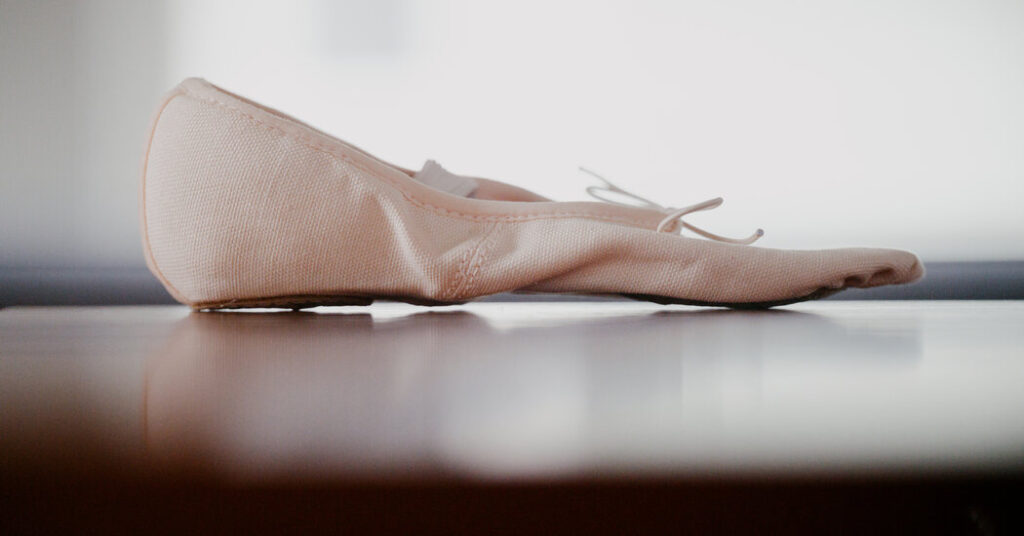
Some of the biggest developments in the ballet shoe have been the addition of the more flexible split sole that shows off the arch (versus a more stable full sole) and stretch canvas. While it can make a foot look attractive, the shoe “is like a sock now,” Orza said. “There’s no resistance. There’s nothing for the dancer.”
Standard ballet shoes have some padding but are generally flat. The big difference between the Orza and a traditional shoe is that there is a supportive heel and layers of foam to cushion the metatarsal. “It makes it more stable and safer,” Orza said, “all the things that I would want as a dancer.”
David Wilkenfeld, the creative director of Bloch, a dance footwear and apparel company, agreed that not many advances had been made in men’s ballet shoes. But he wondered if drastic changes were necessary or even welcome. “Why fix it if it’s not broken?” he said in a joint interview with Fred Perez, Bloch’s global head of footwear.
More cushions may start to work their way into shoes beyond the patented Orza. In development at Bloch, Wilkenfeld said, is a ballet shoe with heel support and, eventually, a new ballet boot for men, with more structure. (Wilkenfeld and Perez said they were not influenced by the Orza.)
It’s also common at Bloch to customize shoes for dancers at major companies. Harrison Coll, a City Ballet soloist, wears his leather Bloch shoes in most performances, but opts for the Orza when he can, though for now it’s only available in canvas.
“I like having the grip to change my weight if I’m running around onstage or if I am partnering,” Coll said of his leather shoes. “So I just have to get used to canvas and feel more confident to wear them onstage. That’s my goal.”
Dancers tend to stick with what they know. For some, the Orza — and especially the first iteration of the shoe, built directly on Orza’s foot — didn’t necessarily hug everyone else’s foot in the way they liked. They were used to more stretch. “Especially at City Ballet,” Wong said, “I feel all the dancers want a shoe that just really looks like their foot. And really the way you can achieve that is with softer materials.”
Most female dancers wear pointe shoes throughout the day, but many opt for ballet shoes for part of class. Miriam Miller, a City Ballet principal, started wearing Orza shoes to help with Achilles tendinitis. Now she can “plié properly without popping my heels off the floor,” she said. “I’m able to keep the sole of the shoe on the floor because it does have a little bit of a lift. So I think that I’ve built strength in a different way without using my calf to plié and point all the time.”
That has led to her using bigger muscles — her glutes, her hamstrings, her quads — in smarter ways. It’s changed the way she jumps: Miller has more power in her legs and feet, which gives her a greater sense of lightness, one bound by strength.
The Orza is more expensive than most — the 2.0, the most recent version, is $69 compared with a general range of $20 to $50 for a traditional shoe. Orza, who runs the six-person company with his wife, Sarah Orza, its chief marketing officer and a former principal with Pacific Northwest Ballet, has engineered the shoe not just for professionals and students, but for recreational dancers, the rising number of adults who study ballet.
Along with a medical advisory board, other advisers to the Orza brand are Jonathan Stafford, the artistic director of City Ballet and the School of American Ballet — his guidance leans toward the business side — and Craig Hall, a repertory director at City Ballet. Orza worked with Hall to create more color options for the shoe. There are five now.
“I would get swatches and I’d send them to Craig,” Orza said, “and he would say, ‘No way. This is orange.’”
Increasingly the Orza shoe is making its way into companies as well as schools, including the City Ballet-affiliated School of American Ballet and Canada’s National Ballet School. The English National Ballet School has around 80 of its dancers wearing Orza shoes. There is also a children’s shoe in development for ages 3 to 9.
The path to get to this point has been arduous. “Can I even do this?” Orza said he would ask himself. “Who am I to be changing something that’s existed for over a century?”
But he had danced in the shoes. And he was happy when he realized that they didn’t fall apart like the shoes he was used to. “As a dancer, I was so stubborn,” he said. “I tried everything, but I would still go back to the ones I started with. And that’s kind of what we’re up against: That tradition of dancing.”
Gia Kourlas is the dance critic for The Times. She writes reviews, essays and feature articles and works on a range of stories.
The post How a Shoe Invented by a Dancer Might Be a Game Changer appeared first on New York Times.