Eight weeks is the length of the current expedition of the Araon, an icebreaker that is carrying dozens of scientists and two New York Times journalists to Antarctica. That’s a long time for a reporter to spend on assignment anywhere, let alone at the bottom of the planet.
Russell Owen clocked 14 months.
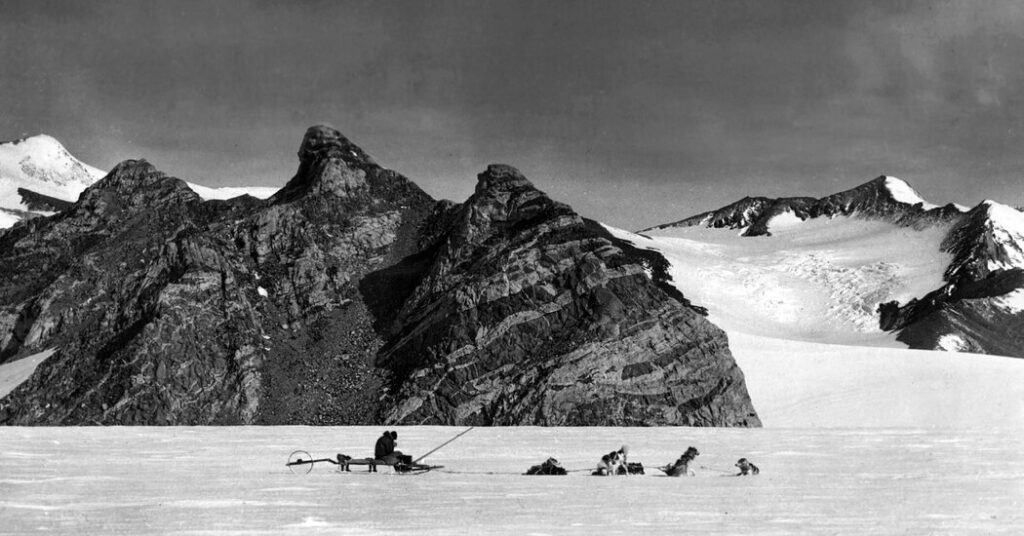
From late 1928 to early 1930, Mr. Owen filed near-daily dispatches for The Times from a landmark Antarctic expedition led by the U.S. Navy commander Richard E. Byrd. He chronicled hardships and triumphs, beauty and mundanity, all of it culminating when Commander Byrd became the first person to fly over the South Pole in November 1929.
Mr. Owen won a Pulitzer Prize for his coverage, and The Times christened him “the world’s first polar reporter.” It was the beginning of what has become nearly a century of Times reporting from the frozen continent.
The newspaper’s ties to the Byrd expedition were less than arm’s length. Adolph S. Ochs, The Times’s publisher at the time, was a longtime supporter of polar exploration and helped fund Commander Byrd’s voyage. To show his appreciation, the commander named a slew of features in Antarctica after members of the Ochs-Sulzberger family, which still controls The Times.
Now we’re back at the end of the Earth, this time aboard a South Korean research vessel with satellite internet, hot showers and a coffee machine. Looking back, Mr. Owen’s stories for The Times tell us a lot about how humanity’s relationship with Antarctica has changed, and how it hasn’t.
When Commander Byrd set off from New Zealand in December 1928, most of the seventh continent was still unknown. Explorers had surveyed a few areas, primarily on the coast. But the interior was a mystery: Might it contain deep valleys sheltered from the ice and snow? New plant or animal species? Fossil remains from a bygone Earth? The commander and his men went there to find out.
They had patriotic aims, too. It was the tail end of the Roaring ’20s, a time of grand American optimism. Commander Byrd’s ship was called the City of New York. His base was named Little America. As he told Mr. Owen:
Although the primary object of the expedition is scientific it will be most gratifying if we succeed in planting the American flag at the South Pole — at the bottom of the world.
First from the ship and then from camp, Mr. Owen transmitted his stories by radio across half the planet to The Times, which rushed them into print, often for the front page. Each article was relayed at a speed of about 1,200 words an hour, so by the time the last paragraph had reached The Times’s radio room, the top of the story might already be set in type. It was a technological marvel in its day, and still plenty impressive in ours.
In his dispatches, Mr. Owen described eerie blizzards, the southern lights and daring rescues at sea:
Commander Byrd is a strong man, an athlete, but for the next ten minutes he fought the fight of his life. Roth could be seen struggling silently but desperately as he went further away. The sun was in the south and so shone on the ice and water that it was difficult to see him in the dancing light.
He wrote about the food: Seal meat, he reported, was “tender,” with “very little fish taste.” Curried whale was “palatable.” Pies made from orange powder, which was consumed to prevent scurvy, were so delectable that it was “no wonder everyone is getting fat.”
On a minus-52 degree day, one of the team’s medics tested the effects of extreme cold on the human body — specifically, his own body. Mr. Owen wrote:
Much to our amusement, he went outdoors without clothes and ran the 200 yards to the other house. He ran as fast as he could and was hitting a good pace at the end in order to keep from slipping. He had caribou slippers on his feet. Steam rose from him as if from a locomotive going up a grade, and his breath rolled out in clouds.
One thing Mr. Owen didn’t have much to say about was the ice. You can’t really blame him. Scientists were only just starting to understand how glaciers and ice sheets worked. As he wrote in 1937:
What causes glaciers to retreat and advance, what longtime changes in climate influence them, science does not know. That they do change is certain, and something of their internal character is comprehended, although much of it is a matter for speculation.
After World War II, nations eyed Antarctica’s potential military and strategic importance, at least until they signed a treaty that protects the continent as a scientific preserve to this day. But Antarctic voyages retained their heroic sheen. On a 1956 U.S. expedition, The Times’s Bernard Kalb recounted the scene when then-Admiral Byrd stepped out of a helicopter wearing the reindeer-skin suit he wore on his polar flights:
The mercury was down to four below zero but he posed amiably for pictures. “I’m the Mayor of this place,” he joked as he stood under a freshly erected United States flag. The photographers worked frantically, asking for “just one more.” The whole thing had a Hollywood air.
Later, as scientists’ knowledge grew, the goal of their journeys became not merely to lay eyes on new parts of Antarctica, but to understand the environment’s inner workings. In 1976, The Times’s Walter Sullivan reported from a failed attempt to drill through half a mile of the floating Ross ice shelf:
Scientists had hoped to penetrate the thick ice so that they could examine the nature of water and life processes existing in complete and perpetual darkness. They had planned to explore the origin of the so‐called “Antarctic bottom water,” which creeps north along the floors of the world oceans and is indirectly responsible for much of the world’s oceanic food.
By the century’s end, the continent was an outpost for serious scientific pursuits: monitoring the ozone hole, studying climate change, detecting particles from space. Working there had become more civilized, less miserable — and, The Times’s Malcolm W. Browne noted in 1990, less welcoming of streaking and other antics.
“We’ve grown up,” John T. Lynch, the science director of the U.S. South Pole Station, told Mr. Browne. “Mature scientists in Antarctica take satisfaction from their work and don’t need any high jinks. Antarctica has joined the world.”
When a team of Times journalists journeyed to Antarctica in 2016, climate change was top of mind:
Alarmed by the warning signs that parts of the West Antarctic ice sheet are becoming unstable, American and British scientific agencies are joining forces to get better measurements in the main trouble spots. The effort could cost more than $25 million and might not produce clearer answers about the fate of the ice until the early 2020s.
The answers are indeed a bit clearer now. Still, little about the ice’s future is certain, which is why scientists keep returning, both this season and for many to come.
Alain Delaquérière contributed research.
Raymond Zhong reports on climate and environmental issues for The Times.
The post From Seal Meat to Ice Sheets: A Century of Reporting From Antarctica appeared first on New York Times.