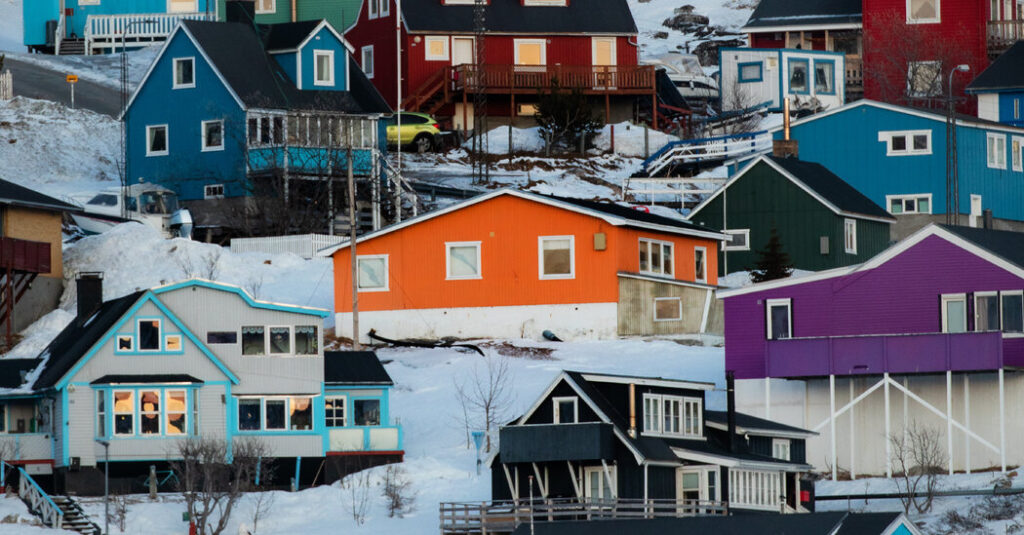
Living in Greenland is a great privilege, and, in many ways, we have it all. But the one thing we don’t have is strength in numbers.
A population of just 57,000 people living along the coast of the world’s largest island is not a great power player. We could all fit into an American sports stadium and there would still be plenty of empty seats. That seems to be why some Americans find it difficult to acknowledge us. Why should so few people claim the right to a vast piece of land?
For Greenlanders, that is not a new question. The idea that a small indigenous population should inhabit and claim such a great piece of land with so many natural resources has been challenged before. Greenland used to be a colony of Denmark, and I believe that any person would be hard pressed to find a relationship between a former colony and its colonizer without dark chapters or difficult issues. We are no exception.
For the past 300 years, we have been on a journey with Denmark toward gaining more say in our own governance. It has been a long road, and we are still on it. Today we are a democracy with our own parliament and our own government — a success we achieved within the Kingdom of Denmark.
Being small is not the same as being incompetent, or incapable. We have built a home in the Arctic that we take pride in. But the size of our population does have one very serious implication for the prospect of independence: It means that we will never be a completely self-sufficient state with the means to defend ourselves.
That underlying truth is well understood in Greenland. Many Greenlanders find that there are too many unresolved issues to move forward with declaring independence today.
And even though there is frustration here with the Danish state’s actions, both in the past and sometimes also in the present, most Greenlanders are content with being part of the Kingdom of Denmark. In other words, we are not unhappy with the house, but we want to alter the interior, as we have been doing over the past several decades.
While our relationship is sometimes complicated, it does not follow that it should end, especially not by force. Complexity is a base line in our history. If we can handle it, that should be respected.
The United States has a longstanding interest in Greenland and considers it part of its national security sphere. That is understandable. We have no issue with the 1951 treaty, supplemented by the Igaliku agreements in 2004, that grants the United States access to Greenland to protect not only your country but also ours. We also recognize that changing geopolitical dynamics calls for a renewed discussion of priorities that should be reflected in our treaties and by NATO. There is absolutely nothing stopping the United States today from adding to that security either within the existing framework or with alterations — without the use of force. Greenland is an ally of the United States, and Denmark is an ally of the United States.
Nevertheless, we find ourselves in a situation where Greenlanders seem to face only two options: being sold or being occupied. That is simply devastating. I see people in Greenland who are deeply affected by these ideas, and the situation calls for a deep breath and some serious dialogue.
We have consistently declared ourselves a part of the Western alliance and an ally of the United States. We are open for business and partnerships and welcome American investments. We especially see potential in the energy and mining sectors that could greatly benefit both parties.
There is a lot of common ground and a lot of aligned ambitions. We insist only that the country we call home is unharmed and that our decision to remain in the Kingdom of Denmark is respected. We want nothing more than to return to our everyday lives and tasks that focus on developing Greenland in a peaceful manner. We believe that peace and stability are key if our natural resources are to be utilized for the benefit of us all. Uncertainty and instability do not spell prosperity and wealth for any of us. We are in this together and we can work this out together.
Naaja Nathanielsen is Greenland’s minister of business, mineral resources, energy, justice and gender equality.
The Times is committed to publishing a diversity of letters to the editor. We’d like to hear what you think about this or any of our articles. Here are some tips. And here’s our email: [email protected].
Follow the New York Times Opinion section on Facebook, Instagram, TikTok, Bluesky, WhatsApp and Threads.
The post Don’t Harm the Country We Call Home appeared first on New York Times.