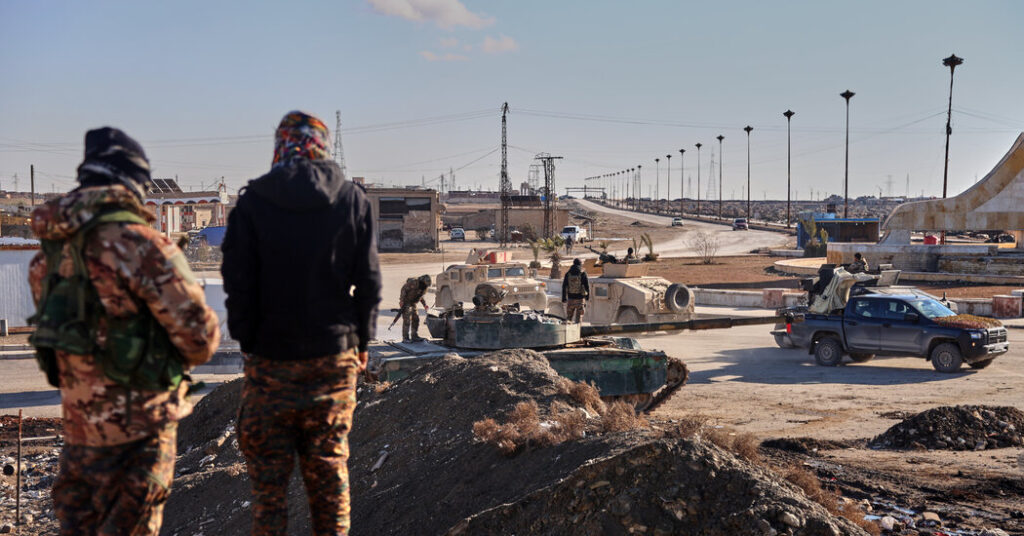
Clashes erupted on Monday around two prisons in northeastern Syria holding members of the terrorist group Islamic State, according to Kurdish officials, a day after a Kurdish-led militia agreed to hand over control of the prisons to the Syrian government.
That agreement between the Kurdish-led Syrian Democratic Forces, or S.D.F., and the central government ended weeks of deadly clashes between the two sides. The S.D.F. agreed to merge fully into the national military and hand over control of security infrastructure — including prisons housing about 8,000 Islamic State detainees — to the government.
But the clashes around two of those prisons on Monday underscored the fragility of that deal. Within hours, both the government and the S.D.F. accused each other of trying to derail the agreement.
The government accused the S.D.F. of releasing Islamic State detainees from al-Shaddadi prison in Hasakah province and of exploiting the security threat posed by those detainees for political gains, according to state media.
“The Syrian government firmly rejects attempts to use terrorism as a security blackmail,” according to a statement published by SANA, the government news agency.
By Monday evening, Syrian officials said they had taken control of al-Shaddadi prison and were combing the area in an effort to rearrest the released prisoners. It was not immediately clear how many prisoners had been freed.
The S.D.F., in turn, accused armed groups “affiliated” with those in power in Damascus, the capital, of attacking the prison in early Monday morning, without identifying the attackers more specifically.
S.D.F. officials also accused armed groups of attacking another prison, al-Aqtan, in Raqqa, the largest city administered by Kurdish authorities and which once served as the capital of the Islamic State’s self-proclaimed caliphate. At least nine S.D.F. fighters were killed in the clashes and 20 others injured, according to a statement by the S.D.F.
The clashes made clear that the cease-fire reached on Sunday had not yet quelled the tensions between Kurdish forces and Syria’s central government over who controls the country’s northeastern region. The Islamic State ruled seized much of that region in 2014, declaring a self-proclaimed caliphate, and ruled it for years before the S.D.F., with U.S. backing, reclaimed the area.
That deal stipulated that the Syrian government would take over control of the northern province of Raqqa and the eastern province of Deir al Zour, which had long been under Kurdish control.
Government institutions in the northeastern province, a semi-autonomous region administered by the Kurds, will also come under the central government’s authority as will Syria’s gas and oil fields in the area, nearly all of which have been under Kurdish control.
The agreement was widely viewed as little more than a surrender by the S.D.F., which for months has been in stalled negotiations with the government over the terms of their integration into the new Syrian state that assumed control after the ouster of Bashar al-Assad in late 2024.
But after a lightning advance by the Syrian military into Kurdish-held territory this month, the S.D.F. forces were put on the back foot and ultimately agreed to the cease-fire deal on Sunday.
As part of the deal, the central government was to assume complete legal and security responsibility over prisons holding more than 8,000 Islamic State members captured during the civil war, including al-Shaddadi and al-Aqtan prisons.
The central government is also to take over the sprawling Al Hol detention camp, which houses tens of thousands of family members of Islamic State fighters, many of them foreigners.
The fate of the Al Hol camp and the prisons has been of particular concern to the U.S.-led international coalition, which partnered with the S.D.F. for years to fight the Islamic State.
Christina Goldbaum is The Times’s bureau chief in Beirut, leading coverage of Lebanon and Syria.
The post Clashes Erupt Around Syrian Prisons Holding Islamic State Fighters appeared first on New York Times.