On many mornings, Sarah Esch’s job as a dispatcher for dockworkers at the Port of Seattle boils down to a question of simple, frustrating math.
“No ships came in last night, so we have maybe 70 jobs today for 600 workers,” Ms. Esch said before dawn on a recent Monday, eyeing the whiteboard used to track available shifts. “Those numbers aren’t great.”
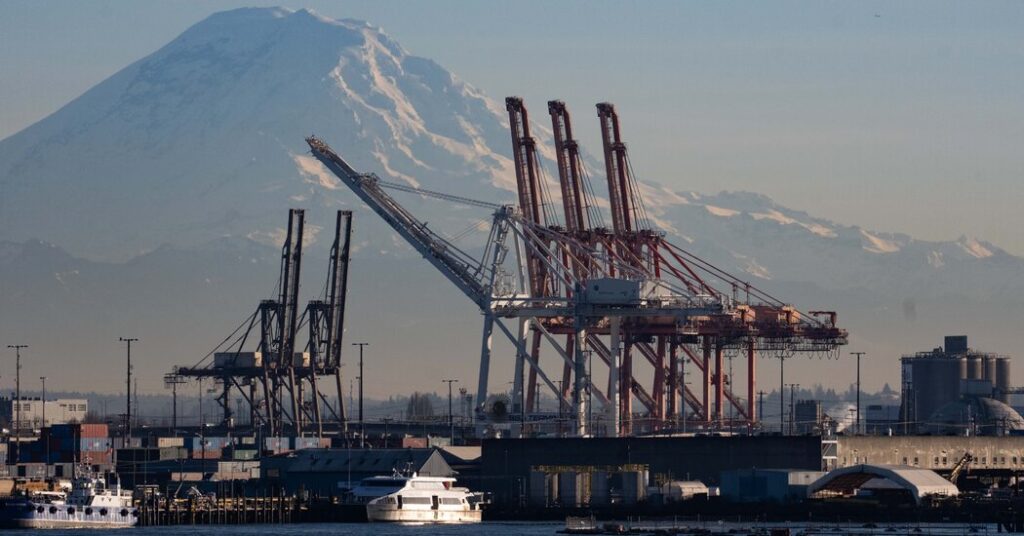
Dock workers in Seattle, like those in other ports up and down the West Coast, do the hard work of bringing Asian imports like electronics and auto parts off boats to make their way to consumers across the West and Midwest. They also load grain, seafood and other American exports onto ships for the return trip overseas.
They are used to uncertainty and shifting economic tides, but nothing since the Great Recession of 2008 compares to what these workers with the International Longshore and Warehouse Union have experienced in the past year.
President Trump frames tariffs as an all-purpose tool and long-term strategy: a way to force other nations to rethink their own trade policies and prod U.S. manufacturers to bring blue-collar jobs back from foreign markets. Any short term pain, the president has argued, is a small price to pay for long-term global economic realignment.
But at this port, and others, the broad tariffs have meant economic uncertainty for veteran workers and put what was once a stable blue-collar career increasingly out of reach for many younger longshoremen.
“People just can’t afford this,” Ms. Esch said.
Longshoremen operate within a system based almost entirely on seniority and showing up. In Seattle, longshoremen rise through three employment ranks with hourly rates, which can start around $40 an hour, and rise to as much as $63 an hour for the most experienced and specially trained workers. People who work nights and weekends earn more.
Entry-level workers are known as “casuals.” They don’t have benefits and aren’t guaranteed work. The second rung on the ladder, known as B-level, comes with health care benefits, the beginning of a pension plan and a guaranteed 32 hours of pay each week. Finally, after five years as what workers commonly call “B men,” dock workers rise to the top, A-level, which guarantees 40 hours of pay a week, full benefits, the right to vote for union hall officers and an ample retirement plan.
“Once you get to A-level, there’s no better career,” said Gina Dobson, 49, an A-level worker with I.L.W.U. Local 19. “But we all tell the casuals, ‘Don’t quit your day job.’”
Some union members can also pass down their “books,” essentially their union registration card, to their children if they die — meaning they start as B men. This perk helps explain why longshoring is such a legacy business: At the Local 19 union hall, third- or even fourth-generation dock workers are common.
“The pay, the benefits, the pension,” Ms. Esch said. “Once you’re in, it’s hard to find another profession that offers this kind of security.”
It took her seven years to rise from casual to B man. She grew up in Colorado and came west to study theater at the University of Puget Sound in nearby Tacoma. She fell into port work while serving drinks at a bar frequented by longshoremen, who encouraged her to try the docks as a more stable way to make a living.
She fell in love with the work — the easy camaraderie, being outside by the water beneath the Seattle skyline, never knowing what a day might bring, the “greasy, dirty sweaty” parts of the job — enough to push through those early lean years. She found free housing through a generous union member and worked second jobs.
Now at 48, she is a dispatcher. Elected by their fellow union members, dispatchers spend their days inside a fishbowl-like office, tracking jobs and doling out assignments. Their technology is decidedly old school: A wall-length whiteboard lists arriving ships. Workers log in using wooden pegs. Ms. Esch and other dispatchers hand write assignments with carbon paper.
Through November, the total number of shipping containers that passed through the ports in Seattle and Tacoma was down almost 4 percent from 2024. That figure may not seem so bad, but it is skewed by an unusual spike in imports during the first quarter of 2025, as shipping companies rushed goods into the United States ahead of potential tariffs. Since August, the monthly drop in traffic has been in the double digits compared to 2024. There was no pre-Christmas rush.
“When China is sending fewer goods into the United States, that hurts. And when other countries aren’t buying soybeans from farmers in the Midwest, we feel that too,” said Sam Cho, a Port of Seattle commissioner. “We’re feeling it all right now.”
This winter, most days bring barely enough jobs for A-level longshoremen. Despite their guaranteed wages, many are losing chances at overtime or higher pay for specialized work, like crane operation.
“Oh, it all sucks,” said Antonio Cappiello, 37, a longshoreman who is an A-level worker. “You just can’t predict from week to week or month to month what your take-home will be.”
At the Local 19 union hall, A- and B-level workers wait for assignments in adjoining upstairs rooms just outside the dispatch office, where they can watch Ms. Esch and her colleagues work the list of available shifts. Casuals wait downstairs, in a room near a parking lot. Ms. Esch usually radios down the bad news. Even within this blue-collar world, where most longshoremen wear the same unofficial uniform of weathered baseball caps or beanies, union sweatshirts and work boots, the gap between the haves and have-nots widens with every spasm of the global economy.
For newcomers, Ms. Esch’s now-regular announcement that there is “no work for casuals today” means careers may end before they truly begin. Old-timers talk about making it from casual to A-man in less than a decade during boom times when there were more than enough hours to go around. Now there is simply not enough work.
“It’s just an everyday disappointment right now,” said Matt Mirante, 31, who has been a casual for seven and a half years and, over the past three months, worked just seven shifts.
He has cousins and other relatives working upstairs, but sometimes considers quitting to focus on this other job, a junk removal business that earns him enough to afford a place of his own to live. He worries about walking away too soon. “I’ve spent so much time already,” Mr. Mirante said. “How could I give that up?”
Abegail Contreras has been a casual for seven years. At 41, she lives with her mother, works several other jobs and shows up almost every morning and evening hoping for shifts. She has picked up four over the last month. “I’ve wanted to be a longshoreman since I was a kid,” she said, adding, “I can see what kind of life it will mean once I make it upstairs.”
When — or if.
At the union hall, the worries extend beyond the tariffs, and when politics comes up, there is less anger at the president and more frustration at the broad, existential decay of America’s shipping economy.
Workers speak with fear about the Port of Rotterdam, in the Netherlands, among the most automated shipping terminals in the world, and the automation experiments taking place 1,100 miles south in Long Beach, Calif. They know how little longshoremen earn in Mexico and South America, and they track everything President Trump says about tariffs.
There is some good news: Improvements at the Seattle port have driven a surge in cruise ship traffic, bringing plentiful work during the summer months. Mr. Cappiello said he had stopped planning summer vacations because “even at A-level, you have to work when there’s work.” But cruise ship hours do not help casuals build up hours for advancing upstairs, and bills come due year-round.
Ms. Esch is not sure she would recommend the work she loves to another generation.
“I just don’t know what the future looks like,” she said. “Is there one?”
Anna Griffin the Pacific Northwest bureau chief for The Times, leading coverage of Washington, Idaho, Alaska, Montana and Oregon.
The post At a Seattle Port Rocked by Tariffs, There Were 70 Jobs for 600 Workers appeared first on New York Times.