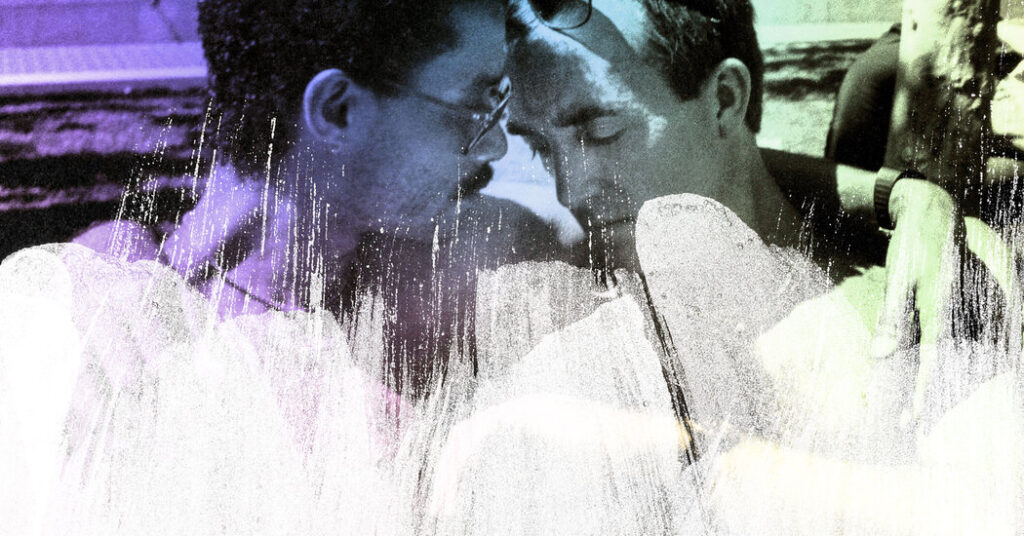
The remarkable success of “Heated Rivalry,” the steamy new television series about closeted gay hockey players, has been widely taken as yet another sign of social progress — evidence that acceptance of queer love continues to grow.
We wish we could share that optimism. Unfortunately, new research that one of us, Professor Charlesworth, helped conduct reveals a darker truth: The decades-long rise in the acceptance of gay people in the United States peaked around 2020 and has sharply reversed since then. The popularity of “Heated Rivalry,” it seems, is a welcome burst of enthusiasm for gay life in a new era of anti-gay prejudice.
This reversal stunned us. In the two decades before 2020, visibility, recognition and legal inclusion of gays and lesbians progressed in lock step — larger and more prominent Pride parades, rainbow-lit landmarks, federal legalization of same-sex marriage. That progress translated into something remarkable: Americans’ bias against gay people declined faster than any other bias ever tracked in social surveys.
Research led by Professor Charlesworth and published in 2022 detailed this decline. Drawing on 7.1 million responses from Americans collected from 2007 to 2020, the researchers tracked both explicit bias (how people answer questions like “To what extent do you prefer straight people over gay people?”) and implicit bias (more automatic responses inferred from how rapidly people associate words, such as “straight” with “good” and “gay” with “bad”). Across every U.S. state and demographic group, anti-gay bias plummeted — by roughly 75 percent on explicit measures and 65 percent on implicit ones, on average. Forecasting models suggested that, at that pace, anti-gay bias could hit zero as early as 2022.
One of us, Professor Finkel, is a host of a podcast called “Love Factually,” which analyzes romantic movies in light of scientific research about relationships. Last June, in an episode about the 2005 film “Brokeback Mountain,” which depicts a love affair between two cowboys, Professor Finkel cited Professor Charlesworth’s 2022 research to make a hopeful point: “There is still a slight preference for straightness over gayness, but it is getting very close to zero.”
But at that time, the Charlesworth research team was analyzing new data showing that anti-gay bias had begun to rise. The analysis of an additional 2.5 million responses from Americans collected from the beginning of 2021 through 2024 revealed that progress had not only stalled; it had reversed. In just four years, anti-gay bias rose by around 10 percent.
Increases also appeared in bias toward Black, darker-skinned, older, disabled and overweight people, but not as starkly. Just as bias against gay people fell especially steeply before 2020, it has surged particularly sharply since.
Perhaps most surprising is that these trends were distinctly robust among the youngest American adults — those under 25. This group increased its animus against marginalized groups in general and gay people in particular at a faster rate than older Americans did. Also surprising is that although anti-gay bias has risen faster among conservatives, it has also risen among liberals.
What explains this decline in tolerance? At the moment, we don’t know. But the evidence suggests that we can rule out two common hypotheses. The first is that the anti-gay backlash is a side effect, or spillover, of the backlash against the movement for transgender rights. If that were so, you would expect increases in anti-trans bias to be meaningfully correlated with subsequent increases in anti-gay bias — which the research does not show.
The second hypothesis is that the anti-gay backlash reflects the rise in moral panic language about sexual grooming, the notion that gay adults are recruiting or influencing children to become gay. But the research shows no evidence of spikes in grooming discourse (measured through Google searches) that are meaningfully correlated with subsequent spikes in anti-gay bias.
If asked to speculate on the cause of the rise of anti-gay prejudice, we would point to two related factors. The first is social instability. Starting around 2020, the United States experienced a sustained disruption consisting of the Covid pandemic, economic strain and intensifying political conflict — each of which has been linked to heightened intergroup hostility and scapegoating. This would explain the overall rise in bias against marginalized groups.
The second factor, which would explain the rise specifically in anti-gay bias, is anti-establishment sentiment. The sustained social disruption since 2020 has fueled resentment and a loss of confidence in institutions perceived to have failed — governments, corporations, the broader establishment. By 2020, support for gay and lesbian equality had become an establishment position. Corporate America, for example, demonstrated a concrete commitment to gay rights, with companies donating hundreds of thousands of dollars for Pride celebrations and other efforts at gay and lesbian inclusion.
Gay and lesbian people, newly woven into the fabric of mainstream society, may have been collateral damage in a broader revolt against a system that felt broken, especially among younger generations grappling most intensely with uncertainty about their future.
Which brings us back to the exuberance surrounding “Heated Rivalry.” The recent rise of anti-gay bias suggests that public attitudes and media representation are no longer moving in lock step. At a time when social advances can coexist with backlash, watching queer stories on television can feel comforting. But comfort on the couch is not the same thing as progress.
Tessa E.S. Charlesworth is an assistant professor of management and organizations at the Kellogg School of Management at Northwestern University. Eli J. Finkel is a professor of psychology at Northwestern University and a director of the Litowitz Center for Enlightened Disagreement.
Source photograph by Bromberger Hoover Photography/Getty Images
The Times is committed to publishing a diversity of letters to the editor. We’d like to hear what you think about this or any of our articles. Here are some tips. And here’s our email: [email protected].
Follow the New York Times Opinion section on Facebook, Instagram, TikTok, Bluesky, WhatsApp and Threads.
The post Americans Are Turning Against Gay People appeared first on New York Times.