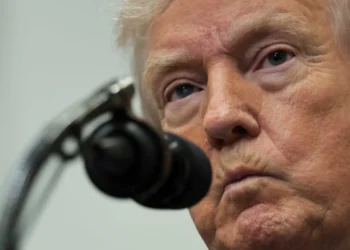
A surge of antigovernment protests swept Iran this month, leading to civilian casualties and prompting President Trump to hint that he was considering military intervention.
Somehow, it was also a betting opportunity.
On the popular platforms Polymarket and Kalshi, armchair prognosticators wagered millions of dollars on the fate of Iran’s supreme leader, speculating the same way a football fan might bet on the future of a struggling head coach.
Polymarket and Kalshi are prediction markets, sites where people can bet on virtually anything, from the outcome of a sports matchup or an election to the date of Taylor Swift’s wedding.
Once a niche phenomenon, the platforms were first embraced by political junkies who wanted to bet on the presidential election. Now prediction markets are everywhere, an unavoidable presence in American politics and culture.
The same weekend that Mr. Trump mulled intervention in Iran, Polymarket odds were featured in the telecast of the Golden Globe Awards. Major media companies, including CNN, CNBC and The Wall Street Journal, have announced partnerships with prediction markets and integrated the platforms’ data into news reports.
The amount of money flowing onto the platforms has skyrocketed. Nearly $12 billion was traded on Kalshi and Polymarket in December, up more than 400 percent from a year earlier, according to data from Piper Sandler, an investment bank. The companies raised billions from investors last year, making them some of the tech industry’s most promising start-ups. And they share a link to the Trump family: Donald Trump Jr., the president’s oldest son, is an adviser to both firms.
The rise of prediction markets has created new risks and raised fears about the spread of gambling. For decades, sports betting was largely banned in the United States, until the Supreme Court ruled in 2018 that the federal prohibition was unconstitutional.
“Are we just going to have gambling on everything in all 50 states?” asked Dustin Gouker, a gambling industry consultant who writes a newsletter about prediction markets. “That’s the moment we’re at.”
The sites have also been dogged by concerns about market manipulation and insider trading. Hours before the U.S. military captured Venezuela’s president, Nicolás Maduro, an anonymous user on Polymarket bet tens of thousands of dollars that Mr. Maduro would fall, fueling speculation that a government official had placed the bets using confidential information about the military plans.
The trader walked away with a $410,000 payout.
Proponents of prediction markets argue that the platforms are fundamentally different from gambling companies, offering a valuable new source of information by allowing people to bet on world events.
Prediction markets are “the most effective way to aggregate information and the crowd wisdom,” said Tarek Mansour, who co-founded Kalshi in 2018. “People don’t lie when money’s involved. You want to be right about your predictions so you don’t lose money.”
He added that Kalshi operated as a regulated exchange in the United States, with a system for stopping insider trading.
Polymarket has begun offering some betting in the United States, though its main platform still prohibits U.S.-based customers. A company representative did not provide a comment.
Prediction markets operate differently from traditional sports books. The websites offer yes-or-no questions such as “Will the Iranian regime fall before 2027?” or “Supreme Court rules in favor of Trump’s tariffs?”
Customers log onto a website and place bets of any amount by buying what’s known as a contract — the “yes” option on the Iran question, for example. These contracts fluctuate like stocks, with the price moving between $0 and $1.
The price reflects the market’s view on how likely an event is to happen. A price of $0.20 suggests a 20 percent likelihood, while $0.90 suggests a 90 percent likelihood. The payout arrives when an event occurs and the value of the correct contract rises to $1. If a savvy customer bought 100 of those at $0.10 each (a $10 outlay), he or she would collect $100 in winnings.
Unlike sports books, prediction markets do not serve as the “house,” taking the opposite side of a bet. They match the buyers on each side, generating revenue by charging trading fees.
The phenomenon gained traction in the 2010s as political betting grew popular. But the businesses did not burst into the mainstream until the 2024 presidential election.
Polymarket, founded in 2020 by the entrepreneur Shayne Coplan, offered odds on the election that showed Donald J. Trump with a larger lead than traditional polling indicated. Mr. Trump trumpeted the projections on Truth Social, his social media platform, sharing a graphic that showed he had a 64 percent chance of victory.
As Polymarket’s profile rose, its legal status was uncertain. The company had been banned in the United States after the Commodity Futures Trading Commission fined it $1.4 million in January 2022 for operating without proper registration. (Some U.S. customers continued to use the site through virtual private networks.) Days after Mr. Trump’s victory in November 2024, federal agents raided Mr. Coplan’s New York City apartment as part of a criminal investigation into whether he was running an unlicensed exchange.
That year, Polymarket was locked in a fierce competition with Kalshi, which was embroiled in a court battle with the Commodity Futures Trading Commission over the legality of betting on congressional elections. Kalshi won the case in late 2024, paving the way for political betting in the United States.
Under Mr. Trump, the regulatory landscape has been transformed. The Justice Department dropped its investigation into Mr. Coplan. Both Polymarket and Kalshi are now available to U.S. customers, with the trading commission’s blessing. Just four months after his home was raided, Mr. Coplan was invited to join a group of executives at the White House for a cryptocurrency summit with Mr. Trump.
But the legal tussling is likely to continue. Several states are battling the prediction markets in federal courts, arguing that the sites should be required to follow rules that apply to traditional gambling companies.
“The states are saying, ‘This is gambling, and you have to follow our licensing and regulation,’” said Andrew Kim, a lawyer at Goodwin who has tracked the litigation. “You don’t have a license — get out of our state.’”
That dispute could eventually reach the Supreme Court. In the meantime, business is booming.
In December, Kalshi said it had raised new financing at an $11 billion valuation. Polymarket is valued at $9 billion after raising funds from Intercontinental Exchange, the owner of the New York Stock Exchange.
The companies are marketing aggressively. Kalshi put up flashy ads in Times Square, displaying election odds. The live telecast of the Globes this month featured Polymarket’s projections for the winner in the best original song and other categories.
“People have more clarity about the world because Polymarket exists,” Mr. Coplan declared in a celebratory post on social media. The platform correctly predicted 26 of the 28 Globe races, he noted.
As interest in prediction markets has exploded, concerns have mounted from legislators and other critics. Among their worries is that someone with nonpublic information — about the date of Ms. Swift’s nuptials, for example — may use the sites to make money, at the expense of less informed buyers who take the other side of the trade.
Mr. Mansour has said Kalshi bans insider trading and supports a bill in Congress that would enshrine that prohibition into law. But some prediction market enthusiasts have argued that insider trading is useful, because it can move the market and lead to more accurate projections.
Another concern is the potential for market manipulation.
In October, people wagered on which words would be uttered during an earnings call for Coinbase, the largest U.S. crypto company. Brian Armstrong, the company’s chief executive, was aware of the betting — and influenced the outcome. At the end of the call, he read several of the words aloud from a list: Bitcoin, Ethereum, blockchain, staking, web3.
“I was a little distracted because I was tracking the prediction market,” he said on the call.
Coinbase brushed off any concerns about impropriety. The call “caused me no heartburn whatsoever,” said Paul Grewal, the company’s chief legal officer.
There was no indication that Mr. Armstrong had profited. Asked later about his role in the betting, he said he hadn’t had any money riding on the outcome.
“The conference call was me just having a little bit of fun,” Mr. Armstrong said.
David Yaffe-Bellany writes about the crypto industry from New York. He can be reached at [email protected].
The post All Bets Are On: The Rise of Prediction Markets appeared first on New York Times.