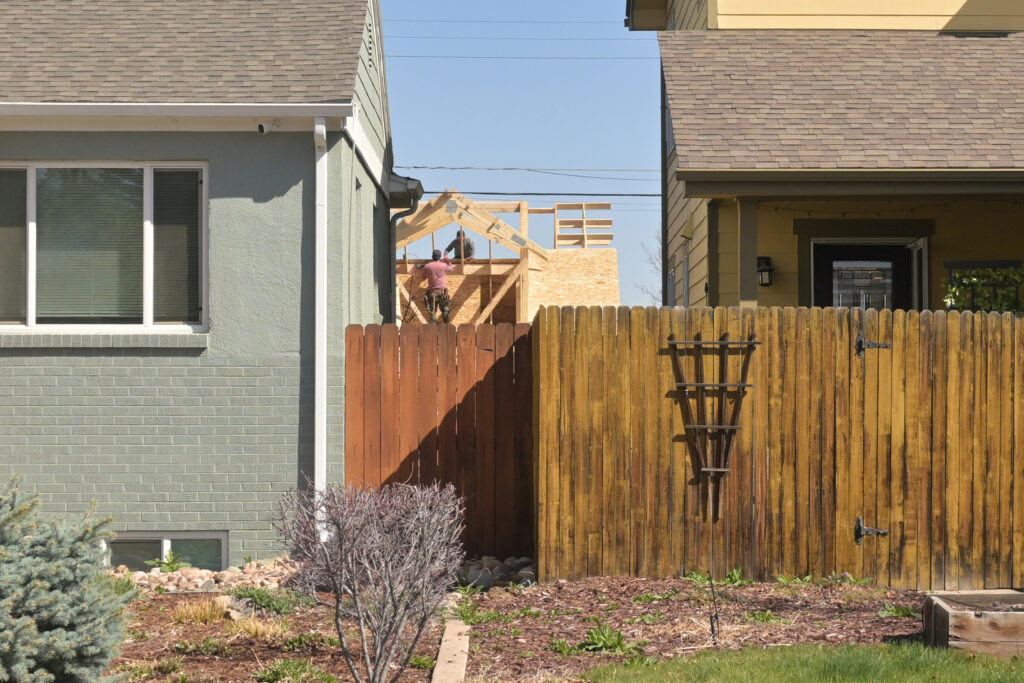
The shrinking American backyard is getting even smaller, and it partly has to do with mortgage rates.
The bygone rates of the early 2020s — the last time they were below 3 percent — have had a powerful hold on their owners, who are hesitant to move if it means taking on a new home loan at twice the rate. So homeowners are increasingly building out their homes by taking the space from their yards.
Nicole Goolsby Morrison sees it firsthand at her Raleigh-based home remodeling company. She has been busy with additions that extend the back of a house anywhere from 4 to 15 feet, and has added bathrooms and bedrooms to front yards. When she talks with clients, mortgage rates come up often.
“People are choosing to stay in their homes because of [their low] interest rates, and because new construction and even resells have gotten so expensive,” she said.
Yards have been shrinking in new homes for years. As costs rose, preferences shifted and some cities and states passed laws allowing development on smaller lots. In 2009, lots less than 7,000 square feet represented 25 percent of new homes. Today it’s 39 percent, even as the size of houses on them grew larger. The Atlantic was already charting, and lamenting, the disappearing lawn a decade ago: “It would signal a profound change in suburbia, and not an altogether attractive one, as McMansions squeeze ever tighter together, hulking and lonely.”
Some projects are modest — a few more feet to modernize a cramped, run-down kitchen, or an extra bathroom for the ground floor, Morrison said. Others are gargantuan, sometimes a whole new house basically devouring the much smaller original.
As the founder of Angi, a website that connects homeowners with contractors and service people, Angie Hicks says, “You’re definitely seeing people that are preferring to stay put, especially if they had locked in a 3 percent mortgage rate.” Some purchased properties expecting to stay a only short time, but now want to stay for good. “The calculus has changed. You might be in your house longer than you expected.”
Hicks said millennials — those roughly 30 to 45 years old — are leading the drive. Overall, her website found that 4 percent of homeowners who did work on their houses in 2025 were expanding its footprint, twice as many as the year before. And 18 percent of people with multiple generations living under one roof say they will expand their houses in the future.
Many people who bought their homes before 2022, then saw them skyrocket in value, now have equity that they can tap to finance remodeling projects. The average cost for a room addition has been quoted at about $50,000, though projects vary widely in scope.
“You may not want to trade your whole mortgage price, but you might be willing to tap your home equity,” Hicks said. “Maybe I’ll go and access some funds because the price of my house has gone way up in the time I’ve owned it. … It’s not going to take my overall borrowing rate from 3 percent to 6 percent. It might take it up to three-and-a-half.”
Rachel Bogardus Drew, who runs the Remodeling Futures Program at Harvard’s Joint Center for Housing Studies, said that home additions represent one answer to the “huge pent-up demand” among people who want to move out of their houses but have not made a move, in a housing market that’s been characterized by sluggish inventory, high prices and elevated interest rates for the past three years.
The number of homeowners in Federal Reserve surveys who say they want to move within the next two years shot up in 2022, from 8 percent to 19 percent, and has stayed high. But those would-be movers aren’t moving. Instead, they’re building.
“There’s been a slowdown in sales and homeowners are making a decision to do these major building projects rather than moving,” Drew said. Looking at private data on locally issued building permits across the country, Drew tracked large increases in permits for major home construction projects in 2022, then again in 2023, and another 5 percent in 2025.
Drew’s center produces a quarterly analysis of remodeling spending. Coming off of a slight decline in spending in 2024, Americans spent more than $2 trillion last year to renovate their homes. The Harvard group projects a record $524 billion will be spent in the first quarter of 2026, up 2.4 percent from the same three months of 2025.
Ben Metcalf, managing director of the University of California at Berkeley’s Terner Center for Housing Innovation, said a lot of people would rather have more house than more yard anyway.
“Shifting cultural patterns: People are spending less unstructured time, and valuing the kind of activities they do in a backyard less than the kind of things they do indoors,” he said. In other words: More time online, less time hanging out with neighbors. “With the shrinking amount of independence that sub-preteen kids have, there’s less time throwing a football with friends in the backyard.”
Evin Isaacson, a lawyer, and her husband, a city employee, now have a backyard just large enough for one giant spreading tree. They extended their D.C. rowhouse — which had two full-size bedrooms and one tiny one before the construction — to make it into the house they’d want to stay in permanently while they raise their daughter, who was born during the lengthy construction process. The addition cut the size of their backyard down to the minimum allowed under D.C. law without a variance. (They asked their contractor to wait to start building until after they used the yard for their backyard wedding.)
The project had more bumps than they bargained for, but they said they persevered in part because of their 2.5 percent mortgage rate.
“Because our monthly mortgage payment was lower, we were able to save additional money to put into the project,” Isaacson said. “There was definitely some not-quite-so-short-term pain in terms of getting here. But we feel really lucky to have been able to invest in this place, and take this 1919 house and give it its next generation of updates so we can raise our family in this house.”
The post Why the American backyard is getting even smaller appeared first on Washington Post.