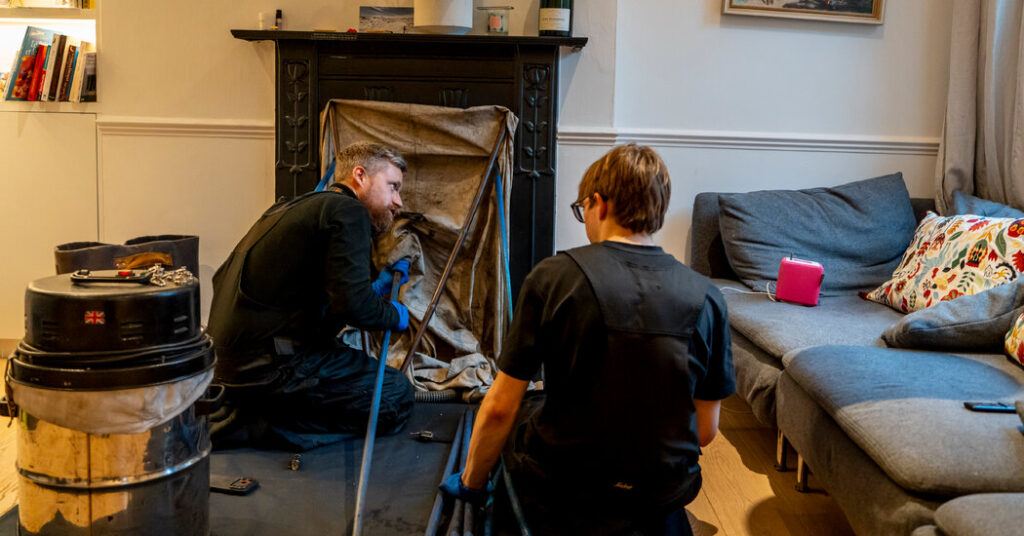
Against a gray London skyline, a spiky round brush protruded from the chimney of a large family house as Josh Firkins got to work.
The brush would have been familiar, Mr. Firkins said, to his great-great-great-grandfather Charles, who began working as a chimney sweep in the mid-19th century. Other aspects of the job would have seemed outlandish to him, though.
A digital camera revealed the chimney’s interior. An industrial vacuum cleaner removed soot and other debris dislodged by the brush. Earlier, a drone buzzed above the house, scanning the state of the rooftop.
Chimney sweeps were once an essential part of British life, when households relied on coal and wood-burning fires to heat their homes. They have played an outsize role in the cultural imagination, whether because of Dick Van Dyke’s portrayal of Bert in “Mary Poppins” or — less cheerfully — the children sent up flues in the 18th and 19th centuries, some getting stuck or suffocating in the process.
The mass adoption of central heating in the second half of the 20th century, and the introduction of clean air regulations, meant open fires fell out of fashion and the industry shrank. But some firms survived.
Now, many sweeps, including those in the Firkins family business, say the trade has been experiencing an improbable resurgence.
According to the National Association of Chimney Sweeps, demand has been bolstered by high energy prices, the popularity of wood-burning stoves and an international climate that has prompted warnings that electricity supplies could be vulnerable to attack by hostile states like Russia.
“People are thinking, ‘Let’s have a backup, let’s have a fire, let’s have a stove in case the electricity goes off,’” said Martin Glynn, the president of the chimney sweeps association, whose membership has risen to about 750 today, from about 590 in 2021. “If you have the ability to burn logs or smokeless fuel, you can keep cooking and have some heating. There is a big increase in demand and people are reopening their fireplaces.”
On a recent day, he said, three people had booked training courses. The association’s membership now includes 40 female sweeps. “It’s alive and kicking,” he said of the group, adding: “We don’t send little boys up chimneys any more, instead it’s CCTV and smoke testing equipment. It’s almost like being a chimney technician.”
A revival of open fires and stoves in homes, even on a small scale, does not come without costs. Scientists and campaigners warn that both produce a fine particulate matter, PM2.5, a harmful pollutant that is associated with respiratory problems, heart disease and even dementia.
In 2023, England banned the sale of almost all traditional coal for domestic use. But even urban areas like London allow the burning of officially authorized smokeless fuels, which produce very little visible smoke, but do generate soot, although much less than coal does. To limit air pollution, the British government recommends that chimneys be professionally swept once a year, and that households choose the cleanest available fuels.
Chimney sweeps have been in business in Britain since at least 1519, the date of the first recorded payment to one, according to a history of the trade, “British Chimney Sweeps” by Benita Cullingford. Records are sparse because sweeps had no guild to keep documents, unlike in some other countries.
In the 18th and 19th centuries, “climbing boys,” often orphans, were enlisted to clamber up narrow chimneys. This dangerous, sometimes deadly activity was outlawed by an act of Parliament in 1875, not long after the death of George Brewster, 11, who got stuck in a chimney in Fulbourn, near Cambridge.
Census records show that Charles Firkins, Mr. Firkins’s ancestor, was sweeping chimneys in 1860. By 1864, his three brothers had joined him.
The family had its share of drama, including one altercation, recorded in the local press, in which Charles punched a rival who mocked the way he advertised his services with the cry, “Sweep, sweep.”
Mr. Firkins, 37, has heard of builders recovering the remains of children in chimneys. More common is the discovery of hidden items. Mr. Firkins uncovered a stash of love letters written by men to a male doctor dating from an era before homosexuality was legalized. Mr. Firkins’s father once recovered a revolver, which was turned in to the police.
More than a century and a half after the family business began, chimney sweeping remains profitable for H Firkins & Sons. In the winter months, Mr. Firkins said, “we’ll probably take 70 to 80 calls a day.”
“People enjoy sitting in front of a fire,” he said. “You can shut the curtains, light a fire and it doesn’t really matter what’s going on outside. People have a glass of wine, the fire’s alight, they read a book. I guess they switch off.”
He believes the rising cost of living is driving the surge in business. Although fires are less efficient than gas or electric systems, they can help ration the use of central heating, while those with access to free or cheap wood can save cash in areas where burning logs is permitted.
“Our busiest times are when there is a recession or when energy prices are high,” he said.
Inside the house in north London, where Mr. Firkins was recently working, Michael Netter, 41, an expert in building conservation and sustainability, watched as his fireplaces were checked during a renovation before he and his family move in.
Mr. Netter, who has lived in London for 14 years, was raised in Toledo, Ohio, in a house with an open fireplace. Still, it was unusual to have his chimney swept by a family firm dating back to 1860. “We certainly wouldn’t have that in the Midwest,” he said.
In Britain, the profession seems safe for another generation, judging from the enthusiasm of Tom Joslin, 19, who joined Mr. Firkins as an apprentice 14 months ago, after leaving college and trying catering and bar work. His youthful appearance causes clients to jokingly ask if he will be climbing into the chimney.
There are one or two downsides, Mr. Joslin said, including dealing with creatures that lurk in chimneys — large spiders, birds that get stuck and the occasional angry hornet. But those are only minor inconveniences.
“I absolutely love it,” he said. “It’s the best job I think I could ever get.”
Stephen Castle is a London correspondent of The Times, writing widely about Britain, its politics and the country’s relationship with Europe.
The post Why London’s Chimney Sweeps Are Enjoying a Resurgence appeared first on New York Times.