
On a nearly three-week visit to South America, during which I interviewed the presidents of Argentina and Peru, many friends asked me the same question: “Who is actually running Venezuela?”
My answer was, “The same crooks as before.”
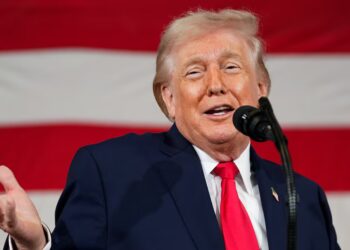
President Donald Trump has claimed he’s running Venezuela following the US raid that captured former dictator Nicolás Maduro, and even posted a picture of himself on social media calling himself “Acting President of Venezuela.”
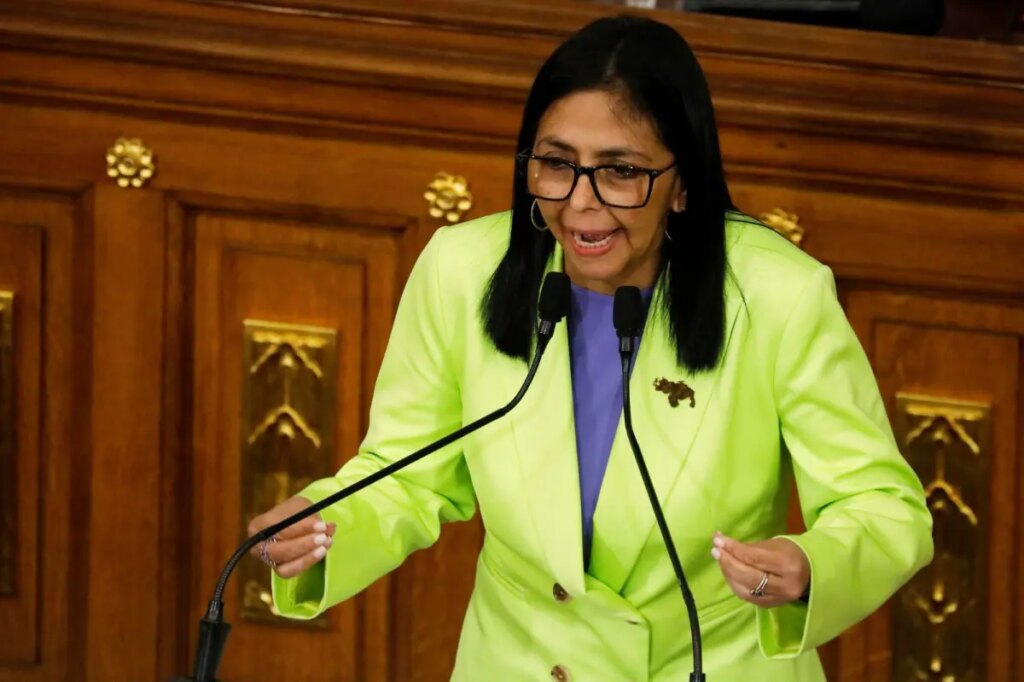
He also said he has talked extensively with former Maduro vice-president — now interim president — Delcy Rodriguez, describing her as a “terrific person” who will presumably follow his commands.
She is, indeed, under pressure from a US naval blockade that could cripple Venezuela’s vital oil exports.
To be sure, Venezuela has released dozens of political prisoners since Maduro was captured in Caracas on Jan. 3 and flown to New York to face narcoterrorism charges.
Still, more than 800 political prisoners remain, according to the human rights group Foro Penal.
Rodriguez has also vowed to increase oil shipments to the United States — something Maduro repeatedly offered in exchange for a lifting of US oil sanctions.
More important, Rodriguez and virtually all top officials of Maduro’s dictatorship — including powerful Interior Minister Diosdado Cabello and Defense Minister Padrino Lopez — remain in charge of the army, police, intelligence services, the “colectivos” paramilitary squads, judiciary and state media.
The regime’s “colectivos” stop people in the streets to check their cellphones and detain those who have posted anti-Maduro statements online.
What’s more, Rodriguez continues to refer to her former boss as the “legitimate” president of Venezuela, and state television describes his capture as a “kidnapping” by US forces.
In her Jan. 15 address to the regime-controlled National Assembly, a day after speaking with and being praised by Trump, Rodriguez denounced the “criminal economic blockade” by US forces.
She also said Venezuela “has the right” to maintain close ties with Russia, China and Iran.
In other words, for Venezuelans, little has changed.
If anything, it’s “Madurismo sin Maduro” — Madurism without Maduro.
Trump administration officials argue it would be unwise to invite opposition leaders to form a new government now, using post-invasion Iraq as a cautionary example.
They fear resistance from the military and bureaucracy would lead to chaos.
But that argument risks perpetuating a bloody dictatorship and scaring off foreign investors.
Trump’s grandiose promises that “we will make Venezuela rich” may end up like others of his that have so far failed to materialize.
Remember the “Gaza Riviera” he said he would build?
Or his campaign vow to end the Russia-Ukraine war “on the first day” of his presidency?
This may be no different.
Instead of praising Rodriguez and falsely claiming that opposition leader Maria Corina Machado does not have “the respect or support within Venezuela” to lead the country — as he said days before receiving Machado at the White House and stating that she is “a wonderful woman” — Trump should have laid out a step-by-step roadmap for the restoration of democracy.
Yet, as of this writing, Trump has not laid out a timeline for measures leading to free elections, such as restoring press freedom and voting rights for the more than 8 million Venezuelans living abroad.
In his first press conference after Maduro’s capture, Trump spoke extensively about oil, drugs and migration but did not mention the word “democracy” even once.
He said a transition could take “years.”
Peru’s interim President José Jeri told me that “there should be a roadmap” — either to install Edmundo González Urritia, the Machado-backed candidate who, according to the most credible voting tallies, won the 2024 election, or to hold new elections in Venezuela.
Former US Ambassador to Venezuela Charles Shapiro told me that keeping the current regime won’t bring stability, but rather do the opposite.
“At some point, in 30 or 90 days, or in six months, the [Venezuelan] people are going to be disappointed,” Shapiro told me: “That’s going to lead to an unstable political situation.”
Shapiro proposed that Trump appoint “a group of notables,” neither regime insiders nor opposition figures, to negotiate a roadmap toward restoring basic freedoms and setting the stage for free elections.
“Who would these people be? It could be people like the president of a university, or maybe a bishop, or the cardinal,” Shapiro told me.
“Maybe this could take place in the papal nuncio’s office” in Caracas, he suggested.
I agree: In the absence of a timetable for the return of the rule of law, Trump will soon move on to other foreign-policy priorities, the Rodriguez regime will entrench itself as a “tolerable” dictatorship for the White House and Venezuela will be neither rich nor free.
The time to start that process is now.
Andres Oppenheimer writes about Latin American policy and economic issues in “The Oppenheimer Report.”
The post The crooks are still in charge of Venezuela — US should plot a road map to freedom appeared first on New York Post.