CARACAS, Venezuela — Before sunrise, Jesús Ramos dropped to one knee, put a ring of yarn around Victoria’s finger and asked her to marry him.
“It was an easy yes,” she said this month.
The couple shared a long embrace. Then Ramos, a former officer of the Venezuelan National Guard, said goodbye and surrendered to the government of President Nicolás Maduro. It was 2020, he had joined a failed attempt to oust the authoritarian leader, and he had been hiding from security forces for more than a month.
He was sent to Jesús El Helicoide, the infamous prison in Caracas run by the regime’s principal intelligence agency, where the couple married. For years after, she visited him there one day each week.
Then, last July, he was transferred without notice to an undisclosed facility. Victoria hasn’t heard from him since.
During a dozen years under Maduro, Venezuela’s socialist state detained thousands of political prisoners. When U.S. special operators captured him on Jan. 3, the legal aid group Foro Penal says, at least 800 remained in custody without trial or access to an attorney.
Since then, Maduro’s vice president and interim successor, Delcy Rodríguez, has begun to release some of them in what she has described as a goodwill gesture toward Washington.
“The message is very clear,” she said. “It is a Venezuela opening up to a new political moment that allows understanding amid divergence and ideological political diversity.”
National Assembly President Jorge Rodríguez, Delcy’s brother, said a “significant amount” would be freed.
But Ramos is part of a smaller group: the 50 or so detainees who have disappeared within the regime’s network of prisons, with officials refusing to say where they’ve been gone or what’s happened to them. While some families are welcoming their parents, children and siblings home, others are petitioning the interim government for proof their loved ones are still alive.
Rights advocates have expressed concern.
“Relatives must be provided with clear and timely information about the fate, whereabouts, and legal status of their loved ones, as well as guaranteed access and regular visits,” the U.N. Fact Finding Mission for Venezuela said last week. “Prolonged incommunicado detention — a human rights violation that many prisoners continue to face — deepens the suffering of families and must stop.”
“The Venezuelan government has forcefully disappeared dozens of political prisoners,” said Martina Rapido Ragozzino, North Andes researcher for Human Rights Watch. “Authorities have for months denied relatives of people detained any information on their fate or whereabouts, forcing them to put together bits and pieces of information and rumors to know where their loved ones are being held.”
The last time Francis Quiñonez saw her son, she told him she had an opportunity to leave Venezuela. Jhonatan Franco, a former National Guard soldier, had been imprisoned since Operation Gideon, the May 2020 incursion to capture Maduro and senior regime officials led by a former U.S. Army Green Beret and a retired Venezuelan general, and Quiñonez was struggling with money.
“He told me to leave, to have a life,” she said, wiping away tears. “I told him no, I would never leave him alone. And I stayed.” Franco, too, has since disappeared.
At least 31 of the missing prisoners are linked to Operation Gideon. The plot, which involved former Venezuelan soldiers, dissidents and at least two American mercenaries, was infiltrated and quickly foiled by Maduro’s security forces.
Jesús and Victoria married at El Helicoide. The announcement that the regime would begin releasing prisoners came on his 34th birthday. “I thought that for this anniversary we would be together,” Victoria said. “But like so many other dates that have been taken away from us, this is another one that we are not together.”
The regime says it has released at least 400 prisoners, but that number is not reflected in the daily announcements.
President Donald Trump, who is working with Rodríguez, said Venezuela had started the process in a “big way.”
“I hope those prisoners will remember how lucky they got that the USA came along and did what had to be done,” he wrote on social media.
The U.N. fact-finding mission called for “the immediate and unconditional release of all political prisoners and all persons arbitrarily deprived of their liberty. … We call on the Venezuelan authorities to act with transparency and urgency.”
Foro Penal director Alfredo Romero described the regime’s releases as tactical, not humanitarian. “Prisoners are seen as government property, to be used as bargaining chips to gain political advantages and maintain the monopoly of power,” he said. “Repression is the cornerstone of the current regime.”
‘Where is he?’
Jesús Ramos saw his participation in Operation Gideon as an act of patriotism. “He didn’t want to live in a country were thousands were killed or arrested,” said a person close to his case. “He tried to change the fate of the country.” The person spoke on the condition of anonymity for fear of repercussions.
Ramos, a captain in the National Guard, left the military in 2019, after Maduro claimed victory in an election widely seen as fraudulent. Neither the Trump nor Biden administrations recognized Maduro as Venezuela’s legitimate president; Washington and Caracas cut diplomatic ties in 2020.
For the couple’s prison wedding, Victoria wore a white shirt and dark red skirt. “I did wear heels,” she said. “At least I deserved that.” He entered with his mother; she, with her father. They looked forward to renewing their vows in a Catholic church.
“I am a woman very much in love with my husband,” she said.
Victoria last spoke with Jesús the day before he went missing. “I keep imagining our church wedding,” he told her. “I love you.”
Soon Victoria was called to El Helicoide and handed Jesús’s personal items. The guards told her he had been sent elsewhere but didn’t say where. With other families, she started a painful search.
“Someone told us they were in Fort Guaicaipuro,” she said, a military facility outside Caracas that was struck by the United States on Jan. 3.
Victoria described the fort as a torture center. Human rights lawyer Tamara Suju has said on social media that the detention area “resembles a large animal cage, where the cells are underground, like sewers, and the guards walk above the detainees, watching them through the bars that form the roof.” A video of a visit by Defense Minister Vladimir Padrino appears to show bars on the ground and an officer looking down.
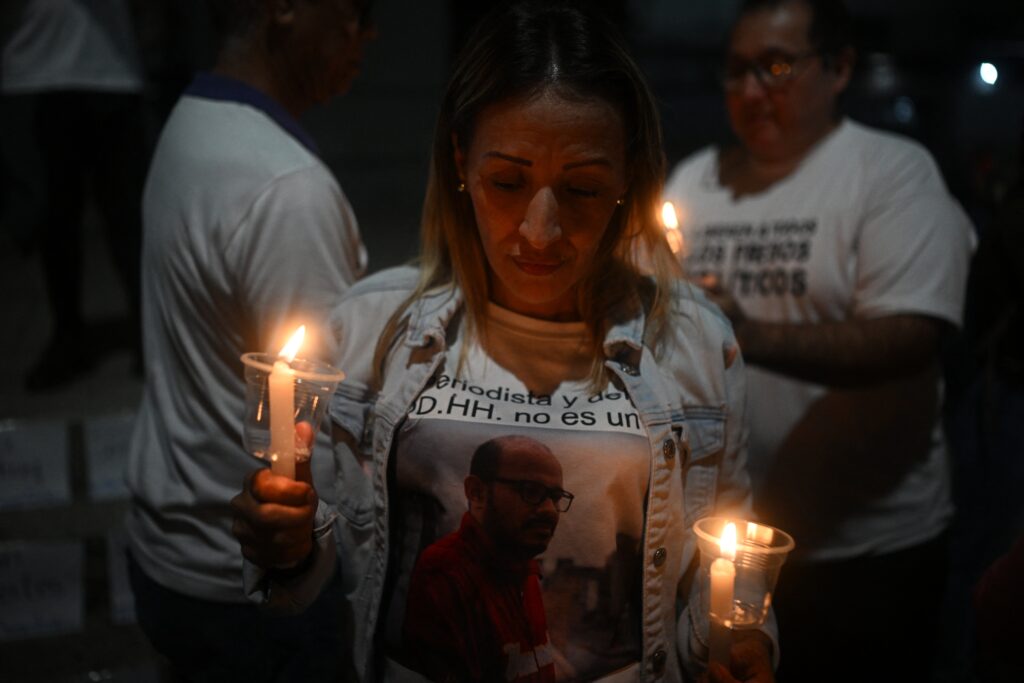
Six days after the government announced the releases, parents, spouses and children of prisoners lit candles outside El Helicoide to honor them. Victoria sat watching from a stairway. A few feet away, officers of the national police and the secret police stopped cars headed to the prison.
“No one tells you anything,” Victoria said. “What is the purpose of weakening them like this, the agony we go through and that they go through? It’s psychological torture.
“They’ve taken him away. Where is he?”
‘I cried and begged them’
When Franco left Venezuela in 2019, he told his mother he was traveling to Peru. In fact, he went to Colombia, to train for Operation Gideon. “He never told me what he wanted to do,” Quiñonez said, but from the start of his career, he was disappointed in the system. “It changed too much,” she said.
Quiñonez lived in Merida state but traveled frequently to Caracas to visit her son. He would call her from prison to let her know he was okay.
Then she learned from another prisoner’s family that a group had been transferred elsewhere. At El Helicoide, she was given her son’s belongings. She hasn’t heard from him since.
She moved to Caracas, where she waits for a call that doesn’t come. Her employer here closed. Still, she stays.
Last month, she visited Fort Guaicaipuro with bread and juice in the hope that her son was there.
“Five masked officers with long guns came out toward me,” she said. “I cried and begged them to receive the bread so that my son could know that I was there, that I was alive, waiting for him.”
The guards, she said, told her to leave.
The post Some Venezuelan prisoners are being freed. Others have disappeared. appeared first on Washington Post.