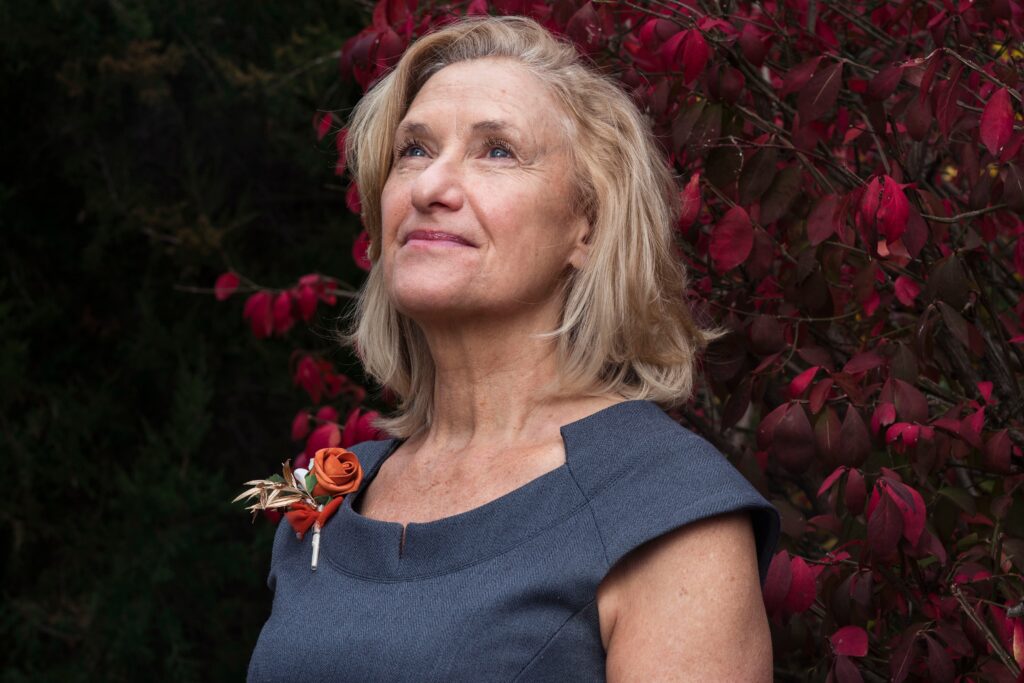
She was kneeling in her front yard, pulling weeds from around a peach tree, when the police and federal agents arrived. Four men, she remembers, with a question. “Are you Barbara Wien?”
By that balmy afternoon in early October, she sensed that her protest campaign against one of President Donald Trump’s most powerful aides might stir trouble. A few weeks prior, she’d seen two strangers lingering outside her Arlington home. Law enforcement, she had surmised. Shaken, she spent a couple of nights in a neighbor’s basement.
Now, members of the FBI, Secret Service and Virginia State Police approached. They demanded her phone, saying it could contain evidence of criminal conduct.
Wien, a 66-year-old retired peace studies professor, took off her gardening gloves and read the search warrant, signed by a judge after police accused her of a “coordinated plan to intimidate and harass Stephen Miller,” Trump’s deputy chief of staff for policy and architect of the immigration agenda that angered Wien so much. Investigators had seen a message in a group chat where Wien vowed to make “his life hell.”
There on her lawn, she learned that she was under criminal investigation for what she saw as taking a stand against the administration’s policies; that her lifelong commitment to political activism had put her in a precarious spot in a nation beset by rising political violence. A nation where it seemed the line between free speech and public safety, between legitimate protest and personal harassment, was becoming increasingly difficult to decipher.
She believed she was confronting a threat to her community — but now, she realized, some thought the threat came from her.
Worry washed over her, but it ebbed as she focused on the reasons she’d begun protesting in the first place. The deportation dragnet sweeping the country, ensnaring mothers, fathers, American citizens. Her neighbors, fired from their government jobs. Her father, who as a young man fled the Nazis.
She’d come to believe the country was sliding toward despotism, a force she’d spent her career working to dismantle around the world. Here was the latest sign, Wien thought: a crackdown on dissent.
The men drove away with the phone. She walked inside, the walls of her home decorated with photographs of her two grown children and a framed “Peace Educator Award.”
She punched into her landline the number for a lawyer.
Three weeks earlier, on Sept. 11, Wien and her husband, Robert Herman, rode in their Prius north through Arlington, toward where they’d heard Miller lived.
Decades ago, on their first date, the couple had attended a civil rights rally at the Lincoln Memorial, and in the years since, they had stood in front of tanks, marched for nuclear disarmament and slept outside the U.S. Capitol demanding an assault weapons ban.
Now, for the first time, they were taking a protest to someone’s neighborhood.
They dropped manila envelopes stuffed with printouts on porches. Among the pile of papers was a cartoon depicting Miller as a vampire sucking the life from Lady Liberty. Instructions for donating food to families of immigration detainees. A flier with a photo of Miller’s face circled in red with a line through it.
“Wanted for crimes against humanity,” the flier stated, listing his home address. “No Nazis in NOVA,” meaning Northern Virginia. (Wien said she doesn’t know who made the flier and didn’t realize it included his address.)
Wien was on a quiet cul-de-sac that day when she noticed a black SUV idling in front of a large white house. She recalls asking the driver to kill the engine as she rattled off information about rising asthma rates. Then she looked up and saw someone on the porch she recognized: Miller’s wife, Katie Miller.
Standing there in her sundress, Wien steeled herself and pointed her fingers at her own eyes, then at Miller, as if to say, “I’m watching you.”
To Katie Miller, it appeared to be a threat — part of a campaign of doxing and “terroristic threats” leveled against her family that pushed well beyond the boundaries of free speech, as she described on Fox News, leaving her concerned for the safety of her children. The day before she saw Wien, conservative activist Charlie Kirk was shot dead on a college campus in Utah, plunging millions into mourning. Was the risk of violence now outside her own door?
To Wien, it was a nonviolent gesture drawn from a lifetime of political activism, a nudge her mother would use to encourage better behavior.
She and her husband climbed back into the Prius and drove home, past yards with signs proclaiming support for fired federal workers, and past the elementary school where the couple volunteered during drop-offs to escort children whose parents were worried about U.S. Immigration and Customs Enforcement.
Everywhere they looked, Wien and Herman saw evidence of the havoc and heartache they pinned on the Trump administration. It was why the couple helped co-found Arlington Neighbors United for Humanity last spring to publicize ways they believed the Millers’ work chafed against the values of their community, a county Trump lost in 2024 by a 4-1 margin.
The group had sent the Millers a letter, drafted and redrafted over potlucks. “Your efforts to dismantle our democracy and destroy our safety net will not be tolerated here,” they wrote. They’d spent evenings outside Metro stations, calling on commuters to sign a petition asking Congress to investigate Stephen Miller’s White House activities.
“I will devote my life to stopping him and other fascists like him!” Wien had posted on Instagram four days before she and her husband went to his street.
In the D.C. region, where politics and public service are woven into the civic fabric, members of Congress, Cabinet secretaries and Supreme Court justices have had to contend with protests outside their homes.
During the first Trump administration, a dozen people rallied outside Stephen Miller’s downtown D.C. condo building, playing audio of sobbing migrant children being separated from their parents. They distributed fliers labeling him a white nationalist and listing the condo’s address.
In the years since, divisions have deepened, and public life can bring with it an undercurrent of violence and physical risk that follows you home. In April, a man firebombed the residence of Pennsylvania Gov. Josh Shapiro (D) while he and his family slept inside. That same month, a 29-year-old pleaded guilty to approaching Supreme Court Justice Brett M. Kavanaugh’s home in the D.C. suburbs with a gun and a plan to kill him. In June, a gunman killed a Democratic state representative and her husband in their Minnesota home. Trump has survived two assassination attempts, at a Pennsylvania rally and one of his Florida golf courses.
White House spokeswoman Abigail Jackson said the Millers are under attack. “There’s been constant death threats against Stephen and his family, as well as a highly sophisticated and organized doxing campaign, tied with extremely violent and threatening rhetoric that is now the subject of ongoing state and federal inquiries,” she said in a statement to The Washington Post. Katie and Stephen Miller did not respond to requests for comment.
Wien’s attorney, Bradley R. Haywood, said her conduct was protected under the Constitution.
“Sometimes the ability to speak truth to power is all you have left,” he said. “That’s all my client was doing.”
Katie Miller, who previously served as communications director for Vice President Mike Pence, stopped letting her children play in their yard, she said on a podcast last year. In August, she called local police to a nearby park, having found yet another poster denigrating her husband and publicizing their home address.
One day during the fall, members of Arlington Neighbors United for Humanity scrawled messages on sidewalks near the Millers’ home. Katie Miller washed them away with a hose.
“To the ‘Tolerant Left’ who spent their day trying to intimidate us in the house where we have three young children: We will not back down. We will not cower in fear,” she wrote on social media. (Wien and Herman said they didn’t participate in the chalking or post fliers in parks.)
Records show Arlington police concluded that the chalk messages weren’t threatening. But Katie Miller argued in a Fox News interview that protesters coming to her home were inciting the kind of violence that killed Kirk. “If we don’t step up and start putting people in cuffs for these actions, what comes next?”
In September, as the Secret Service gathered potential evidence after Wien’s visit — including manila envelopes she had distributed and security footage from the neighborhood — Stephen Miller warned of a left-wing “domestic terror movement,” bringing a national megaphone to the tensions at his doorstep.
“To our enemies,” Miller said at Kirk’s memorial service, “… you cannot frighten us. You cannot threaten us. Because we are on the side of goodness.”
By early October, the Millers’ home was listed for sale. Neighbors noticed the family’s Halloween decorations were gone and big black SUVs no longer idled out front. The family moved into military housing at Fort McNair in D.C., joining a growing number of Trump officials sequestering themselves in a country deeply divided.
Katie Miller recounted on a podcast telling one of her children she needed to return to the Arlington house to retrieve some clothes. The 4-year-old replied: “Mommy, you can’t go back there. It’s not safe.”
When her phone was seized, Wien learned she was under state investigation for possibly violating a Virginia law that makes it a misdemeanor to publish a person’s name or photograph, along with identifying information, “with the intent to coerce, intimidate, or harass.”
Prosecutors in Arlington County are still investigating. Wien has not been charged.
In November, Rep. Jim Jordan (R-Ohio), chairman of the House Judiciary Committee, opened an inquiry into the Arlington commonwealth’s attorney, Parisa Dehghani-Tafti, a second-term Democrat who had raised concerns about federal involvement. Jordan accused her of ignoring the Millers’ safety out of “political bias” and requested a trove of documents.
Dehghani-Tafti declined, citing the ongoing investigation and saying Congress lacked the ability to intervene in a state law enforcement matter. “I can assure you that this investigation has been, and continues to be, handled consistently with the Commonwealth Attorney’s oath,” she wrote to the lawmaker.
“We are doing our due diligence to uphold the rule of law,” Dehghani-Tafti told The Post, adding that she has taken additional security measures because of backlash surrounding the case.
A few days before Christmas, Wien heard that FBI agents had visited the homes of two of her friends and a former student to ask questions about her.
Meanwhile, Wien noticed corners of the internet were ablaze with outrage. She’d dedicated her life to working to stop violence. Now, some viewed her as part of the problem, inflaming the country’s divide.
“The left are the ENEMY!!!” one social media comment read.
“Democrats are domestic terrorists.”
“Progressives are trying to murder Stephen Miller.”
Wien, who retired from American University in 2024, spent her career promoting peace throughout the world. She brokered conversations between military officials and humanitarian workers, protected civilians from death squads in conflict zones, and helped establish hundreds of conflict resolution degree programs on campuses worldwide.
Stephen Miller described immigrants as invading the country, but Wien was an immigrant’s daughter. Her father escaped the Holocaust with the help of a U.S. diplomat and never wavered in his gratitude for America after his arrival by ship.
Katie Miller had worked for Elon Musk as he slashed the ranks of the federal bureaucracy. But many of Wien’s neighbors were fired civil servants, and now she spent her free time trying to find them work.
Katie Miller said in a post on X that the U.S. Agency for International Development — a decades-old organization responsible for running foreign aid programs around the world — was “the training ground for terrorism” and called its dismantling “heroic.” But Wien’s 68-year-old husband worked for years at the agency, helping countries make the transition from communist rule.
“Of course we’re going to stand up for the rights of others,” Wien said.
“Can’t imagine doing anything else,” Herman added.
While the Millers moved to the protection of a military base, Wien felt herself becoming more exposed. Unlike the Millers, she didn’t have security out front.
She’s an early riser and her husband is a night owl, a mismatched schedule they now joked might be helpful. Always someone to keep watch over their home. Neighbors had offered keys to their spare rooms.
A judge ordered the return of Wien’s phone, but she was afraid to use it, thinking she might be spied on.
She knew some thought she’d crossed a line outside the Millers’ home. She said she wanted him to change his mind, not his address.
“We never intended to threaten his children, threaten his family or have him flee Arlington,” she said one afternoon in her living room. “But it’s nothing compared to what the immigrants are going through.”
She wondered whether the Millers had read her group’s letter. After it was returned as undeliverable to the Millers’ house, the group sent it to the White House and posted it online.
“Just come down off your doorstep and talk to us,” Wien said, recalling her brief interaction with Katie Miller that September morning. “What did she really fear?”
“Well, there are crazy people who do crazy things,” her husband replied. “And we might get to know some of them, dear.”
She nodded, still trying to make sense of what all this meant for her family and the future of American democracy.
They saw where a stranger shared their address on Facebook, encouraging others to show up. Their landline answering machine had begun to record messages from voices they didn’t recognize.
“We’re going to do to you what Barbara did to the Miller family. We’re going to make your life as miserable because that’s what happens to Nazis like you,” one man warned. “So saddle up.”
The post She protested at Stephen Miller’s home. Now police are investigating. appeared first on Washington Post.