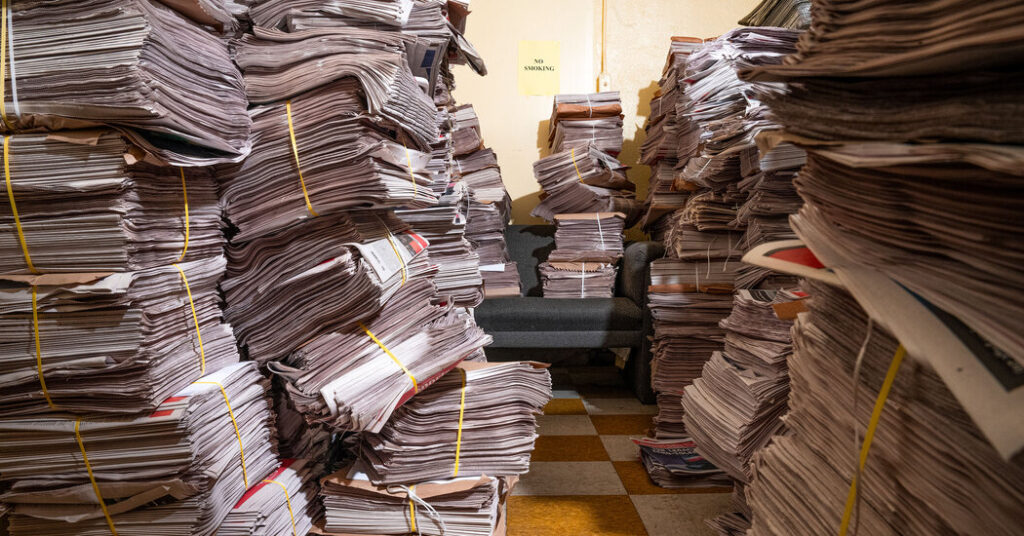
The Pittsburgh Post-Gazette, one of America’s oldest newspapers, announced this month that it would cease publication. The family-owned company that operates the paper made the announcement after a court ruled against it in a dispute with unionized workers. Pittsburgh is hardly alone. Since 2005, more than 3,500 newspapers have shuttered. On average, two close every week.
The consequences of the collapse of the local newspaper business have been severe. When communities lose their local news outlets, civic engagement drops, corruption rises, government waste increases and political polarization worsens. Communities no longer know themselves. No number of headlines about goings-on in Washington can change that.
But the death of The Pittsburgh Post-Gazette does not mean that Pittsburghers must go without local news. While the market failure of the newspaper business has been well documented, what is less known is how communities all over the country have responded to this crisis.
Hundreds of nonprofit local news organizations have sprung up, from Lafayette, La., to New Bedford, Mass., to Chicago. Rather than relying primarily on advertising revenue, nonprofit newsrooms are sustained by coalitions of philanthropic institutions, local businesses, individual donors and readers. Under this model, local journalism is treated as a public good, essential to civic life, akin to a museum or a food bank.
Many of these nonprofits started within the past decade. They operate where audiences can be most easily found today: online and in email inboxes. There’s less focus on print and newsstands. This new generation of local nonprofit outlets — some of which are supported by the American Journalism Project, where I work — has already distinguished itself with journalism of the highest quality. In the past three years, the Pulitzer Prize for local reporting has been awarded entirely or jointly to a nonprofit newsroom that did not exist even a decade prior.
The excellent reporting by nonprofits includes the Pulitzer-winning work of Mississippi Today, founded in 2016, which exposed tens of millions of dollars in misused Mississippi state welfare money. The Indiana-based Mirror Indy uncovered systemic abuse at a mental health facility in Lawrence, Ind. In the run-up to the 2025 election, the Boyle Heights Beat in East Los Angeles reported a shortage of in-person polling centers; officials solved the problem as a result. The City, a nonprofit based in New York City, revealed allegedly corrupt practices within then-Mayor Eric Adams’s administration after a senior adviser attempted to give cash, memorably concealed in a bag of chips, to a reporter.
The success of these newsrooms suggests the problem facing local news is not a lack of public appetite but an outdated business model. The new approach is rapidly growing: The number of local nonprofit news outlets more than doubled from 2017 to 2022, according to the Institute for Nonprofit News. In Vermont, VTDigger boasts a monthly audience of 500,000 in a state with just over 600,000 people and now has an operating budget of $3 million, supported by reader donations, advertising and individual and institutional philanthropy alike. The Baltimore Banner brought in more than $13 million in revenue in 2024, with about half from subscriptions, a third from advertising and a fifth from donations.
Many work with established media companies in partnerships that allow online-only nonprofit newsrooms to distribute some of their work in legacy newspapers. And some legacy newspapers, like The Salt Lake Tribune, have become nonprofits.
The value of independent local journalism is acknowledged across our deep partisan divide. Last year, both Republican and Democratic state lawmakers cited The Texas Tribune in the documentation and analysis behind 25 separate bills. After a recent Texas state legislative election, two competing candidates jointly voiced support for another nonprofit, The Fort Worth Report, writing, “While we disagree on many issues, we agree on this.”
Thus far, nonprofit start-ups have not expanded nearly enough to replace the full depth of coverage that vanishes when a newspaper closes. Some, like The Houston Landing, have also closed. Members of the Institute for Nonprofit News now employ over 3,000 journalists, well below the 45,000 reporting and editing jobs lost at newspapers since 2005. These gaps are not abstractions: Reporters are eyes and ears at school board meetings, city halls and statehouses, probing for wrongdoing and holding the powerful to account. The concrete value of that work does not go unnoticed; even today, Americans continue to express far higher levels of trust in local news reporting than in national media.
The collapse of the newspaper industry unfolded over decades. Rebuilding local journalism will take time, money and community support.
In Pittsburgh, there are particular reasons for optimism. The city has a robust philanthropic community with a track record of investing in institutions that anchor public life. The city has world-class museums, universities, libraries and hospitals. As The Post-Gazette has shrunk, nonprofits like Spotlight PA, Pittsburgh’s Public Source and the public radio station WESA have stepped in, as has the city’s other daily paper, The Tribune-Review. A chapter of the news-focused philanthropy group Press Forward was recently founded in the city, indicating recognition that the city has the ingredients needed to ensure local journalism still thrives.
The end of a venerable newspaper is disheartening. But it does not have to mean the end of local journalism — in Pittsburgh or anywhere else.
Sarabeth Berman is the chief executive of the American Journalism Project.
The Times is committed to publishing a diversity of letters to the editor. We’d like to hear what you think about this or any of our articles. Here are some tips. And here’s our email: [email protected].
Follow the New York Times Opinion section on Facebook, Instagram, TikTok, Bluesky, WhatsApp and Threads.
The post Local Newspapers Are Closing. Local News Is Surviving. appeared first on New York Times.