BRUSSELS — European Union leaders on Saturday signed a landmark trade agreement with South American nations to create what they have trumpeted as the world’s largest free-trade zone.
This deal is more than 25 years in the making. But its culmination comes at a time when the E.U. is moving with a new, urgent sense of purpose, as President Donald Trump upends long-standing alliances and the norms of global trade.
The E.U. voted this month, despite stiff opposition from some of its 27 nations, to approve the deal with the trade bloc Mercosur, which includes South America’s two biggest economies, Brazil and Argentina, and Paraguay and Uruguay. The pact will cut tariffs on an array of signature products from Argentine beef to German cars.
The deal was praised by leaders of both blocs. “This moment is not only about bringing countries closer together but about connecting continents,” European Commission President Ursula von der Leyen said to repeated rounds of applause at the signing ceremony on Saturday in Asuncion, the capital of Paraguay.
“It is basically the symbol of a new partnership between Mercosur and Europe,” von der Leyen said. “We are creating the largest free trade zone in the world. We are creating a market of 700 million people and a GDP of almost 20 percent of the global GDP is being traded here. This is phenomenal.”
Without naming Trump, she rebuked the tariff-loving U.S. president who on Saturday announced new punitive levies against European allies that oppose his desire to take over Greenland. “This agreement sends a very strong message to the world,” von der Leyen said. “It reflects a clear and deliberate choice. We choose fair trade over tariffs. We choose a productive, long-term partnership over isolation. And above all, we intend to deliver real and tangible benefits to our people and our businesses”
Argentine President Javier Milei also trumpeted the deal “As a prophet from a dystopian future, Argentina understands first-hand that confinement and protectionism — supported by rhetoric, instead of results — are the main causes of economic stagnation and poverty growth,” Milei said. “To rethink instruments, to accelerate processes, and to adapt negotiation schemes to the pace of the global economy — it is a necessity, not an option.”
Trump’s tariff blitz, and his administration’s wavering interest in being responsible for European security and general disdain for the E.U., have spurred a push to “diversify” and “de-risk” from the United States. Europe is looking for other friends and hedging its bets.
As jilted U.S. allies such as Europe and Canada close ranks against Washington, the E.U. has sped up trade talks with Malaysia, the United Arab Emirates and other countries. In the fall, the bloc inked a trade accord with Indonesia and now hopes to clinch a big one with India.
European Commission President Ursula von der Leyen, head of the E.U.’s executive branch, has declared that Europe is charting its own course. “Only if we are economically strong, we can secure our independence,” she said before traveling to South America.
European officials have emphasized the contrast between establishing a free-trade zone of more than 700 million people and Trump’s approach of imposing tariffs, suspending cooperation on climate, health and international aid and threatening military force.
With South America balancing its interests vis-à-vis the United States and China, E.U. leaders have cast the Mercosur deal as a way to assert the bloc as a global player — and a steady hand in troubled times.
Still, the push has also created friction. The bloc has grappled with its own strained relationship with Beijing and economic competition from China. And securing the backing of all 27 E.U. member countries in trade negotiations is tough, given conflicting national priorities.
The treaty now goes before the European Parliament for ratification, which could take months. Opponents, including in France and Poland, are threatening to sink it.
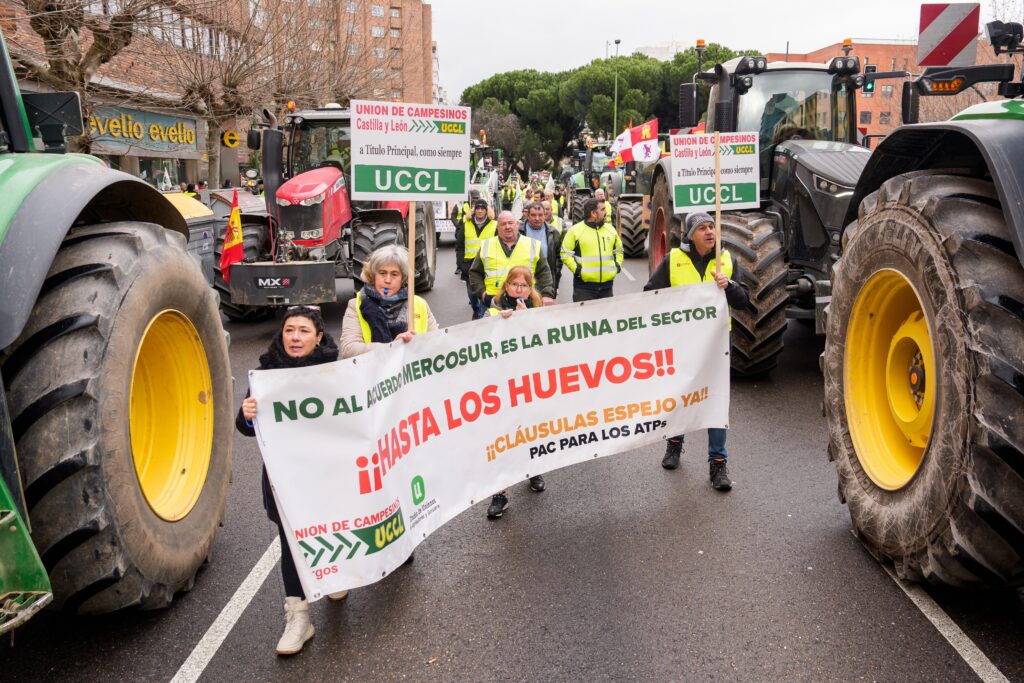
Critics have expressed concern over environmental protection and deforestation. Farmers and beef and poultry producers, an economic pillar and powerful lobby, argue that an influx of cheaper goods from South America produced with looser standards would dent their livelihoods.
France, Poland and Italy sought to block or water down the deal. But Trump’s tariffs and domestic political turmoil in France may have left even Paris, historically an E.U. heavyweight, with little sway.
“Other member states were of the view that we cannot really delay this much further — that there would be a huge loss of credibility for the European Union if it cannot go ahead at this time,” said former E.U. trade negotiator Ignacio García Bercero, a senior fellow at the Brussels research institute Bruegel.
The Mercosur deal long predates Trump, Bercero said. “Now it is clear, however, that in the current geopolitical context, concluding this type of agreement is more important than ever. When we are facing a very disruptive situation, not only with the United States, but also China, it becomes more important than ever to consolidate your trade agreements, to expand your alliances.”
As the E.U.’s 27 heads of state and government debated the deal in December, European farmers rumbled into Brussels on tractors to protest. French farmers did the same on the streets of Paris this week, blocking roads near the Eiffel Tower, and have pledged to clog the streets again next week in Strasbourg.
But other industries are keen to tap into the South American market. German carmakers, for example, buffeted by Chinese competition and U.S. tariffs, welcomed the deal.
The European Commission made 11th-hour concessions, including billions in agricultural aid, which brought Italian Prime Minister Giorgia Meloni onside and ultimately secured a majority for the green light last week.
The commission, which says it addressed grievances with safeguards and quotas on South American imports, will focus now on winning the support of the European Parliament, according to trade spokesman Olof Gill. The commission has “built in every necessary protection for our farmers,” Gill said. He described the deal as “a geopolitical signal.”
European Council President António Costa, pledged the deal would not only benefit European businesses but also “boost the EU’s sovereignty and strategic autonomy.”
E.U. leaders attempted to avert a costly confrontation with Trump by signing a skeletal trade deal last year. Still, they have tried to show that despite U.S. protectionism, they can lead in maintaining open and orderly global markets.
Economists expect the Mercosur deal will mean only a limited boost for the E.U. economy. E.U. exports to Mercosur countries stood at around 55 billion euros in 2023, while exports to the U.S. were over 500 billion euros.
Its “overall economic impact remains modest,” analysts at ING, the global bank headquartered in Amsterdam, wrote this week. Even so, they added, the “true value of the deal goes beyond simple economics.”
“It sends strong signals to the U.S. and China” that the E.U. is serious about curbing reliance, ING analysis said, and could create momentum to finalize other languishing talks, including with India. “For the E.U., this is not just about trade — it’s about securing strategic resources and counterbalancing global competitors.”
If ratified, the agreement would deepen E.U. ties to a region in which China is the largest trading partner and which the Trump administration has declared to be a U.S. sphere of dominance. Trump this month ordered strikes on Venezuela, which borders Brazil, and U.S. forces captured President Nicolás Maduro.
Venezuela was suspended from Mercosur a decade ago over trade and human rights concerns. Bolivia, which recently joined, can eventually join the E.U. trade deal.
Beatriz Rios contributed to this report.
The post E.U., spurred by Trump’s tariffs, signs free-trade deal with South America appeared first on Washington Post.