I missed the Grateful Dead. Jerry Garcia died in 1995, the same year I was born, yet I am still possessed by the band’s music. I was raised in the orbit of Deadheads; my dad was a casual fan, and his sisters, twins, were devoted: they followed the band on the road in the 1980s. When I got my first iPod, my parents had filled it with songs burned from my dad’s CDs. Songs like “St. Stephen,” with its ambiguous yet beautiful lyrics, changed my idea of what music could be: “Wishing well with a golden bell / Bucket hanging clear to hell.”
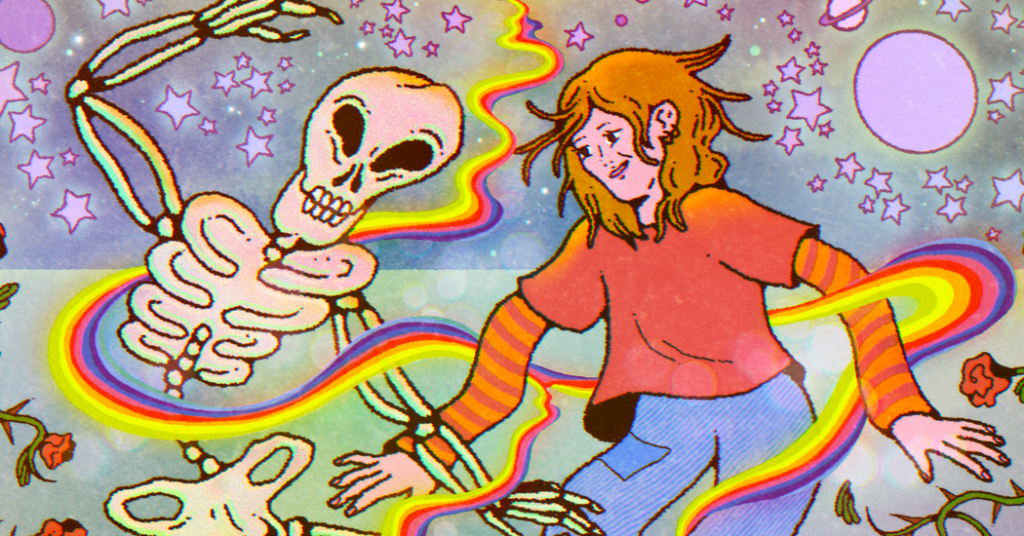
The long shadow of the band loomed over my childhood in San Francisco in other ways, too. In thrift shops I’d visit in Haight-Ashbury, the skeletons and skulls that symbolized the band were everywhere, frightening me. But the band itself was a thing of the past, like the Beatles, like Cary Grant, like plenty of other cultural icons that my parents introduced me to over the course of my childhood. The fact that many members of the original band were still alive and touring in other Dead-adjacent formations (Furthur, RatDog, etc.) didn’t make an impression. I thought that my experience of the Dead would be through playlists.
It wasn’t particularly cool to be a young person who liked the Dead back then. They certainly are an acquired taste, especially in recordings of their live shows. Not everyone wants to listen to a 15-minute version of “Eyes of the World” and compare it with an 11-minute version of “Eyes of the World” from 17 years earlier. In the 2010s, the Grateful Dead just wasn’t in the air; it wasn’t of our time.
In 2011 something unlikely happened that changed that. The pop star John Mayer heard the song “Althea” by chance on Pandora. Mr. Mayer had never been a Deadhead, but he was hooked. Like many before him, he dived in headfirst. He learned a lot of the Dead’s songs. Eventually he approached Bob Weir, a songwriter and guitarist in the band, to see if he’d be interested in playing together. They started performing together, with others, including some original members of the band, as Dead & Company. This version of the Dead soon began to fill stadiums.
It was in the era of Dead & Company, when I was in my mid-20s, that I came back to the music. During the pandemic, I had started listening obsessively to old shows in the Internet Archive’s Grateful Dead collection — a fantastic compendium of bootleg recordings of whole concerts that fans had made over the years. I was interested in the lost world this music conjured, a world of free-spirited teenagers like my aunts who had left home young and hit the road. What could I learn about them, and myself, by listening? I was returning to the bygone world of my own childhood, too, the already-vanished San Francisco where I no longer lived.
In the intervening years, I had grown up. I began to understand the music differently; the Dead have a reputation for being a party band, and they certainly can be — there is plenty of “dancin’ in the streets” to be had. But the music is also colored by darkness. This should have been obvious to me, even from the band’s name, from the skulls nestled alongside the roses, but it wasn’t something I really heard until the pandemic, when death knocked on every door. I came to understand how the escapism involved in following the Dead was not only about chasing joy and wearing scarlet begonias in your hair; it was also a mode of coping by running away. Many people in and around the band — and the people with them on the road — suffered from addiction, were in accidents, died younger than they should have. Even Jerry, who was just 53. The best of the songs are as full of loss as they are of life, and it was something about this combination, and the way you could never predict where a song would go — not really — that pulled me in.
How often do we get a second chance to board a ship of fools that has already sailed? How often do we get to glimpse something we thought we’d missed, that we’d never seen before and thought we never would? It’s rare, and I was lucky.
I saw a good run of Dead & Company shows, at Citi Field, Fenway Park, Oracle Park, the Sphere in Las Vegas. I was stunned by and taken in by the crowd — the parking lots outside baseball stadiums where people sold merch and burritos and mushrooms out of bags and nitrous-filled balloons and mandalas. The vans, the T-shirts, the psychedelia, the symbols of hippiedom in all its different shades: People flocked to it all with religious fervor. The D.I.Y. tie-dye spirit had been repackaged in an upscale, watered-down form for millennials, by brands like Online Ceramics. Did it amount to a kind of cosplay, as some older fans grumbled? Who was I to say? I hadn’t been around back then. I went to these shows with a group of friends around my age who became closer friends as a result, and with friends of their friends who became my friends. We were almost all second-generation Deadheads, in our 20s and 30s.
I met people who had been going to shows since the late ’60s. I met kids. I met a lot of younger people like me, whose passing interest in the Dead had been reignited by the possibility of actually attending concerts that, at least in terms of scale and set list, mimicked the ones we never got to see. (The band even played “Drums” and “Space,” two interludes of experimental noodling that were a mainstay of the original Dead shows.) We were enfolded in a version of a culture that had preceded us, and in it we glimpsed certain possibilities, or I did. A friend, watching two “spinners” — people who twirl hypnotically to the music for long, intense stretches, whirling-dervish style — observed that society wasn’t really built for spinners anymore. That’s true, but then, it never really was: The pointless exercise of dizzying dancing exists outside of a culture obsessed with productivity, where even most hobbies seem in service of self-improvement; spinning, meanwhile, is simply spinning.
Yet on these evenings the world did belong to spinners. We learned that there are other ways to live. We could live in intimacy with strangers who shared a fervor for something that had no real purpose. It was just music.
Onstage, Dead & Company weren’t trying to resurrect Jerry, which would have been impossible anyway. Nor were they doing what so many other bands of earlier eras have done: trotting themselves out to play the same hits over and over, the forever tour that keeps on keeping on. Dead & Company did something distinct and yet faithful, walking that thin line between what used to be and what is now. I felt this overlapping of timelines at shows, my own timelines and the collective ones. My friends and I had all seen the photos and the footage, inflected with the grainy aura of long ago, and had listened to versions of these songs from 1972, from 1989, from 1992. With the spellbinding drop of “Morning Dew,” or the jubilant, overlapping guitars of “Playing in the Band,” I was both remembering and anticipating, straining to hear where the music was going. Because in one sense I knew, and in another I didn’t. You were never sure what the band was going to do. That was the magic.
Bob Weir died last week at 78. Mr. Weir was the heart of Dead & Company, as I saw it; Mr. Mayer had star power, but Mr. Weir was the embodiment of how the Dead seemed to cheat time. It’s hard to prove, but he once plausibly estimated that he’d spent more time playing guitar in front of live audiences than any other living person. Mr. Weir had always been the Grateful Dead’s closest approximation of a rock star, handsome in a ponytail and short shorts. He managed to become its elder statesman, with his shock of white hair and his often bare feet, and he kept this latest project connected in some way to the past while making it new. I hesitate to declare another “end” to the Dead, which has already had so many ends and new beginnings. It’s true, though, that with Mr. Weir’s death something has come to an end. But, as with the music itself, we never actually know where things are going.
Sophie Haigney is working on her first book, a collection of essays about collecting. She is the web editor at The Paris Review.
The Times is committed to publishing a diversity of letters to the editor. We’d like to hear what you think about this or any of our articles. Here are some tips. And here’s our email: [email protected].
Follow the New York Times Opinion section on Facebook, Instagram, TikTok, Bluesky, WhatsApp and Threads.
The post You’re Never Too Young to Love the Grateful Dead appeared first on New York Times.