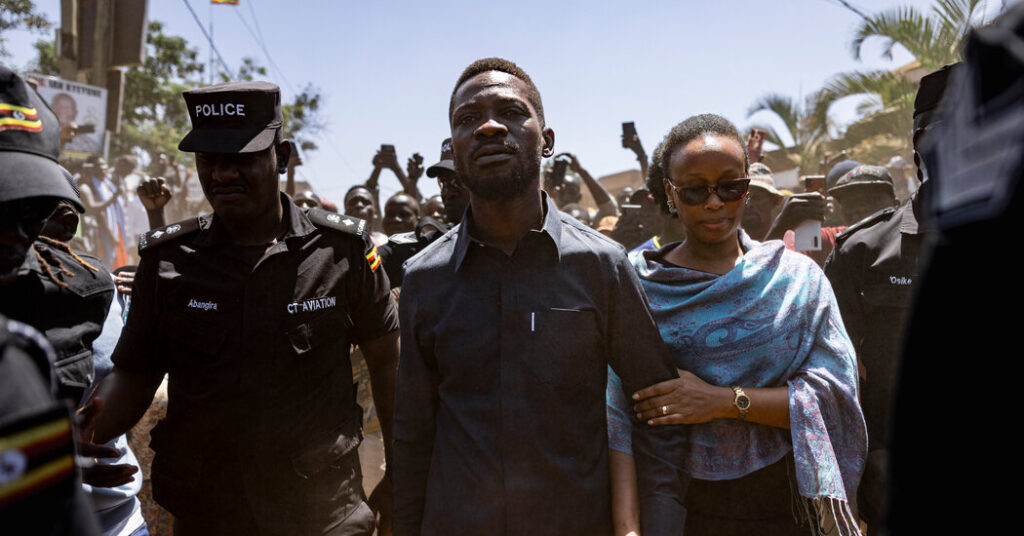
The main opposition leader in Uganda was “restricted” to his home, the Ugandan police said on Saturday morning, before an expected announcement by the country’s electoral commission that President Yoweri Museveni had won re-election.
The opposition leader, Bobi Wine, who challenged Mr. Museveni in the election, is at his home near the capital, Kampala, the police spokesman Rusoke Kituuma said at a news conference on Saturday. He added: “His home is restricted because we don’t want it to be used as a springboard for inciting violence.”
Late on Friday, Mr. Wine’s party, the National Unity Platform, said on social media that he had been abducted and that Ugandan security forces had landed a helicopter on the grounds of his mansion outside the capital, Kampala.
On Saturday, the party’s secretary general, David Lewis, said in a telephone interview that he could not confirm the accuracy of that social media post, which was on X. By midmorning, the post appeared to have been deleted. Mr. Wine would communicate for himself, Mr. Lewis said.
Neither the party’s statements nor the precise location of Mr. Wine could be independently verified. Since Tuesday, Ugandan authorities have cut access to the internet nationwide, severely limiting communication in the country.
The internet blackout was a measure to stop the spread of misinformation that could potentially be weaponized, the government said. The effect has been to dramatically reduce the information flow available to most Ugandans and to block their ability to communicate by email, social media and WhatsApp.
Mr. Museveni, 81, has ruled Uganda for four decades since he fought his way to power at the head of a rebellion in 1986. An election win would give him five more years in office. Partial results from the vote, which was on Thursday, were announced by the electoral commission, whose leaders were appointed by the president. They showed him far ahead of Mr. Wine or any of the other presidential candidates.
The Ugandan authorities have deployed a heavy police and military presence to the streets of Kampala in recent days in an effort to forestall protests. Analysts have said it is part of a strategy to minimize the need for what could be a more heavy-handed response should violence begin.
The internet blackout has also made it more difficult for opposition supporters to organize in the capital.
In an interview at his home on Monday, Mr. Wine, who became famous as a pop star before entering politics, hinted that he thought he might lose the election, saying that he feared rigging and warning that in the event of defeat he would call for protests. He also predicted that the internet would be cut and that he would be placed under house arrest.
“I am hounded everywhere by the police and the military,” Mr. Wine said. “I don’t know where I’m going to be. I don’t know where my fellow leaders are going to be, but we know that the people of Uganda will be there.”
Mr. Wine also challenged the ruling National Resistance Movement party in 2021. The ruling party was rattled but ultimately easily prevailed. Dozens of people were killed during the 2021 campaign, and Mr. Wine was detained and beaten several times.
This time, few people gave Mr. Wine, 43, a realistic chance of victory. His campaign, though energetic, has been weakened by defections and a lack of money.
The ruling party has also been able to deploy significant institutional advantages, given the dominance it has established during decades in power. Mr. Museveni’s central argument to voters is that the country has made huge gains in terms of stability and economic growth under his leadership.
Given his age, however, many Ugandans are focused on who might succeed him as president. Mr. Museveni’s son, Gen. Muhoozi Kainerugaba, who heads the country’s armed forces, is viewed as the most likely successor.
Matthew Mpoke Bigg is a London-based reporter on the Live team at The Times, which covers breaking and developing news.
The post Uganda Opposition Leader Bobi Wine Is ‘Restricted’ to His Home, the Police Say appeared first on New York Times.