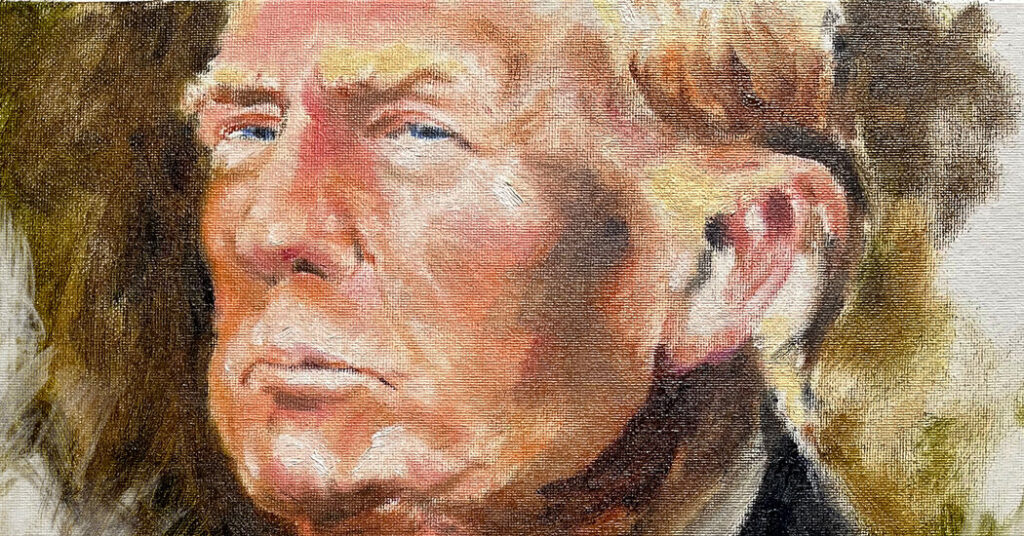
Donald Trump spent his first term as the frustrated caretaker of the decaying Victorian mansion called the American conservative movement — floating plans to tear it down and build anew but mostly just knocking down a few walls, adding a gilded bathroom, doing some renovations that the residents had long desired (the Federalist Society Ballroom got a special shine-up) while letting mold and time do its work on the Limited Government Wing.
His second term has been a different story. The smoke of demolition is everywhere, cranes are swinging wildly, and if the shape of the original building is still vaguely visible through the smoke, it’s clear that the final renovation is going to be radical. More of the original residents have fled to nearby properties (you can see a bunch of them clustered in the Mike Pence Gazebo), while others have barricaded themselves inside the True Conservatism Suite, where folks are pouring tea and wearing earplugs. A bunch of newcomers are throwing up competing additions (the A.I. Tower is a shiny spire overshadowing the Based Medieval Turret and the Garden of Cronyism), and the contractors are having a fistfight in the Hall of Christian Zionism.
Out front, emblazoned with the Trump logo, a builder’s sign promises, “Future Home of American Nationalism Inc.”
Trump is abnormal in a million ways, but demolitions like this one are a regular feature of American politics. Political coalitions come and go; alliances and clusters of ideas outlive their usefulness; time and chance happen to us all. The Whigs and the Mugwumps and the Progressives all had their day and departed. No one should be surprised if the movement that William F. Buckley Jr. and Barry Goldwater forged and Ronald Reagan brought to power is giving way to a quite different mode of right-wing politics.
But we’re in an odd position because the new mode can be defined only broadly; the specifics are so tightly bound to the whims and charisma of one man that it’s hard to visualize exactly what shape it will take when he’s no longer the president.
It’s not that Trump alone is the decider, since the overall process of destruction and renovation is linked to the deeper forces that have made nationalism potent the world over. Against that backdrop, we can predict that a nationalist right will be more intensely focused on American interests in foreign policy, less internationalist and idealistic than prior incarnations of conservatism. We can assume that it will be more open to government interventions in the economy than the laissez-faire or libertarian style of right-wing politics. We can take for granted that it will be more concerned with issues of immigration and national identity and immigration and less engaged with the cultural issues that motivated the religious right. And we can expect it to be more radical — more reactionary in some ways, more futurist in others than — than the Burkean conservatism it has seemingly displaced.
But within that broad outline a great many things are up for grabs. And because Trump is such a volatile figure, so determined not to bind himself to any permanent commitment, he’s presiding over a transformation that will remain inherently unsettled and incomplete as long as he’s in charge.
This makes his historical influence somewhat hard to classify. In his first term, Trump appeared to fit the political scientist Stephen Skowronek’s theory of what he called “disjunctive” presidents — figures like Jimmy Carter, Herbert Hoover and John Quincy Adams who unhappily straddle transitions between old orders and emerging ones and who reveal the necessity of a transition without mastering or defining it.
In his more empowered and triumphant form, Trump has clearly transcended that label. He’s responsible for bringing certain aspects of the conservative era to completion — the fall of Roe v. Wade, the big judicial and political swing against affirmative action, the triumph of unitary executive theories of presidential power — to a degree that would have seemed unlikely in 2017. At the same time, he’s buried other aspects of the conservative era, like Reaganite foreign policy idealism and socially conservative moralism, more completely than was the case when Pence was one of the leading voices of his administration.
Likewise, he’s made the old institutions of movement conservatism, think tanks and magazines, even Fox News, seem superannuated or irrelevant while presiding over a transition to the new forms forged in imitation of his success — the world where podcasters and influencers and online celebrities set the terms of conservative debate, where political allegiances are inseparable from personal feuds and grievances.
But if all this means that Trump is now much more significant and transformative than a disjunctive figure like Carter, he still doesn’t quite match Skowronek’s description of “reconstructive” presidents, figures like Reagan and Franklin Roosevelt who gave a new political era its full shape. For one thing, Trump is not especially popular, and his party doesn’t seem well positioned to achieve the decade-plus of dominance that we associate with the Reagan and New Deal coalitions. A broad right-of-center coalition was visible immediately after Trump’s defeat of Kamala Harris, but it’s been receding for the past year as the administration has alienated non-MAGA voters.
For another, the new nationalist era is still defined primarily negatively, in terms of things that probably won’t return to Republican politics any time soon: the nation-building efforts of George W. Bush, the immigration amnesty of the Reagan era, the sweeping changes to entitlements pushed by Paul Ryan, the buttoned-up moralism of Pence. In terms of a positive agenda, there are a lot of very different ways that the Republican Party of 2028 or 2032 could be nationalist, and many of the fiercest battles inside the Trump coalition — especially the great influencer war that broke out after Charlie Kirk’s assassination — reflect fundamental divisions over what, exactly, a nationalist right should want.
Consider a few examples. First, in foreign policy, a nationalist right could be isolationist or realist or imperialist. It could play global great-power politics with the cold-eyed gaze of Henry Kissinger and Richard Nixon, aim for a “come home, America” agenda in the style of Pat Buchanan and maybe now Marjorie Taylor Greene or try to split the difference with a Donroe Doctrine that dominates Latin America but cedes ground outside the Western Hemisphere.
.op-aside { display: none; border-top: 1px solid var(–color-stroke-tertiary,#C7C7C7); border-bottom: 1px solid var(–color-stroke-tertiary,#C7C7C7); font-family: nyt-franklin, helvetica, sans-serif; flex-direction: row; justify-content: space-between; padding-top: 1.25rem; padding-bottom: 1.25rem; position: relative; max-width: 600px; margin: 2rem 20px; }
.op-aside p { margin: 0; font-family: nyt-franklin, helvetica, sans-serif; font-size: 1rem; line-height: 1.3rem; margin-top: 0.4rem; margin-right: 2rem; font-weight: 600; flex-grow: 1; }
.SHA_opinionPrompt_0325_1_Prompt .op-aside { display: flex; }
@media (min-width: 640px) { .op-aside { margin: 2rem auto; } }
.op-buttonWrap { visibility: hidden; display: flex; right: 42px; position: absolute; background: var(–color-background-inverseSecondary, hsla(0,0%,21.18%,1)); border-radius: 3px; height: 25px; padding: 0 10px; align-items: center; justify-content: center; top: calc((100% – 25px) / 2); }
.op-copiedText { font-size: 0.75rem; line-height: 0.75rem; color: var(–color-content-inversePrimary, #fff); white-space: pre; margin-top: 1px; }
.op-button { display: flex; border: 1px solid var(–color-stroke-tertiary, #C7C7C7); height: 2rem; width: 2rem; background: transparent; border-radius: 50%; cursor: pointer; margin: auto; padding-inline: 6px; flex-direction: column; justify-content: center; flex-shrink: 0; }
.op-button:hover { background-color: var(–color-background-tertiary, #EBEBEB); }
.op-button path { fill: var(–color-content-primary,#121212); }
Know someone who would want to read this? Share the column.
Trump himself has bounced among these perspectives, lately disappointing the isolationists with his willingness to pursue regime change (albeit on the cheap), while he swings between imperialism and realism depending on whether the last person in the room whispered “Greenland” in his ear or reminded him that Vladimir Putin keeps giving the finger to his overtures.
But for the future, the world of 2028 and beyond, Trump has said and done enough conflicting things that a nationalist successor could reasonably claim to be Trumpian while having a more consistently hawkish or dovish policy, while confronting China or giving ground, while backing Israel to the hilt or backing away from the special relationship. “America first” rules out certain kinds of neoconservative internationalism, but it otherwise allows for a host of competing possibilities, from a future in which nationalist foreign policy is defined by an erstwhile neocon like Marco Rubio to a future in which it’s defined by Tucker Carlson.
Then, too, the future of nationalist economic policy could go in multiple directions, depending on who inherits Trump’s mantle and which thinkers and interests have his successor’s ear.
If nationalism allows for more government intervention in the economy than the previous Republican consensus, that doesn’t tell you what kind of intervention or to what end. Does the tech right become an enduring source of funds and influence, with the big Trumpian bet on artificial intelligence extending toward the singularity, or does anti-A.I. backlash bring Steve Bannon’s critique of Silicon Valley back to the fore? Do the attempts to build a more solidaristic nationalism through family policy and industrial policy have their day (don’t bet on it), or is nationalism mostly made manifest as a cronyist support for favored companies and industries? Does the one powerful policy holdover from the era of movement conservatism, the taboo on tax hikes for the rich, endure if deficits become more crushing or inflation becomes worse?
Likewise with culture and national identity. Is the of future right-wing nationalism multiracial, like the coalition that Trump won with in 2024, or is it more white-identitarian, like the edgelords who are gaining online market share and writing social media copy for the Department of Homeland Security? Are secure borders enough to bind the right, or will a vote for post-Trump Republican always be a vote for the aggressive-yet-shambolic mass deportation efforts that we’re witnessing play out in Minneapolis right now?
If the nationalist right is multiracial, what binds its vision of Americanism together? A revived Christianity? A lukewarm civic religion of the kind that the most based Republicans disdain? And if it’s more racialist and white-identitarian, how can it hope to govern a country where mainstream opinion and swing voters remain conspicuously neither? Trump’s unique status as a personalist vessel for incompatible ideas has postponed some of these questions. A JD Vance- or Rubio- or Ron DeSantis-led right would need to answer them more concretely.
Finally, does a nationalist right accept constitutional norms or seek to unbind the presidency completely? Trump’s second term is much more Caesarist than his first one. But it’s also been constrained so far by his inability to marshal the kind of legislative power that Roosevelt enjoyed, which in turn is linked to both his self-defeating politics of enmity and his failure to command majority support from the public for any sustained length of time.
Do his successors look at this record and draw the lesson that they need to be more politically popular and sensitive to mainstream opinion, more engaged with policy and legislation, less inclined to alienate allies in the Congress or the courts?
Or do they look at the record and say that what’s needed is just even more Caesarism, the Franco-esque figure of some online imaginings, the Augustus to end our late-republican disorder?
I have my own set of preferences. Give me a future nationalist right that is realist and internationalist in foreign policy; that balances national solidarity and technological dynamism in economic policy; that aims for a multiracial, religiously informed understanding of Americanness; that’s open to constitutional evolution but grounds its fundamental legitimacy in democratic majorities.
This vision might be fanciful — but not simply because it’s in tension with some of the more demagogic elements in Trumpism. Any coherent set of nationalist ideas would be in tension with various elements in Trumpism because an essential volatility is inherent to his political profile, his way of being in the world.
This means that if the new nationalism ever fully stabilizes (and it might well not; the current president could have similarly volatile successors), Trump will not be remembered as the founder, the institution builder, the Rooseveltian reconstructor of political order.
Instead he will be a much stranger historical character, requiring a presidential category all his own. In the political-science literature, a new phrase will be needed to describe a figure who moved history so decisively, who revealed so much and created so many novel possibilities but whose legacy was demolition and gaudy towers built with weak foundations, awaiting a true founding to be finished.
Perhaps the word they’ll be looking for is “developer.”
The Times is committed to publishing a diversity of letters to the editor. We’d like to hear what you think about this or any of our articles. Here are some tips. And here’s our email: [email protected].
Follow the New York Times Opinion section on Facebook, Instagram, TikTok, Bluesky, WhatsApp and Threads.
The post Trump’s Second Term Has Ended the Conservative Era appeared first on New York Times.