President Trump established a new committee on Friday to oversee the Gaza Strip as it is rebuilt, composed primarily of top American diplomatic officials, including his son-in-law.
As part of the peace plan he negotiated in the fall, Mr. Trump also named the U.S. general overseeing special operations in the Middle East to lead the military force that will be deployed to Gaza to disarm Hamas and occupy the Palestinian enclave during the yearslong campaign to rebuild it. The White House did not immediately answer a question about whether American troops will be part of that force.
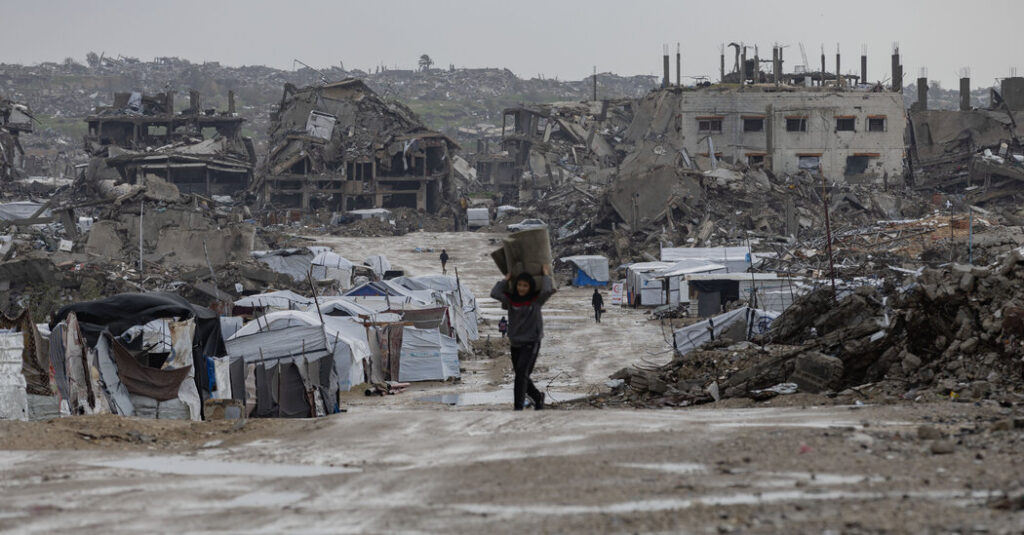
Mr. Trump’s announcement, delivered in a White House statement, gave some of the first hints of the power structure that will govern the Palestinian enclave after more than two years of war that has killed more than 71,000 Palestinians and at least 1,671 Israelis. Most of Gaza has been destroyed by Israeli bombardment in the fighting.
The challenges facing Mr. Trump’s peace plan will be enormous. Even after a cease-fire agreement went into effect in October, hundreds of Palestinians have been killed by the Israeli military, which maintains a near-constant bombardment of the Gaza Strip, demolishing thousands of buildings. Ali Shaath, a Palestinian official tapped by Mr. Trump to help govern the enclave, said on Thursday that it would take three years just to clear the rubble from the bombed-out cities.
Mr. Trump’s “Board of Peace,” which he named himself the chairman of, is backed by a legal United Nations mandate and had previously been expected to be composed of world leaders who would supervise the Trump administration’s plan for an “International Stabilization Force” to occupy, demilitarize and govern Gaza during a yearslong reconstruction effort.
But the list of officials on the executive board announced on Monday included three members of the Trump administration — Secretary of State Marco Rubio, Steve Witkoff and Robert Gabriel — as well as Jared Kushner, Mr. Trump’s son-in-law; Ajay Banga, the head of the World Bank; the billionaire Trump ally Marc Rowan; and former Prime Minister Tony Blair of Britain. Of the seven, only Mr. Blair is not American, and he was previously the Middle East envoy for the Quartet, a diplomatic group made up of the United States, Russia, the United Nations and the European Union, and considered a candidate to lead a transitional government in Gaza.
A second executive board, similarly named the “Gaza executive board,” includes a wider roster of foreign officials from Europe and the Middle East, and is implied to be in a supporting role. Some American officials sit on both executive boards, as well as Mr. Blair.
Maj. Gen. Jasper Jeffers, the commander of U.S. Special Operations Command Central, which operates in the Middle East, was also tapped to lead the “International Stabilization Force,” the peacekeeping force authorized by the United Nations to be deployed to Gaza as part of the peace plan. General Jeffers previously helped oversee a brokered cease-fire between Israel and Lebanon last year.
It is not clear how the international force would ensure that Gaza is demilitarized. Hamas, which specializes in insurgent tactics and has not disbanded its battalions of armed fighters, has long regarded giving up all its weapons as tantamount to surrender, with armed struggle against Israel a crucial part of its ideology. On Thursday, Mr. Trump threatened Hamas with a renewed conflict if they did not disarm, writing on social media: “they can do this the easy way, or the hard way.”
The overwhelmingly American presence on the Board of Peace, and the U.S. military leadership of the international peacekeeping force that will occupy the Gaza Strip, reflects Mr. Trump’s strong hand in overseeing the cease-fire agreement and reconstruction plan for Gaza — the terms of which were largely dictated by Mr. Trump and his administration. Even as hundreds continue to be killed amid the fragile cease-fire, Mr. Trump has counted Gaza among a growing list of wars that he claims to have ended.
When the United Nations Security Council approved Mr. Trump’s peace plan, Russia and China said they had abstained from the vote because the United States had not provided more details on how the Board of Peace would function and whether it would establish a Palestinian state.
The separation of powers and authority remains unclear among the executive board, the Gaza executive board and a third panel of Palestinian technocrats who are expected to manage the day-to-day administration of the enclave’s government. And the relationship between the three authorities — one dominated by Americans, a larger council with a broader international roster and a third composed of Palestinians — is likely to be fraught with tensions over how exactly Gaza should be governed and rebuilt.
The U.N. resolution authorized the Board of Peace to oversee Gaza at least until the end of 2027, while stipulating that the Palestinian enclave would be managed day to day by the panel of Palestinian technocrats, known as the National Committee for the Administration of Gaza. The Trump administration is expected to name the full panel, headed by Mr. Shaath, a former Palestinian deputy minister for planning, in the coming days.
Chris Cameron is a Times reporter covering Washington, focusing on breaking news and the Trump administration.
The post Trump Announces Largely American Council to Oversee Gaza appeared first on New York Times.