The vehicles all jolted to a stop — S.U.V.s full of masked immigration agents and cars carrying activists and journalists who had been tailing them — and in what felt like less than a second, everyone was out on the frozen Minneapolis street corner, facing off.
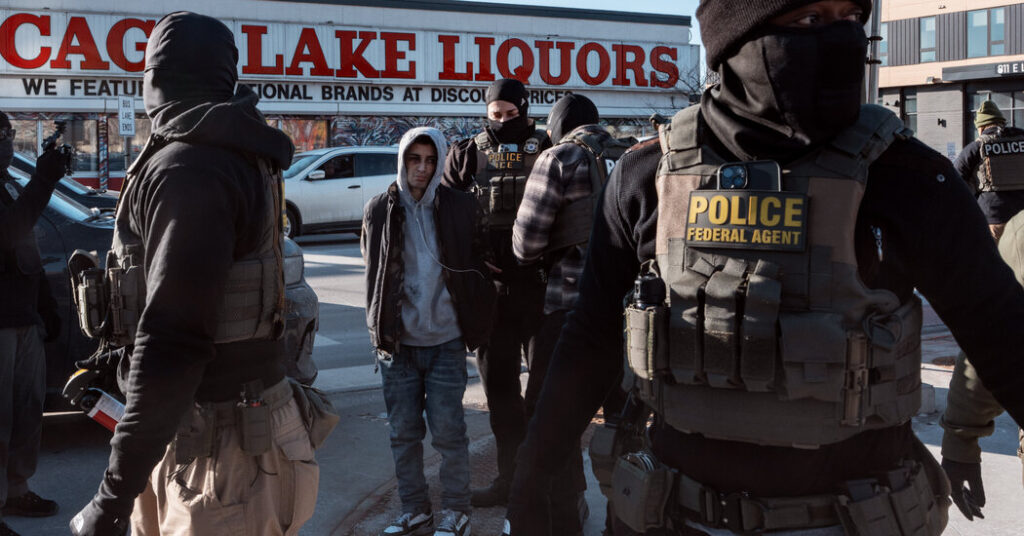
Car horns and sirens and the screech of whistles from the activists almost drowned out the profanities hurled at the ICE agents. Men in military-style uniforms descended from an S.U.V., pointing cans of pepper spray at the cars. Other federal agents were already surrounding a man in a hoodie who had been standing at a bus stop on Lake Street.
Activists scrambled toward the bus stop, some of them masked as well. Blowing their whistles, they held their phones aloft to shoot video, trying to alert the whole block: ICE is here. ICE is here, arresting someone. Expletives and pepper spray spattered the crowd. The agents stuck the man in the back of a car and were gone.
Fear and fury can explode on any street corner during this charged time in Minneapolis, any time, any place the muscle of the federal government meets the rage of the citizens who reject its tactics.
Thousands of people attended a march last Saturday to mourn Renee Good, the woman an ICE agent had shot and killed days earlier. There have been school walkouts, daily protests outside the federal building where agents take detainees, four-person protests on frigid street corners and an hourslong demonstration after an ICE agent shot a man in the leg while attempting to detain him on Wednesday night.
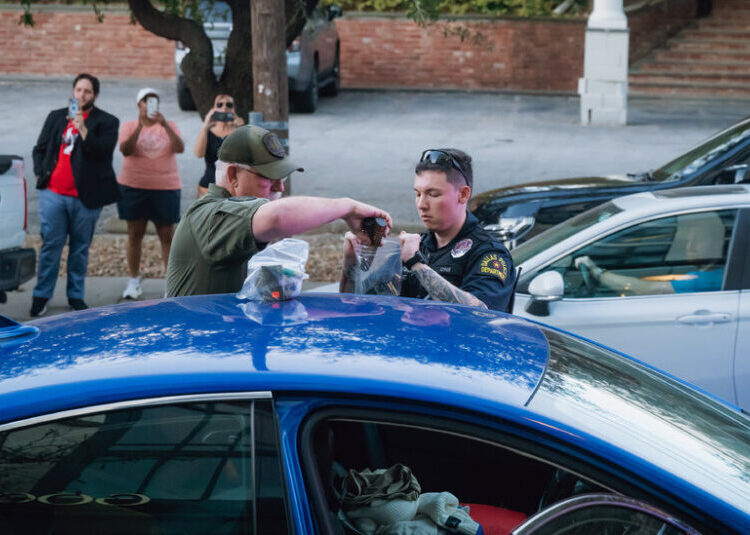
But the city’s defiance toward the thousands of federal agents surging into Minneapolis also looks like this: locals using their cars, whistles, phones and local networks to monitor and confront the agents wherever they can, sticking close to them to complicate their efforts, like cornerbacks guarding wide receivers.
It is a cat-and-mouse game with a global audience, high stakes and a looming element of danger. Activists are pressing against a gray zone of legality as they try to confront heavily armed federal agents they accuse of doing far worse.
Many of the protesters are white, though others, including Native Americans, have participated. Several white protesters and volunteers said they felt that they had a special responsibility to stand up for neighbors who they said would be vulnerable to targeting by ICE.
These white volunteers also said they had been motivated to get involved after Ms. Good’s killing on Jan. 7.
The Trump administration has said an immigration crackdown in Minnesota is necessary to combat widespread fraud in the state, especially in Minnesota’s Somali community, which President Trump has repeatedly derided and insulted.
Mr. Trump and other federal officials have asserted that the ICE agent who killed Ms. Good acted “in self-defense,” statements Minnesota officials have rejected. A New York Times analysis of videos of the shooting contradicts the Trump administration’s account.
Driving around in their own cars in shifts, scanning the streets for vehicles they think are suspicious — often large American-made S.U.V.s with out-of-state license plates — the volunteers report sightings to neighborhood group chats.
On a recent day on East Lake Street, a normally busy commercial strip, most of its immigrant-owned businesses were closed: Employees and customers were afraid to leave their homes.
Midmorning, the sound of car horns and whistles interrupted the frozen quiet. A dark S.U.V. came hurtling down the street, followed by two activist cars in hot, loud pursuit. Then another S.U.V. sped in the other direction, pursued by another convoy of activists. Traffic yielded to let them pass.
Activists say they are instructed not to break traffic laws while following ICE and to record interactions and arrests, but not to obstruct the arrests. The point, they say, is to document what they call ICE’s abuses, to identify and record ICE vehicles to make it easier for everyone to spot them and to make ICE aware that agents are being watched. They also want to waste the agents’ time by forcing them to elude activists’ cars — time that agents could otherwise use on detentions.
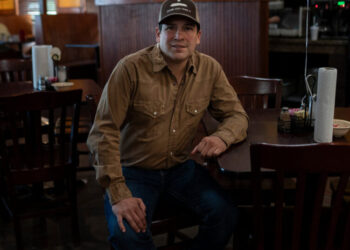
“Thanks for a lot of American people, because they’re helping us a lot,” said Miguel Sanchez, 57, a florist at one of the few businesses still open at the Mercado Central, a mini-mall of Latino businesses on East Lake Street. The mall’s usual entrances were locked and guarded by a few volunteers who stood on the corner, whistles around their necks. Just inside the door were coffee, Mexican pastries and stacks of beanies for the volunteers.
The ICE-on-activist encounters can quickly turn heated. Videos taken in Minneapolis have shown ICE agents dragging volunteers from their cars or arresting them after they followed ICE vehicles.
A federal judge in Minnesota on Friday ordered agents not to retaliate against people “engaging in peaceful and unobstructive protest activity.” The judge said agents could not use pepper spray on such protesters or stop or detain protesters in vehicles who were not “forcibly obstructing or interfering with” agents.
Not long after the bus stop arrest on Wednesday, at the intersection of two quiet residential streets, a black S.U.V. carrying ICE agents pulled around to block the cars that had been following it. One of the agents got out, touching off a barrage of honking and whistling.
“Quit chasing,” he warned the activists. “Quit running through red lights.”
But by then people were out of their cars, a dozen of them or more, in no mood to back down.
“Get out, get out, get out, get out,” a woman screamed. Her fury had her bent forward, aiming her words at them, fists back. “Get out of our city! Get out of our city! Get! Out! Get! Out!”
Later that night, word spread through social media that ICE agents had shot someone on the north side of the city. A crowd soon gathered there and stayed for hours, slipping over the icy streets and sidewalks, lobbing insults at the ICE agents arrayed behind police tape: “You Nazi pig!” “Bunch of cowards!”
Bullhorns relayed the protesters’ refrain, over and over: “Go! Home!”
The crowd shrank when the agents threw tear-gas canisters and sting ball grenades that set off earsplitting bangs and showers of bright lights, to which protesters responded by throwing fireworks. The crowd then grew again when one of the tear-gas canisters hit a car carrying young children, including an infant, prompting emergency responders to rush the children to the hospital.
The next morning, the city was quiet. Neighborhood group chats had few reported ICE sightings. Two friends who had set out in their car to patrol their neighborhood did laps on East Lake Street for more than two hours without seeing anything.
Then, during their afternoon shift, someone monitoring the area on foot alerted the group chat that an S.U.V. carrying ICE agents had been spotted in an Auto Zone parking lot. The friends arrived just in time to see the S.U.V. pulling out. They did a quick U-turn to follow it.
“Leave them alone!” a woman yelled at the activists.
The driver lobbed an expletive back and tailed the S.U.V. onto the highway. The passenger took down its Idaho license plate number for future reference. But the ICE agents soon ran a red light and disappeared. The volunteers were left stranded at the light.
Vivian Yee is a Times reporter covering North Africa and the broader Middle East. She is based in Cairo.
The post The People of Minneapolis vs. ICE: A Street-Level View appeared first on New York Times.