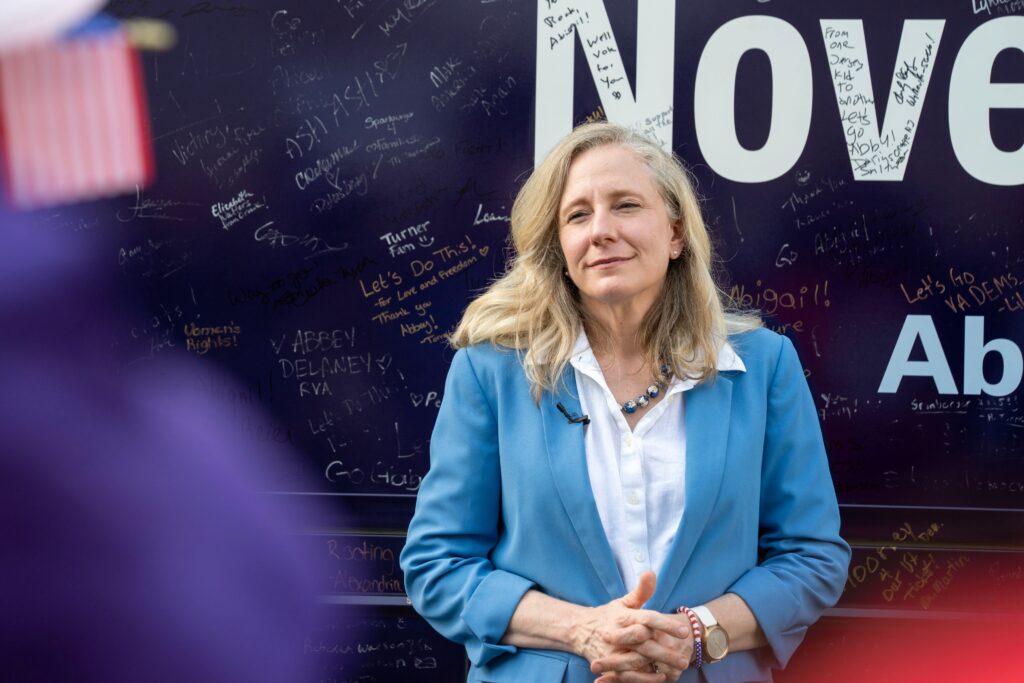
Virginia Gov. Abigail Spanberger (D) quickly moved to shift leadership at the state’s universities in her first hours in office Saturday, appointing 27 people to fill board seats at three public colleges and signing an executive order directing her administration to review the appointment process.
The nominations came less than a day after five board members at the University of Virginia, including its two leaders and a major donor to the school, resigned under pressure from Spanberger. All had been appointed under her predecessor, Republican Glenn Youngkin.
Among Spanberger’s picks were former Democratic governor Ralph Northam to the board of the Virginia Military Institute and several former board members at George Mason University and U-Va. As governor, Northam, a VMI graduate, orderedan investigation into the school’s treatment of Black students.
Spanberger also selected former George Mason rector Tom Davis, a former Republican congressman, to return to that board six years after he announced the hiring of current university President Gregory Washington, who has faced conservative calls for his removalover his diversity, equity and inclusion policies. Carlos Brown will return to U-Va., where he served as vice rector until July.
The appointments, if confirmed by Virginia legislators, mean the Democrat’s appointees would hold a majority on the boards at George Mason and U-Va. early in her term. Typically, Virginia governors have appointed about a quarter of university board seats each year.
At U-Va., the state’s flagship university in Charlottesville, board rector Rachel Sheridan and vice rector Porter Wilkinson stepped down Friday, along with Paul Manning, who’s donated $100 million to the university, Stephen Long and Douglas Wetmore, according to letters obtained by The Washington Post and other people familiar with the matter.
In letters, Sheridan and Wilkinson touted their accomplishments on the board and said they hoped the newly appointed university president, Scott C. Beardsley, would be allowed to continue leading the school. Sheridan said her and other members’ efforts to do right by the university had become “paralyzed through purposeful political warfare.”
“It is a distressing fact of civic life in the United States that toxic national politics converts every disagreement, even among well-meaning people who share the same hopes and believe in many of the same values, into a pitched battle of competing camps,” Sheridan wrote to Youngkin.
The shake-up on the board came as other state Democrats signaled they would move quickly to unwind some changes made at Virginia colleges during the Youngkin administration.
Jay Jones (D), who was sworn in Saturday as attorney general, dismissed the general counsels at George Mason and VMI. Democratic legislators also vowed to make more changes in how the state’s public colleges are governed.
The governing boards at U-Va., George Mason and VMI had several vacancies in recent months after state Democratic senators rejected picks made by Youngkin. Spanberger had previously said she intended to quickly fill the vacant seats at those three schools, which have each undergone turmoil this year.
On Saturday, Spanberger appointed 10 people to the board of U-Va. and its affiliated schools, along with five people to VMI and 12 to George Mason.
The three universities have faced intense scrutiny from the Trump administration and other conservatives in the past year over DEI policies, the response to antisemitism and the provision of gender transition care, among other topics.
In February, conservatives on the governing board at VMI declined to renew the contract of retired Army Maj. Gen. Cedric Wins, the military institute’s first Black leader, after years of tension over his DEI policies. George Mason has been the focus of multiple federal investigations, with Washington — that school’s first Black leader — often being the direct target of conservatives’ ire.
At U-Va., former president James E. Ryan resignedlast summer amid pressure from the Trump administration and complaints that he and other university leaders had not moved quickly enough to unwind diversity-related initiatives. The U-Va. board chose Beardsley as new president last month, despite a request from Spanberger to wait.
Democrats and some students, faculty and alumni at colleges have criticized what they have called an inappropriate intrusion on university operations by the federal government. They also questioned how the governing boards at the institutions — dominated by Youngkin appointees — led the schools during those conflicts. Some board members also faced calls to resign.
On Friday, news that Spanberger had sought the resignation of U-Va. board members quickly drew criticism, including from Virginia state senators. Spanberger’s request was first reported by the New York Times.
The Jefferson Council, a conservative alumni group, said Spanberger’s request was “not only legally questionable, it clearly represents a dangerous highly politicized power grab.”
“This action by Governor-elect Spanberger is unprecedented in the history of the Commonwealth and represents an extraordinary abuse of executive power,” the group said in a statement.
More shifts at George Mason, VMI
Meanwhile, additional leadership shake-ups were in the works at two other Virginia colleges.
George Mason University counsel K. Anne Gambrill Gentry and associate counsel Eli Schlam, along with VMI general counsel Patrick O’Leary, were notified this week by Jones’s office that Friday would be their last full days as their universities’ top attorneys, according to a VMI spokesperson and an email from Gentry reviewed by The Post.
Jones’s office did not respond to a request for comment Friday.
Gentry had been appointed by former state attorney general Jason S. Miyares (R), whose office also did not respond to a request for comment.
In Virginia, university counsels currently are named by and report to the office of the state’s attorney general. Their service, which includes providing legal guidance to the school in lawsuits and other operations, typically can span multiple administrations.
But as Miyares took office in 2022, he fired the top counsels at U-Va. and George Mason. At the time, a Miyares spokesperson said it was common for incoming attorneys general to appoint counsel that shares their “philosophy and legal approach.” U-Va.’s counsel, Tim Heaphy, had also been on leave as he led a House investigation into the Jan. 6, 2021, insurrection at the U.S. Capitol.
George Mason officials did not respond to a request for comment.
Democratic state legislators are also considering changes to appointments to university boards, including whether to extend terms to six years.
In another sign of change at George Mason, rector Charles “Cully” Stimson tendered his resignation Friday in a letter obtained by The Post. Youngkin appointed Stimson to serve on the board in 2023.
Stimson, who has been George Mason’s rector since July 2024, has overseen the board as it sought to dismantle DEI and pare back other policies it saw as too liberal.
New VMI board appointee Northam attended Spanberger’s inauguration Saturday, along with all but one of Virginia’s living former governors. Long after most of the others had left, Northam stayed and watched VMI cadets in the parade.
Gregory S. Schneider contributed to this report.
The post Spanberger names 27 to Virginia college boards, including Northam at VMI appeared first on Washington Post.