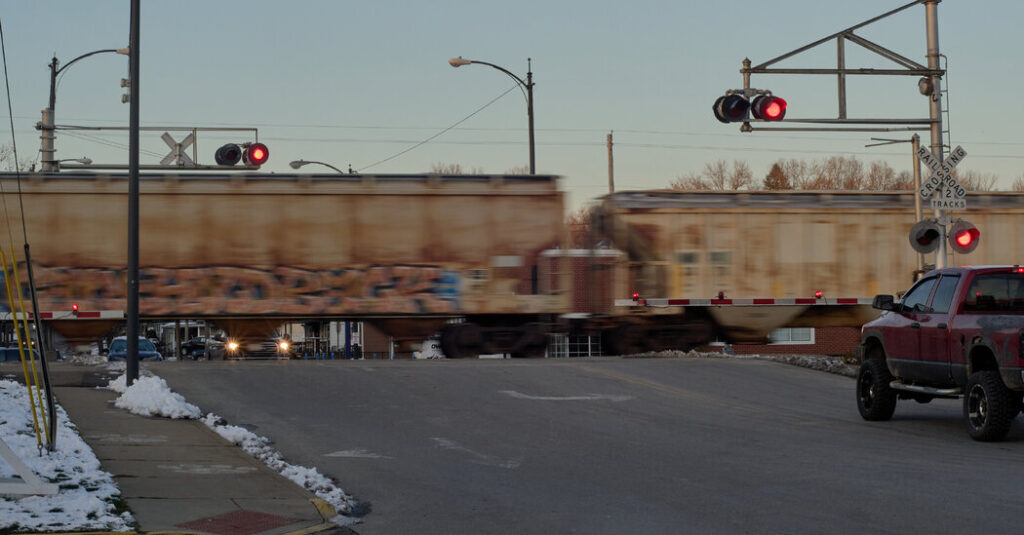
Norfolk Southern’s freight trains still barrel through East Palestine, Ohio, passing close to the building where Kari Brieck intends to move her pet grooming business this year.
She set up the business last year with the help of an $18,000 personal injury payment from Norfolk Southern. One of the company’s trains derailed here in February 2023, dealing a huge blow to the town of 4,700.
Days after the crash, the authorities carried out a controlled burn of hazardous chemicals in five of the overturned rail cars, sending vast plumes of dark smoke over the town — an act that federal safety regulators later said was unnecessary. Ms. Brieck’s home is a third of a mile from the crash site. Since the accident, she has had heart problems, and her son had to have a lymph node removed.
Despite those trials, Ms. Brieck, 33, said she was committed to staying in East Palestine. “I want people to know you can still thrive in an environment that was previously damaged,” she said.
It has been three long years in the battle to save the economy of this town, which sits on the Pennsylvania border, about 50 miles northwest of Pittsburgh.
Like other small Rust Belt towns, East Palestine has found it hard over the years to recover after big employers — like the large pottery makers that the town was known for — shut down. The Covid-19 pandemic slammed businesses in the town, and just as they were trying to regain their footing, the rail disaster occurred.
“You just get punched in the face again with the train derailment,” said Antonio Diaz-Guy, East Palestine’s manager, a municipal post that involves attracting investment.
Temporary evacuations of residents meant less spending in the town. Fewer people came in from Pennsylvania to buy gas and alcoholic beverages, which can be cheaper in Ohio.
Wanting to help, Mr. Diaz-Guy left his job at a logistics company last year to take over the village manager role. He has deep roots in the town. His father was a migrant orchard worker when he met his mother in a laundromat in East Palestine. (She still does her laundry there every Sunday.)
One way Mr. Diaz-Guy hopes to woo businesses is to offer them speedy permitting. To do that, he set up the town’s own commercial permitting department, allowing firms to avoid the often long process of going through Ohio’s state permitting portal. Already, he said, five projects are getting expedited permitting, including an 85-acre business park and a new brewpub in a rail building that Norfolk Southern partly renovated.
“East Palestine has historically not been prepared to accept opportunity when it presents itself,” Mr. Diaz-Guy said. “We’re fixing that.”
But some businesses left for good, depleting the town’s tax revenue.
Edwin Wang, an entrepreneur from New Jersey, set up three businesses with some 45 employees in East Palestine just months before the derailment. They included two factories that made heat-resistant industrial products, and one of them was next to the derailment site.
Mr. Wang closed his businesses.
“We lost our customers,” he said, “and we lost our engineers and technicians. They are all working for our competitors now.”
Mr. Wang is suing Norfolk Southern for $500 million in damages. A second attempt at mediating a settlement recently failed.
In 2024, Norfolk Southern reached a $600 million class action settlement with residents and some businesses. It also agreed with federal agencies to pay more than $310 million to settle claims and cover costs stemming from the derailment, though Ohio’s attorney general chose not to join the deal, calling it inadequate.
The Atlanta-based railroad last year agreed to be acquired by Union Pacific, an even larger rail company. Regulators still have to assess the deal, a process that could extend into 2027.
East Palestine’s mayor, Trent Conaway, said he had developed good relations with employees at Norfolk Southern, which he could draw on when the town needed something from the company. Mr. Conaway said he feared that the merged company might be less responsive.
“It is a big company and a big merger, and you wonder how that’s going to affect the future,” he said.
In a recent merger document, Union Pacific and Norfolk Southern said that if they combined, they would “honor Norfolk Southern’s commitments to East Palestine and the surrounding communities.”
Some in East Palestine said they wanted the disaster to lead to an overhaul of national rail safety regulations so that other towns would not experience a similar accident.
The derailment happened after a rail car’s wheel bearing overheated and caused an axle to break. Norfolk Southern had detectors on its tracks approaching East Palestine to pick up overheated bearings, but they may have been too far apart to avert the disaster.
Norfolk Southern has installed 265 detectors since the accident, giving it a total of 1,184, a spokeswoman said. Norfolk Southern reported 15 derailments on its mainline tracks in the first 10 months of last year. That was up from 12 in all of 2024, but well below an average of 41 in the five years through 2023.
Within weeks of the derailment, a bipartisan group of senators, including Ohio’s JD Vance, introduced a sweeping railway safety bill that, among other things, would have required rail companies to have an adequate number of detectors.
Donald J. Trump, who got 72 percent of the vote in East Palestine in the last presidential election, supported the bill, calling it “terrific” in 2023. But the bill faced opposition from the powerful freight rail lobby, which said it didn’t properly address safety challenges. It never was put to a full vote in the Senate.
Mr. Conaway, who said he had voted for Mr. Trump in 2024 and who spoke at the Republican convention that year, said the failure to pass legislation was “a little frustrating.”
The White House did not say whether it planned to apply pressure on Congress this year to move rail legislation.
“From Day 1, President Trump and Vice President Vance have used every lever of executive power to ensure the people of East Palestine receive the support they deserve,” Kush Desai, a White House spokesman, said in a statement. “Through a multiagency effort, the Trump administration has surged resources to the environmental cleanup, invested millions of dollars to monitor health effects across the community and will continue to hold rail carriers to strict safety standards. We are in this for the long haul.”
Mr. Desai noted that during the first year of Mr. Trump’s second term, the Department of Transportation had increased track inspections nearly 19 percent from 2024 and had overseen a decrease in train accidents.
Mr. Vance was instrumental in getting the National Institutes of Health to set up a $10 million grant to study the long-term health effects from the derailment, according to a 2025 announcement from the agency.
Federal regulators measuring air and groundwater said it was safe for residents to return to East Palestine soon after the derailment, but many in the town still fear for their health, and some scientific researchers say there are grounds for concern.
Dr. Beatrice Golomb, a professor of medicine at the University of California, San Diego, said there were cases in which chemicals could appear to be at safe levels in the environment but could become harmful when they interacted. This was the case for many veterans of the 1991 gulf war who suffered from fatigue, cognitive difficulties and chronic pain, she said. (The Centers for Disease Control and Prevention formally recognized gulf war illness last year.)
In a survey of 55 people exposed to the East Palestine derailment, done by Dr. Golomb and others, nearly three-fourths had gulf war illness symptoms.
“What we’re seeing in East Palestine strongly mirrors the findings in the gulf war,” Dr. Golomb said.
Misti Allison, who is chair of the community advisory board for a long-term health study in East Palestine, said she had decided not to settle with Norfolk Southern for a personal injury payment. She said she wanted to be able to sue for much larger sums if she or her family got sick from the derailment in the future.
“If my kids get cancer in the future, I want them to be held accountable,” she said.
But many residents did settle, and have been waiting for months for their payments from the $600 million agreement. In a video presentation in 2024, a lawyer for the claimants said they could expect $25,000 in personal injury payments. But some, like Ms. Brieck, the pet groomer, received significantly less.
“Nobody’s going to get the amount they promised,” she said.
The payments were delayed in part by a dispute between the claims administrator, Kroll Settlement Administration, and the class lawyers. A new administrator, Epiq, was appointed. It said that it had recently mailed checks for a portion of people’s personal injury awards but that it was currently unable to determine the full award amount.
Chaney Nezbeth, the chief executive of the Way Station, a charity that has been providing assistance to East Palestine residents, said the uncertainty surrounding the payments had been especially difficult for some people.
“I hate to use the word, but it is traumatizing,” she said.
Peter Eavis reports on the business of moving stuff around the world.
The post ‘Punched in the Face’ by a Rail Disaster, an Ohio Town Fights Its Way Back appeared first on New York Times.