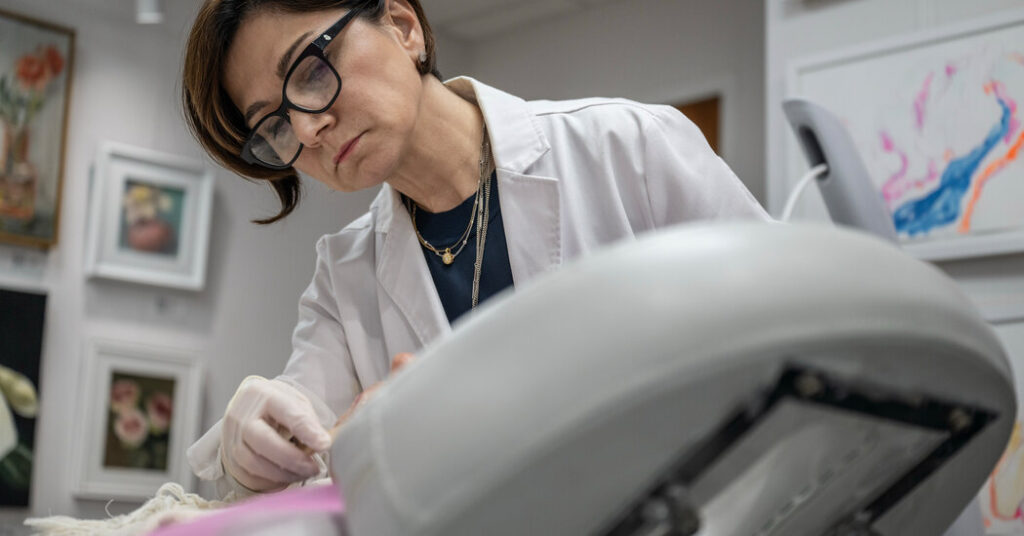
Dr. Jaishree Capoor was pushing her 91-year-old mother in a wheelchair along Fifth Avenue in Manhattan when a ground-level office caught her eye.
There was a private entrance, and a sign indicated that the office, in an apartment building on the corner of East 86th Street, was home to a medical practice for adolescents. On a whim, Dr. Capoor, a pediatric physiatrist who works with young people with cerebral palsy and other motor and developmental challenges, asked the office manager if any space was available.
It turned out, a consultation room had just been vacated, and Dr. Capoor sublet the space on weekends when the practice is closed.
The arrangement, which started in October and costs Dr. Capoor $500 a month, means her patients don’t have to miss school and their parents don’t have to take time off from work. And because the office is near the apartment she shares with her mother and sister, Dr. Capoor can quickly get home to help care for their mother, who has severe dementia, and be back in time for her next patient.
Dr. Capoor also works part time from an office in Queens and a therapy gym in Westchester County. The ad hoc arrangements give her access to patients in multiple areas while allowing her to maintain a low overhead.
“It’s like a micropractice,” she said.
Dr. Capoor is not the only New York physician with an independent practice who is cobbling together part-time, often transient arrangements, as rents rise and renovating spaces for medical use can be prohibitively expensive. In Manhattan, monthly asking rents average $58 per square foot for outpatient offices, according to JLL, a real estate services firm, which forecasts rising rents and declining office availability this year. And, on average, it costs $500 to $600 per square foot to make the spaces work for medical practices, said Matt Coursen, health care lead for U.S. leasing at JLL. A 2,211-square-foot space, average for an outpatient office in 2025, could end up costing over $128,000 a month.
The arrangements help doctors expand their practices without huge financial commitments. Many smaller practices have already been feeling the squeeze from bigger players like hospital groups and private equity firms, both of which have increasingly been buying up and consolidating solo practices. Nearly 80 percent of doctors nationwide work for hospitals or other corporate entities, according to a 2024 report from the Physicians Advocacy Institute. As of January 2024, 30 percent of U.S. physician practices were owned by corporations, doubling from about 15 percent in January 2019.
“Independent practice has gotten more difficult over the years,” said Hayden Rooke-Ley, a senior fellow at the Brown University School of Public Health who has done research on the corporatization and consolidation of the U.S. medical field. “Relative to large hospitals and corporate players, reimbursement for independent practice has declined and operating costs have grown, making access to capital more challenging.”
The rising demand for part-time, hybrid and short-term arrangements has created business opportunities for doctors who can afford to lease office space. Some are taking on the costs of making the spaces work for medical use with the intention that they’ll sublet some or all of those spaces to other physicians. Others are signing multiple leases and furnishing offices that can be booked on an as-needed basis. And more online platforms have sprung up in recent years to connect health professionals who need space with those who have it.
Dr. Maria Sokolina signed a 10-year lease in 2023 for a space on West 57th Street in Manhattan for her dentistry practice. The monthly rent is $6,000, and she spent about $500,000 renovating it and installing equipment.
To help cover her expenses, Dr. Sokolina, whose primary practice is in Clifton, N.J., shares her office with two other dentists. One uses the space once a week, and the other two days a week. Another physician, Dr. Zarui Chopuryan, uses one of the rooms in the evenings to offer collagen stimulation and other cosmetic treatments, after working in palliative care at Montefiore Medical Center in the Bronx during the day.
“I’m building up a practice,” said Dr. Chopuryan, who pays $1,500 a month for the room.
Dr. Masoud Saman, a plastic surgeon, placed an advertisement on a medical society website to rent out a spare exam room after he remodeled his office near Columbus Circle. He was looking for someone with a specialty that would complement his own.
“I’m the nose-job person here,” Dr. Saman said. “Someone who does eyelids would be a nice, symbiotic relationship.”
Real estate brokers are typically not involved in these off-market transactions. A doctor with an office may offer a licensing agreement for a year at a time to a colleague who needs the space for three hours every Friday. “It’s like a timeshare,” said Ruth Colp-Haber, president and chief executive of Wharton Property Advisors, a real estate brokerage. (Those working out of the space part time must have their own malpractice insurance.)
Therapists in particular have been scrambling for space after years of remote counseling during the pandemic. Some are seeing patients, for example, in law offices after those businesses have closed for the day, said Ms. Colp-Haber, whose company works with a firm offering such an arrangement.
Daniel Glazer, a clinical psychologist in the United Kingdom, co-founded US Therapy Rooms in 2021 and now has over 3,000 listings. Many of them offer part-time options, Dr. Glazer said, including monthly packages for space once a week ($400 to $700) and even by the hour ($30 to $50).
“Part-time arrangements have evolved from a niche offering to the new normal,” he added.
Batya Srolovitz, a psychotherapist who started a practice in October, used the platform to find her current setup: She is now one of seven mental health professionals who occupy a suite of offices on Manhattan’s Upper West Side. Each is subletting from a therapist who holds the lease.
Ms. Srolovitz sees patients there Mondays through Thursdays and recently placed an ad offering her office for use on Fridays, when she sees clients virtually, and weekends.
Kathleen Maher, another therapist, turned the need to rent an office for herself into a side business called TherapyHive.
Before the pandemic, she was leasing space in a building in the Flatiron district that she had divided into 38 offices for herself and other mental health professionals. When demand for in-person sessions dwindled during Covid, she set up a website with a reservation platform and furnished some offices so they can be booked on an as-needed basis. “I must own 16 couches now,” she said.
Carla Mannino, a psychotherapist and the owner of Gotham Psychotherapy, made a different kind of change during the pandemic. With landlords offering discounts on vacant spaces, she saw an opportunity to realize her dream of working in the Chrysler Building. She signed a one-year lease with Regus, a co-working company, for a corner office with a peek at one of the building’s famous gargoyles.
She took on more space cautiously, signing six-month leases at a time as she hired staff.
“At any point, I could pull the plug,” Dr. Mannino said.
By 2024, people were returning to offices and all of Regus’s space in the Chrysler Building was spoken for. But Dr. Mannino’s practice was still growing, so she added space in the nearby Chanin Building. An underground tunnel connects the two structures.
“We go through the tunnel all the time,” she said.
Dr. Mannino now has a staff of 25, and she is paying more for rent than she would if she were to sign a lease of her own elsewhere, she said. But she loves the arrangement.
“I don’t have to worry about HVAC or Verizon,” she said. “I’m 58 years old. I don’t want to sign a 10-year lease.”
The post ‘Like a Timeshare’: Doctors Get Creative as Rents Climb appeared first on New York Times.