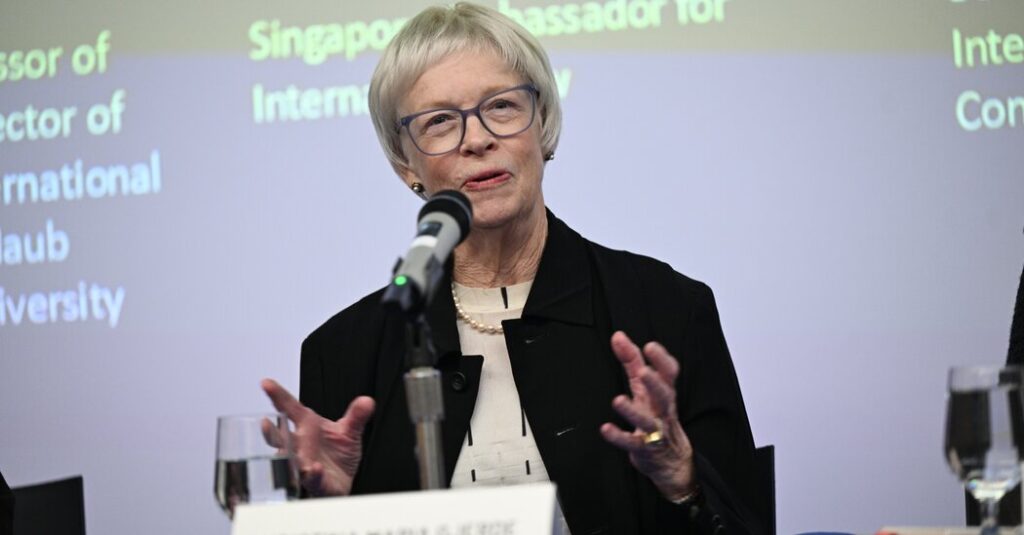
Kristina Gjerde, a marine conservationist who inspired and played a key role in negotiating a landmark United Nations treaty to protect the biodiversity of the high seas — the vast ocean waters beyond national coastlines — died in Boston on Dec. 26, just three weeks before the treaty went into effect this weekend. She was 68.
Her death, in a hospital, was from pancreatic cancer, said her husband, Adam de Sola Pool.
Ms. Gjerde (pronounced JERD-ee) was a maritime lawyer who in the 1980s abandoned commercial practice to become a conservationist after a snorkeling trip to the South Pacific, which opened her eyes to the wondrous world beneath the waves.
She steeped herself in ocean science and became one of the earliest and most effective advocates for protecting the high seas, the roughly two-thirds of the world’s oceans outside the jurisdiction of any country, which provide 90 percent of Earth’s habitat for life.
After years of planning and multiple rounds of negotiations, the U.N. adopted the High Seas Treaty in 2023. In September, Morocco became the 60th country to ratify it, setting off a 120-day countdown before it entered into force on Saturday.
Formally named the Biodiversity Beyond National Jurisdiction Agreement, the treaty calls for creating vast marine sanctuaries where fishing and other activities will be restricted, with a goal of conserving 30 percent of the ocean by 2030.
It is “a huge, big deal that has been decades in the making,” Jane Lubchenco, a top White House environmental science adviser under President Joseph R. Biden Jr., said in an interview.
The treaty would not exist without Ms. Gjerde, Dr. Lubchenco said. “Obviously she didn’t do it single-handedly,” she added. “But she was the heart and the soul and the brains of the negotiations.”
Ms. Gjerde was one of the first people to call for protections of marine life and for sustainable development in the waters beyond each nation’s exclusive economic zone, which extends 200 nautical miles from coastlines.
The area covered under the High Seas Treaty represents nearly half the Earth’s surface. It includes the largest known creature (the blue whale) and eerie inhabitants of deep-sea darkness like the anglerfish, which uses bioluminescence on a “fishing pole” to attract a meal.
A patchwork of agreements governs some activities on the high seas, like shipping and regional fisheries. But no comprehensive treaty had addressed biodiversity, which is under increasing threats from overfishing, the prospect of seabed mining and climate change. In a warming world, oceans have become hotter and more acidic, with less oxygen.
While 145 nations (including the United States) have signed the treaty, 83 (including China but not the U.S.) have also ratified it in their national legislatures, meaning they agree to be legally bound by the rules that emerge from further talks.
Those rules — including boundaries of marine sanctuaries and restrictions on economic activities within them — will be hammered out by the ratifying parties. Contentious issues still to be addressed include how to share the benefits from marine resources, such as a cancer treatment that might be found in a deep-sea sponge.
In the early 2000s, when the high seas were mostly out of sight and out of mind, Ms. Gjerde began writing scholarly papers about strategies for protecting the ecology of the open ocean. She co-founded advocacy groups, including the High Seas Alliance, the Sargasso Sea Alliance and the Deep Sea Conservation Coalition.
Her talents were for bringing parties together and, perhaps most of all, for recognizing that multinational agreements require a commitment to unsung bureaucratic processes rather than pure idealism.
During five negotiating sessions at the U.N., between 2018 and 2023, Ms. Gjerde had a seat at the table among diplomats because of her position as high seas adviser to the International Union for Conservation of Nature, a Switzerland-based organization of governments and civil society groups.
She wrote the first table of contents for what became the High Seas Treaty. When a draft text came out, she went through it paragraph by paragraph and gave suggestions.
“Because she was so trusted, a lot of countries took those suggestions,” said Minna Epps, the director of ocean policy for the international conservation union.
The final treaty “bore her fingerprints on every page,” Mark J. Spalding, the president of the Ocean Foundation, which raises money for marine conservation, wrote in a social media post after Ms. Gjerde’s death.
Kristina Maria Gjerde was born on Aug. 24, 1957, in Walnut Creek, Calif., the youngest of three children of Marion and Hildegard (Wolf) Gjerde. Her father was an elementary school teacher, and her mother was a laboratory researcher.
She received a bachelor’s degree in history from the University of California, Los Angeles, in 1981, and a law degree from New York University in 1984.
She spent four years practicing admiralty and corporate law at the New York firm of Lord Day & Lord, handling ship leases and shipping bankruptcies.
When she decided to switch to public interest law, she won a fellowship in marine policy at Woods Hole Oceanographic Institution in Massachusetts.
From 2003 to 2006, she was a Pew fellow in marine conservation, during which time she developed concepts for how law, science, economics and technology could together manage the ocean as a global commons — the prototype for the High Seas Treaty.
Starting in 2013, she was an adjunct professor of international marine environmental law at the Middlebury Institute of International Studies in Monterey, Calif.
Besides her husband, whom she married in 1988, she is survived by her son, Darius; her sister, Doreen Deniz; and her brother, Michael.
Her husband said in an interview that Ms. Gjerde realized that she was unlikely to live to see the High Seas Treaty become codified law. But she was thrilled when enough nations signed the agreement to give a green light for detailed rule-making to begin, including identifying the boundaries of marine sanctuaries.
“Like any good lawyer or policy person, she said, ‘The devil’s in the details,’” Mr. de Sola Pool recalled. “She knew there’s a lot of politics that will go into making an effective treaty versus a paper treaty.”
Trip Gabriel is a Times reporter on the Obituaries desk.
The post Kristina Gjerde, Advocate for Ocean Biodiversity, Dies at 68 appeared first on New York Times.