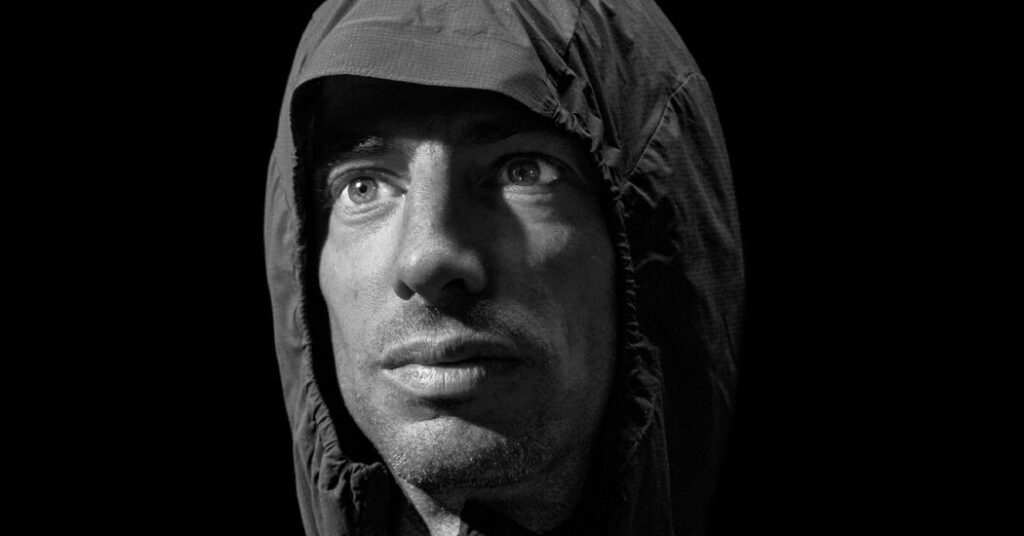
Imagine yourself on an isolated mountain pass. The wind is whipping, the air is thin, there is nothing around you except the sky and the sound of your feet hitting the craggy ground. Many of us have experienced the wonder and exertion that comes with a great hike in a wild landscape. These are places we may love to visit, but for Kílian Jornet, this is where he is most at home.
Jornet, 38, is a professional ultramarathoner and mountaineer whose life’s work is literally to run — or ski — up mountains. Even in the world of elite athletes, he is exceptional. Jornet holds the fastest known time for scaling Mont Blanc and the Matterhorn. He’s climbed Everest twice, in the span of a week, and he did it with no supplementary oxygen or support. His VO2 max (a key indicator of aerobic endurance) is one of the highest ever recorded; his stamina has been studied by researchers; and he has pushed the limits of what is considered physically possible.
Last fall, Jornet, who grew up in Spain and now lives in Norway with his trail-runner wife and their three children, flew to the United States and set off on his most radical (or cockamamie) challenge yet — an adventure he cooked up called States of Elevation. He climbed 72 of the highest peaks in the Western states over the course of a month, and, just for good measure, he also cycled between all of them — a ride totaling over 2,500 miles.
I’m exhausted just writing about it! But as I discovered in our conversation, Jornet is not just physically extreme; he is also a deep thinker who has important lessons to impart about what our bodies and minds are capable of when we push them, the joy — and danger — that effort can bring and the distinct, but no less difficult, challenges of everyday life on the ground.
Subscribe: Apple Podcasts | Spotify | YouTube | Amazon | iHeart
You’ve written that “what made me fall in love with traversing mountains at high speed is … the feeling it gives me of being naked and inconsequential, unrestrained. It brings me freedom and connection.” What are you connecting with? In the first instance, it’s to connect with oneself. We are overconnected with so many things. Every second we are getting information on social media, on the news, of things that are very far away, and we don’t often find the time to connect with ourselves, our body, our mind and with the people we love. When I run in the mountains, it’s to find this connection.
You’ve been connected to the mountain since you were a child. You grew up in a mountain lodge in the Pyrenees. Your father was a mountain guide, your mother was a teacher. What did your parents teach you about how to be in nature? What’s funny is that both of my parents were really far away from competition. They had a background of classical mountaineering, but it was never about competing and winning. It was always about exploring. I remember when we were kids, often before going to bed we would go out to the forest with my mother, and then we would close our headlamps to get back to the lodge. At the beginning, my sister and I were very scared. We don’t have any light! How will we find our lodge? And my mother was there saying, “Just listen to nature through other senses,” and we got more comfortable. So what they taught us was to accept the environment. Often we see nature as something that is external, and we go there to visit and to take pictures and say, Wow, that’s wonderful. And then we go back to our safe place. And probably what my parents taught us was just to feel calm there, to feel comfortable.
Even though your parents didn’t instill that competitive drive in you, you seem to have had it innately. You’ve said that as a teenager you discovered you had masochistic tendencies? I have been very competitive since I was a child. I loved to suffer, just to get out and push my body. Not many kids like to do that, especially teenagers. I loved to cycle for six, seven hours. My dream was an uphill that never ended. I just wanted to be climbing on my bike or running uphill forever. So I was going with grown-ups — all my friends doing that were in their 30s or 40s — and I remember many days I was going to school running 16 miles one way.
Oh my lord. I just loved that feeling of pushing the body.
I read a story that when you were in school, to test your body, you stopped eating for an entire week, only drinking water, and then five days into the experiment, you passed out midrun. Where does that impulse come from? I think it’s our nature to explore. And probably my curiosity was to explore my body to understand it better. I remember telling a friend: “Take all my food from my dorm, and if I don’t pass out, don’t give me anything, even if I really beg.” Four or five days later, I was just training normally and I passed out.
How do you know how far you can push yourself? With experience, you get to know your body pretty well. That’s very connected with the mind, too, and that’s where it gets tricky. Two years ago, on an expedition to Everest in the Himalaya, I was climbing not the normal route but a different route. I was alone, and at 8,200 meters I got hit by an avalanche and broke some ribs. I had a long way down — more than 15 hours to get down from that point. It was not good weather. I had not been eating for, I don’t know, 15 hours, and I was completely alone. Normally you need carbohydrates to get the energy at that level. But somehow you find resources in different ways. That’s how a parent can lift so much heavier weight than he or she would have thought if their child is in danger, or how in life-threatening situations we are able to develop strength or endurance that we didn’t think we were capable of. The limit is something we don’t want to reach, because it’s probably death after that. It’s a very fine line.
That’s a terrifying story. Were you scared? I wasn’t scared. I was alert, I would say. I think it’s important to be afraid many times and say, The conditions don’t look right, or I don’t feel ready for that, and turn around. It’s very important to listen to the fear. But when these situations come, I try to be calm and just accept it, and to leave all the panic because that’s only going to make me make bad decisions. The same comes from euphoria. Another time, I was climbing and I was feeling super strong and super good. I knew I was doing things that technically were at my limit, and I came to the summit and I felt superhuman, like I can do anything. The euphoria is as dangerous as the fear, because then you are blind. Mountaineering is very anticlimactic, because you are doing something very extreme on the emotional side, sometimes very close to death. You climb a summit, and you just want to be there, super excited. And your reason is saying: Just breathe and be calm and don’t think that you are strong. Just be reasonable.
Are you religious? Because it sounds very Buddhist in a way, like meditation where you’re taught to watch your emotions, watch the pain in your body, but look at it from a distance and not let it overtake you. I’m not a religious person, but climbing mountains is a sort of meditation in that you are very present in the moment. You need to focus so much on the movement you are executing that nothing else exists. I always joke that I’m not a smart person; I cannot do meditation like normal. I need to climb mountains and expose myself to find the same peace that you can do just sitting and meditating.
I spent time in Tibet, and their religious practice is actually movement. They do circumambulations of holy sites, and it is that exact practice of movement and focus to actually reach a state of enlightenment, if you will. In terms of sport, it’s kind of the same. Some things you can’t explain rationally. When I was doing the crossing in the Pyrenees and in the Alps in the last years, I had a lot of episodes of déjà vu that lasted for a very long time. I remember one time climbing in the Himalaya, I was completely without any nutrition. I had not been drinking or eating anything for more than 30 hours, and I was at 8,300 meters. I was in the middle of a storm, and I was hallucinating. I had a vision of a second person who was following me. I knew that it was a hallucination, but somehow I needed to save this person. I felt very responsible for this person. And I’m happy that I had this hallucination, because somehow having the responsibility to save this person, I didn’t give up, and I survived that day. If not, probably I would be dead in the mountains. So sometimes it feels that it’s our unconsciousness that is finding tools to keep us moving, to keep us alive.
Some people would say it was a miracle. Yeah, you could say it’s a miracle, or you can say that it’s just that when your rationale is not working anymore, your unconsciousness takes over and acts for you. You can call it whatever, but there are ways that we have to keep going that normally in our daily life we are not able to activate.
What are you thinking about when you’re putting one foot in front of the other in these wild spaces? If it’s a very demanding or very technical route, then you are just thinking about the next movement: If I go this direction or if I do this move, what’s the danger in the next two steps? So not really any deep thoughts. But then most of the time it’s just enjoying it. This past September, I was doing this long project in the U.S., from Colorado to Washington, States of Elevation, biking and running mostly in all these national parks. The nature is so wild, and it wasn’t demanding technically, so I could really enjoy the landscapes, arriving at a summit and seeing the sunrise and the shape of the mountains and having an encounter with an elk and being amazed.
It’s funny that you said it’s not demanding technically. Let me just describe what you did. This past fall, in just over a month, you ran up 72 of the tallest peaks in the lower 48, and if that wasn’t enough, you biked over 2,500 miles between them, basically, as one publication described it, you ran a marathon and rode a stage of the Tour de France every single day for a month. That wasn’t demanding? Yeah, it was very physically demanding. It was demanding for the body, but technically it wasn’t dangerous, and it was not technical climbing with the skills that I believe I have. But physically it was very challenging, mostly because it was so big and sometimes I went almost 60 hours without passing any village. So then you need to carry a lot of things, and that’s very physically demanding. The first week, I was feeling horrible. The altitude plus the dry air plus the physical effort that I was doing for more than 20 hours every day — I was on my edge. And then suddenly I really felt that my body stopped to fight those things and started to adapt. I don’t know how to describe it, but I really had this feeling of my body opening up and accepting what I was putting on it. At the end of the trip, I could have continued for another month. My body was feeling, That’s the new normal for this guy.
How were you sleeping? Well, I have three kids; they are very young. I joked with my wife, it was like taking a vacation there. I think I averaged four to five hours of sleep per night, which is the same I do at home now with the kids. I’m lucky that I don’t need much sleep to recover. Normally my average over the year is around six hours of sleep per night. We often think that we need to treat the body well, but sometimes if we try to protect our body at every cost — if we are never thirsty, never hungry, never tired, never stressed — the body will not develop the capabilities to fight those things. And I think it’s because I had been exposed very often to these things since I was a kid that I have been developing the capacities to adapt.
Another endurance athlete who has been in the mountains with you wrote that “it’s frankly not a great idea to rely on his” — meaning your — “judgment if you want to have a safe and fun time in the mountains.” I think he was talking about risk tolerance. How do you think about the risks you’re willing to take and the risks that you’re not? That’s one that I’m still trying to figure out. I know that my risk tolerance is high. It’s something that I am aware of. I try to be very analytical when I’m in the mountains, try to analyze the situation well and to know what I’m not good at. But sometimes I have been continuing in situations where I knew that I was rationally not comfortable with it, but somehow I felt OK with it. That’s something that I don’t want to experience much more, because I know that in the mountains a big part of surviving is luck, but you cannot rely on that all the time.
People have died doing what you do, and people close to you have died doing it. Your friend Stéphane Brosse died right in front of you in 2012. Can you recount what happened? We were in the Mont Blanc area in the Alps. Stéphane was an idol. When I started ski mountaineering, he was winning all the races, and then he became a friend. We were living nearby, so we started to do some projects together, and we had this project of crossing the Mont Blanc range in one push in the skis. We were almost finished and we were happy, just at the summit, enjoying. There were some birds flying around, and I remember we were smiling and laughing about where we were and how fun it was. And we were walking on the ridge and we didn’t notice that we were walking on a cornice. And because the wind is strong, the snow is compact but it’s not holding into the rock. So we were walking there and the snow broke in between our feet. He fell about 600 meters, and I was on the other side, and I stayed on the snow. For me, it was the first time. I grew up in a family of mountaineers, so I knew about the risk, I knew about death. But not until the point that it happened close to me did I really understand that, Yeah, that is real. I was, like, 20 years old. He was 40 years old with a family, and I felt like it would be so much easier if I died instead of him. It took me a long time to accept that. And probably the years after I was taking too many risks in the mountain just to try to see if it was a mistake that he died instead of me.
It’s interesting to me that you didn’t deal with that death by taking a step back. You actually pushed yourself harder. Why? To try to see if it was me who was meant to die in the mountain that day and he was just on the wrong side of the ridge. And mountains were the place where I felt connected, and where he felt connected, too. So it’s not a place that I would abandon because it’s dangerous. At the same period, after every race, I was going to the race party and drinking a lot of alcohol. And I don’t like alcohol. I don’t like the flavor. But for a couple of years, I was getting drunk a few times a year after the race season, just to try to escape and to deal with the grieving.
We’ve talked about controlling fear, but I do wonder, after that experience, are you afraid to die? I think I’m more afraid to die now with kids. Last year I was doing this crossing in the Alps, and one day the mountain was, like, falling apart. With the melting of permafrost, the mountains are just collapsing a lot in the Alps. So it’s big blocks of rocks, like the size of a car, that collapsed because the ice is melting inside the rocks. I was doing this crossing, and for many hours I was exposed to those things. Some rocks were falling very close to me. And I ended up that day feeling, Why am I so stupid? Why didn’t I turn around at the first point where I saw that this was going to happen? It’s not just that I want to see my kids growing up, but it’s for them to have a father. So I’m not afraid of the feeling of dying, but I’m most afraid of my kids losing a father.
Your wife is also a professional ultrarunner. How do you divide up the responsibilities at home with two athletes having to train? I’m lucky that we are in a part of the world where the culture is very equal. We spend half of the time each with the kids and the babies, and that’s the norm here. So we train mostly when the kids are in school, and then on the weekends we train much less. We just go to the activities with them, and then we do one session each, either early in the morning or in the evening when they are sleeping. Also, for the last two years I have been doing projects and racing, and my wife has not, mostly because it was first the pregnancy, and then after giving birth she couldn’t compete. So now it’s time for her. I need to prioritize my goals less in this next year.
Does it feel like culture shock when you come home, having to take care of the kids and spend your weekends changing diapers? The time with the kids and those routines is something that I really, really love, but it’s coming down [from the mountains], from something that is a very simple life, focusing on one activity that is tiring and difficult and stressful, but it’s somehow simple. So you come from this kind of environment to something that is much more complex, but also the consequence is much lower: Going to supermarkets — should I choose pasta or rice? Or I’m going to a meeting and if I say this or that, it’s not that you are going to die. So this rush of adrenaline, this consequence of what you are doing — I think that’s the hardest to come down from.
Reading about your life and listening to you makes me wonder about indulgence. For me, part of the joy of life is not doing hard things. You’ve talked about how you’ve only managed to spend one day on a beach relaxing before having to be on the move again. You’ve talked about never eating in restaurants when at home, and you don’t really socialize. What does indulgence look like for you? I think it’s about what I really like. I don’t go to restaurants, but I don’t really enjoy them. I think many things we do because they are socially accepted and the norm. Before, I was trying to force more of those things. Today I went skiing in the powder, and that’s pleasure. It’s training too, but it’s pleasure. It’s not only about performance; it’s about getting to a place where you look around and it’s beautiful. Now I’m at a point in my life that I really do what I want to do and try not to feed on what people expect me to do. If I have a gala, now I can say, No, I really don’t want to do that because I enjoy going to bed early and waking up early and having a quiet morning and seeing the sunrise. It’s just about embracing this beauty.
This interview has been edited and condensed from two conversations. Listen to and follow “The Interview” on Apple Podcasts, Spotify, YouTube, iHeartRadio, or Amazon Music
Director of photography (video): Jake Magraw
Lulu Garcia-Navarro is a writer and co-host of The Interview, a series focused on interviewing the world’s most fascinating people.
The post Kílian Jornet on What We Can Learn From Pushing Our Bodies to Extremes appeared first on New York Times.