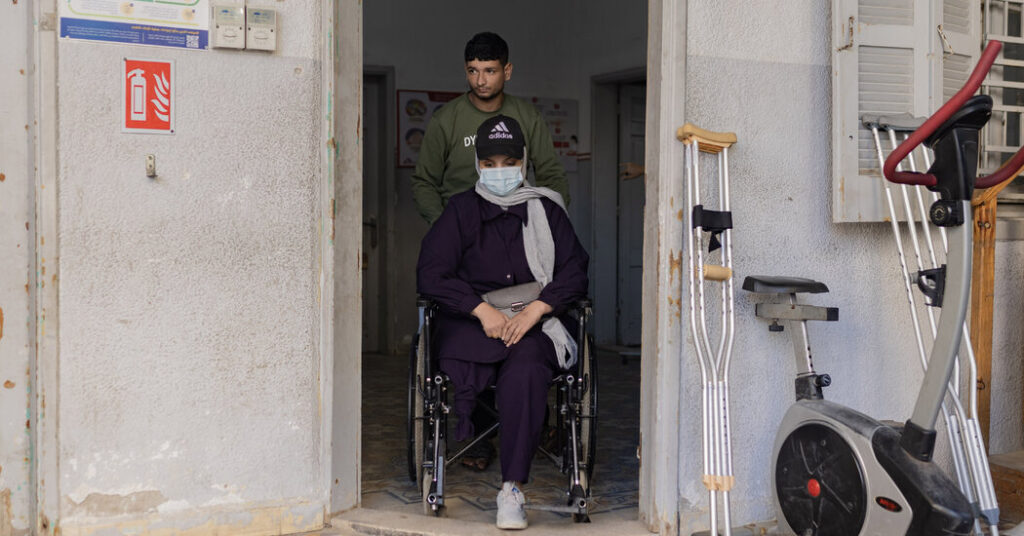
Aseel Hamada sat waiting for a physical therapy appointment at a medical clinic in Gaza City.
She’d lost her right leg from above the knee and suffered wounds to her arm and face on Sept. 9, when the apartment she was preparing to evacuate along with her family was hit by tank fire. She is still waiting to undergo plastic surgery on her facial wounds, which she concealed behind a surgical mask.
Now the clinic, run by Doctors Without Borders, may be forced to shut down.
“If M.S.F. stops working, people will lose their lives,” Ms. Hamada, 24, said quietly, using the acronym for Médecins Sans Frontières, the group’s French name.
“There are no alternatives,” she added. “M.S.F. is everywhere in Gaza because the need simply is everywhere.”
The Israeli government has given Doctors Without Borders until the end of February to pull out of the Gaza Strip, and has already cut off its ability to bring in supplies. Under new regulations, Israel demands that international aid groups provide lists of Palestinians on their Gaza payrolls, a measure it says is intended to ensure that militants do not infiltrate the groups.
Israel has produced evidence that one M.S.F. worker killed in an airstrike in 2024 was a member of Palestinian Islamic Jihad and involved in rocket production.
Doctors Without Borders says it vets all new hires but was unaware of the worker’s P.I.J. activity and would never knowingly hire a militant.
It noted that at least 15 of its workers were killed in the war.
Doctors Without Borders is among a few dozen groups that refused to comply with the new policy. It said that doing so would violate European privacy laws and rules.
The new Israeli policy also gives officials the right to bar aid groups for certain categories of political speech. Israeli officials said that the group’s frequent denunciations of the Gaza war as “genocidal” and accusations that Israel was committing war crimes amounted to prohibited efforts to “delegitimize” the country.
In publicly seeking to explain their decision to bar Doctors Without Borders, Israeli officials have also asserted that the group was exaggerating its importance in Gaza.
But visits to several M.S.F. clinics and hospitals showed its vital role in the territory’s medical system.
Busy treatment wards and clinics, overworked nurses and physicians, and waiting rooms crowded with grateful patients all put a human face on the organization’s statistics. Collectively, they make clear that shutting down its operations in Gaza would be a devastating blow to an already ravaged health care system.
Despite a fragile cease-fire, most Gazans are still living in tents or damaged buildings. Getting enough food or clean drinking water can be a daily struggle. Israel rejects accusations that it has starved Palestinians in Gaza and says it allows the flow of international aid, fuel and other supplies to hospitals. It has blamed the United Nations for failing to distribute supplies that are already in Gaza.
Aid groups have said the restrictions imposed by the Israeli military have often made delivering food within Gaza difficult, and see the new Israeli policy as another measure preventing Palestinians from receiving more than the bare minimum.
At the same time, Israeli lawmakers banned the United Nations agency for Palestinian refugees — long the biggest aid provider in Gaza — as part of a yearslong clash with the organization. Only about half of Gaza’s hospitals are running, according to the U.N., and more than 18,500 patients need urgent medical evacuation abroad.
In a ward run by Doctors Without Borders at Nasser Hospital in Khan Younis, the largest functioning hospital, Abdullah al-Belbeisy, 20, was being treated for severe burns on his hands and face. A cooking-gas tank had exploded when neighbors in the next tent were lighting a wood fire — a common accident among displaced families forced to live in makeshift conditions. About 15 patients waited to receive wound care or physical therapy.
“This is a clean, healthy place,” Mr. al-Belbeisy, said “Without M.S.F., many of us wouldn’t survive. ”
Amal Abu Warda, 63, sat with her right hand heavily bandaged, her fingers swollen and stiff. She had been hit by shrapnel in September and had undergone 10 procedures at the group’s facilities, including a skin graft. After 12 physical therapy sessions, she said that she was starting to gain control over her fingers.
Near the ward’s entrance, Mohammed Baraka, 26, worked through leg exercises, after previous operations that left metal plates in his leg. He comes every other day — sometimes making the six-kilometer trip on crutches, he said — “so I don’t lose my ability to walk.”
The cease-fire hasn’t diminished the need for surgery. One orthopedic surgeon, Dr. Mohammed Di’bis, 29, said doctors were performing roughly 20 operations a day.
Dr. Di’bis, whose government salary from the Ministry of Health is supplemented by Doctors Without Borders, said any interruption in the group’s work would be “deeply unjust.”
“Without M.S.F., we’d lose essential medications, dressing materials and even medical devices,” he said. “In many cases, M.S.F. has been the only organization supplying the hospital here.”
Maryam Z. Deloffre, an expert on humanitarian aid at George Washington University, said international law requires all warring parties to facilitate the flow of humanitarian aid to civilians without imposing arbitrary restrictions, though repressive states frequently set barriers that leave relief organizations having to make compromises to do their jobs.
“Humanitarian workers are frequently confronting these kinds of moral dilemmas,” she said. If aid groups agree to comply with such restrictions, they can be seen as complicit but would still be helping people. If they refuse to comply and withdraw, then they’re standing on principle but failing to help those in need, she explained.
“What we need to consider here is, what company does Israel want to keep?” she added. “It tends to be authoritarian, belligerent states who do this.”
Several nonprofits are complying with the new Israeli restrictions. They include more ideologically conservative groups, and others that are less outspoken than Doctors Without Borders. Among them is World Central Kitchen, a relief organization founded by the celebrity chef José Andrés that has taken a leading role in the Gaza aid effort.
Roberta Alves, a spokeswoman for World Central Kitchen, confirmed that it had registered under the new rules but declined to comment further.
Others following the new rules include Samaritan’s Purse, an evangelical group; Catholic Relief Services; and the International Medical Corps, which ran field hospitals in Gaza throughout the war. Samaritan’s Purse declined to comment, and the other two groups did not respond to requests for comment.
At the Doctors Without Borders clinic in Gaza City, Wafaa Zomlot, 39, a physical therapist, was puzzled by Israel’s demands for Palestinian workers’ names.
“Nothing about us is hidden,” she added, adding that staff have long undergone security checks for permission to travel. “The Israeli authorities already know everyone in Gaza.”
With just weeks until the deadline to shut down, workers and patients were filled with despair.
Hunter McGovern, a project coordinator at the clinic, which specializes in wound care for traumatic injuries, recalled what happened when military action in September forced the clinic to shut down temporarily.
“It was heartbreaking,” he said. “Around 270 to 280 patients a day depended on our services. If you do not change the bandages on some of these horrific wounds, people risk serious infections and even death.”
When the clinic reopened over a week later, said Luay Harb, 41, a nursing supervisor, patients immediately returned. “That tells us something important,” he said. “The service we provide is essential.”
In Deir al-Balah, at one of the group’s field hospitals inside a tent, Islam Abu Jabal, 33, brought her 2-year-old daughter, Elaf, who was burned when a pot of water boiling over a wood fire slipped and spilled on her.
Ms. Abu Jabal said she had tried other clinics but kept coming back to this one. “Here, I feel safe,” she said. “My daughter feels safe. The doctors treated her with kindness and patience. They didn’t just dress her wounds, they cared for her.”
Nearby, Ahmed Shaldan, 22, sat in a wheelchair awaiting his fifth physical therapy session for a leg injury from a missile strike
Told that Doctors Without Borders would be forced out, he said he was stunned.
“This care is not extra, it’s essential,” Mr. Shaldan said. He looked down at his leg. “If I want to walk again, I need this place.”
David M. Halbfinger is the Jerusalem bureau chief, leading coverage of Israel, Gaza and the West Bank. He also held that post from 2017 to 2021. He was the Politics editor of The Times from 2021 to 2025.
The post Inside the Doctors Without Borders Clinics that Israel Is Closing in Gaza appeared first on New York Times.