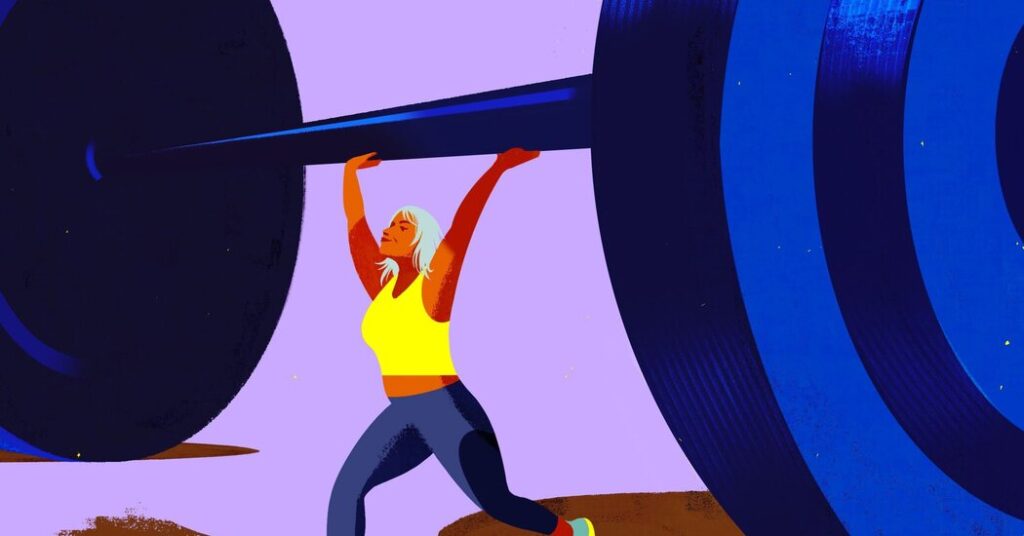
Not to be all Russell Crowe about it, but this morning, I biked to the gym before dawn, loaded up a barbell and did three sets of five squats with the weight of a small washing machine on my back. Then, having done that without too much trouble, I picked more than a hundred pounds of metal off the floor. I am 62 years old and feeling pretty proud of myself.
When I was first diagnosed with osteoporosis, at age 58, I argued with the endocrinologist. I am healthy, I told him. I am fit. I have been a runner, a swimmer, a yoga practitioner for all my life. The doctor, a cold fish, was unmoved. “You have had cancer and a pulmonary embolism in the last five years,” he told me. “You aren’t as healthy as all that.” I sulked. At 60, I started taking a statin.
Then, last summer, I gained more than 10 pounds. The weight gain was perfectly explicable: I had a new job, came home each evening ravenous and depleted and regularly needed a cheese plate and a tequila beverage to revive before dinner. This time, my beloved gynecologist issued a gentler warning. Weight training, she reminded me, is one of the best ways to combat the weight gain that often accompanies aging. In addition to building muscle strength and bone density, it can also boost metabolism.
I knew this, of course. “Lift heavy” has become a mantra on social media, prescribed as a cure not just for age-related ailments but for better posture, low self-image and depression. But I am suspicious of trendy remedies and frankly thought of myself as indomitable, so I had relegated weight training — like aging itself — into the category of things that other people do.
If I’m honest, it was vanity and not health-seeking that led me to register for Starting Strength, a thrice-weekly weight training class at the CrossFit gym near my home in Brooklyn. I wanted my trousers to fit me in a more flattering way. Developed by a Texas-based powerlifting coach named Mark Rippetoe, “Starting Strength” is both the title of Rippetoe’s 2005 book and a course that instructs weight lifters of all levels in five primary lifts: squat, bench press, shoulder press, deadlift and power clean.
Rippetoe’s acolytes tend to disdain bootcamps and weight machines and other newfangled exercise trends, believing that physical strength is built by learning the proper technique for lifting barbells loaded with increasingly heavy weight over time. My husband, always a gym guy, had taken the course and stressed the importance of learning to lift heavy under supervision to minimize the risk of injury.
The art of heavy lifting is learning to operate in the margin between success and failure. You ask your body to move so much weight that it forces an argument in your mind. Can I, can’t I? Will I, won’t I? One of my classmates calls each lift “an act of courage.” Our coach, a soft-spoken, wry man named Jeremy Fisher (who, at age 48, can shoulder press 260 pounds), will quickly eyeball a new student and assess their limits. “You start where you are,” the lifters say, and in my class there are people — men and women, old and young — who are squatting 5 pounds and others who are squatting more than 200. In July, when I started, I had never used a barbell before. I yoked my shoulders to a 22-pound bar, moved my butt down below my arthritic knees, then pushed myself back to standing. After three sets of five, I saw stars.
I have always been what my husband calls sporty, but I am not, in truth, innately athletic. As a child I wore a patch over one eye, making me terrible at playground dodgeball and fearful of balls in general. In elementary school, I was neither fast nor strong, quickly out when playing foursquare. At my elite prep school, three seasons of sports were required. I played field hockey and lacrosse, never made the junior varsity team and once earned a “C” in coordination.
So it wasn’t skill that propelled me to a lifetime of exercise. For me, physical challenge is an anxiolytic. I am, by temperament, dogged and competitive, anxious and a little bit solitary. Family backpacking vacations and long afternoons of hill sprints during track season taught me to appreciate the meditative detachment of hard physical work, and the subsequent feeling of being completely wrung out. Nothing else quelled my chattering brain in quite the same way.
In my 20s and 30s, I was driven by a propulsive momentum, hurling myself at romantic adventures and professional opportunities with semi-recklessness. Marathon training, freezing ocean swims, hot yoga, late-night tennis lessons — these were my attempts to find equilibrium, as if I could siphon off my toxic adrenaline by raising my level of physical stress. For my 38th birthday, I went on a backcountry skiing adventure that involved building an igloo and sleeping in ice. But I mostly avoided the bro-ish free weights area of the gym. I didn’t like the metal music or the clatter or the grunting, and I did not want to be a woman among all those men.
In those days, I believed my ability to endure heartbreak, disappointment, extreme temperatures and late nights meant I was strong. In fact, I was merely young.
As you age, stuff happens that no amount of mental toughness can forestall. The pulmonary embolism, brought on by a long flight at age 56, scared the hell out of me. For months afterward, I was shaken. I could have died. The breast cancer, the following year, was less existentially scary, but far more painful. My bones started thinning around then, thanks to the medication I took to prevent a recurrence of cancer. By the time I joined Starting Strength, the osteoarthritis in my knees was causing a limp.
When you lift heavy over time, you build reserves of strength. You accrue power for now, and also for later. It requires facing your own physical limitations (and maybe your own mortality). This self-knowledge can come at any age, but it came to me late and only when the evidence was undeniable.
In class, we proceed slowly and carefully. With every lift, Jeremy observes the alignment of our joints and the angles of our backs, occasionally issuing corrections: “chest up,” “drive with your hips.” In the squat, after shouldering the weight, I back up from the rack and consider my feet, how they feel on the floor. I suck in my breath, pull my shoulders back and fiercely compress every muscle in my core. I am making my body into something firm and hard: a lever, a hinge. I sink down, then push with my hamstrings, glutes and quads until I am standing again. Then I exhale.
Panic and self-doubt set in after three reps. “You’re putting yourself in a worse and worse position as you go down,” Jeremy explained. I start to imagine my knees crumbling, sinking, getting stuck near the floor. Then it’s a matter of simply not giving in. I hold my breath. I commune with a spot of blue tape on the wall. I reconsider my feet. I press my shoulders into the bar, and the bar into my shoulders. At the end of three sets, my body is humming.
I keep a record of my progress on my phone. It’s two steps forward and one step back. I am squatting 65 pounds right now, which is more than I was squatting at Christmas and less than at Halloween. In the culture of my gym, it’s all baby weight. I am a novice here, a fresh beginner; sometimes, with my gray hair and arm flab, I worry that I’m ludicrous. But the gym is cool. Nirvana is playing, and we cheer each other on through whatever we, individually, are struggling with. Whatever the number on the iron plates, this is hard. I have a goal for my squat, but I won’t say it out loud. That would be getting ahead of myself.
Here’s what I’ve noticed. My trousers fit. I can carry the cat litter bag up four flights of stairs without any fuss. I can move the biggest cast-iron pan out of the oven and easily lift my suitcase into the overhead rack. My walk to the subway is pleasurable again, and my last bone scan showed improvement.
Audio produced by Jack D’Isidoro.
Lisa Miller is a Times reporter who writes about the personal and cultural struggle to attain good health.
The post How I Learned to Love Lifting Heavy appeared first on New York Times.