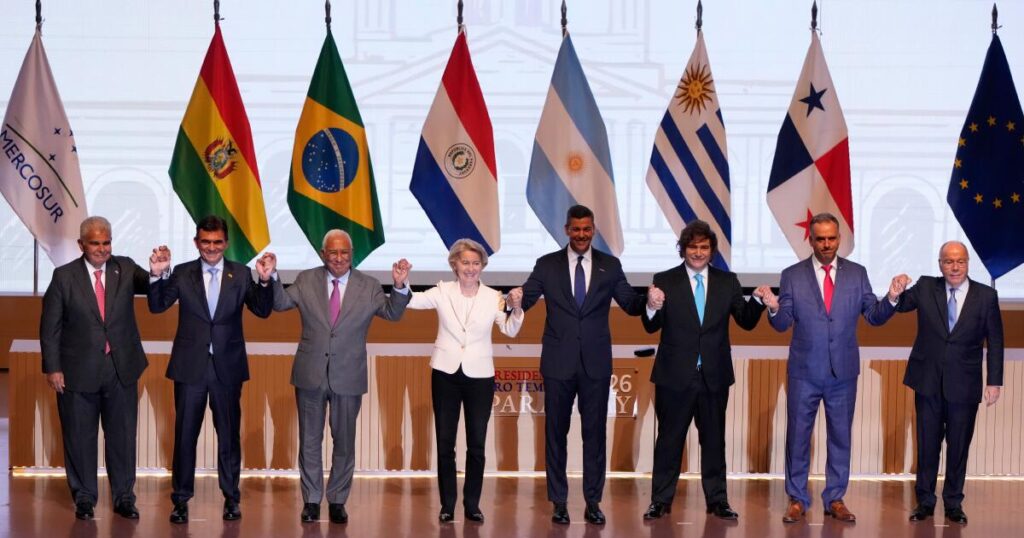
ASUNCIÓN, Paraguay — The European Union and the Mercosur bloc of South American countries formally signed a long-sought landmark free trade agreement on Saturday, capping more than a quarter-century of tortuous negotiations to strengthen commercial ties in the face of rising protectionism and trade tensions around the world.
The signing ceremony in Paraguay’s capital of Asunción marks a major geopolitical victory for the EU in an age of American tariffs and surging Chinese exports, expanding the bloc’s foothold in a resource-rich region increasingly contested by Washington and Beijing.
It also sends a message that South America keeps diverse trade and diplomatic relations even as President Trump declares dominance in the Western Hemisphere.
European Commission President Ursula von der Leyen, who head’s the EU’s executive branch, said that “the geopolitical importance of this agreement cannot be overstated” amid revived skepticism about the benefits of free trade. As the ceremony got underway, Trump announced 10% tariffs on eight European nations over their opposition to an American takeover of Greenland.
“We choose fair trade over tariffs. We choose a productive long-term partnership over isolation,” Von der Leyen declared at the ceremony attended by regional leaders including the presidents of Mercosur members Argentina, Uruguay and Paraguay and the foreign minister of the trading bloc’s biggest economy, Brazil.
“We will join forces like never before, because we believe that this is the best way to make our people and our countries prosper.”
Pushed by South America’s renowned cattle-raising countries and Europe’s industrial sectors craving new markets for cars and machines, the accord creates one of the world’s largest free trade zones and promises to make shopping cheaper for more than 700 million consumers.
After decades of delay, the politically volatile deal still must clear one final hurdle: ratification by the European Parliament.
Powerful protectionist lobbies on both sides of the Atlantic, particularly European farmers scared of the possible dumping of cheap South American agricultural imports, have long sought to nix the agreement. Tractor drivers clogged the streets in outrage across the continent in recent weeks and could still stall the deal’s implementation.
Although the accord eliminates tariffs on more than 90% of goods and services between the European and Mercosur markets, some tariffs will progressively be cut over 10-15 years and key farm products such as beef will be limited by strict quotas in an effort to assuage European farmers’ fears.
Those limits, as well as safeguard measures and generous EU subsidies to cash-strapped farmers, pushed agricultural powerhouse Italy across the line earlier this month.
France, however, remains opposed to the accord, with President Emmanuel Macron expressing worry that farmers’ frustration with the EU could drive more voters to the country’s far right in next year’s presidential election.
“Everything will depend on the political appetite of the European Parliament,” said João Paulo Cavalcanti, a Brazilian lawyer specializing in international trade. “That could clearly create an obstacle to approval.”
Batschke writes for the Associated Press.
The post European Union and Mercosur bloc of South American nations sign landmark free trade agreement appeared first on Los Angeles Times.