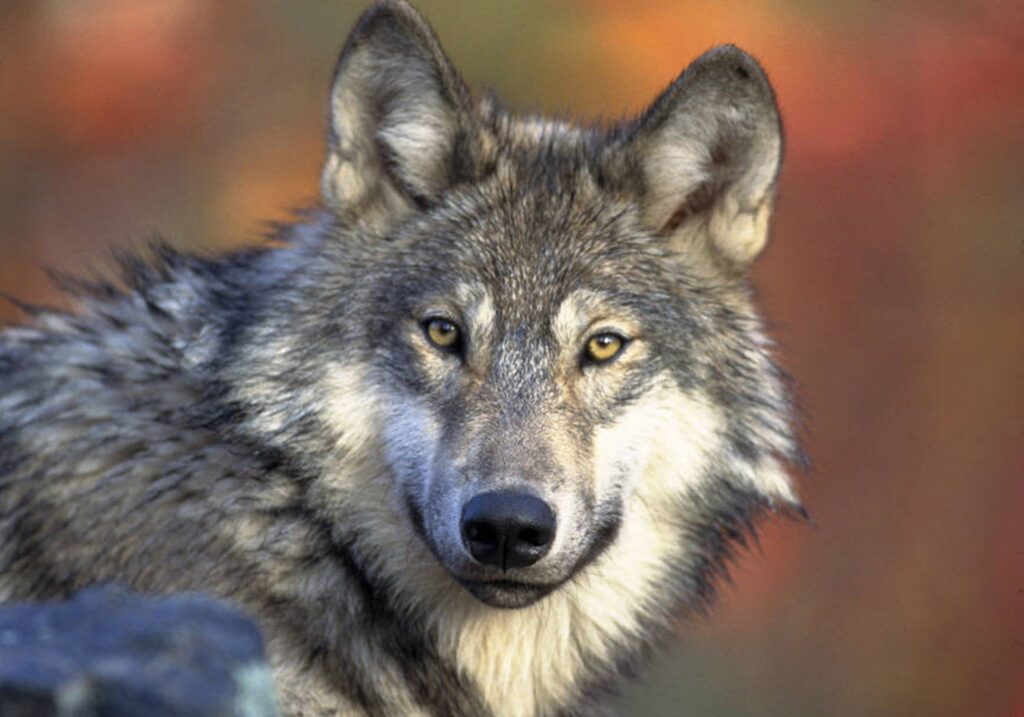
BOULDER, Colorado — Colorado was preparing to fly in as many as 15 gray wolves from Canada when a letter from the Trump administration arrived last fall, sternly ordering the state to “cease and desist.”
In December, the federal government upped the stakes, threatening to seize control of Colorado’s effort to reintroduce the predators to a state where their howls had nearly been silenced.
The intervention from Washington, which alleges Colorado violated an agreement with the U.S. Fish and Wildlife Service, has abruptly thrown a voter-approved wolf revival into disarray, essentially blocking the state’s ability to bolster a nascent population and raising doubts about the contentious program’s viability.
While welcomed by many ranchers and other critics, the takeover warning baffled former senior agency officials and environmental groups. They called it a misinterpretation of the agreement, as well as an impractical idea from a federal agency that has lost 20 percent of its workforce over the past year and has historically encouraged state-led wildlife conservation.
Yet Colorado’s mostly Democratic leaders suspect a political motivation, one tied to President Donald Trump’s broad campaign to retaliate against their blue state and its governor, Jared Polis, over mail-in voting and the imprisonment of Tina Peters, an election-denying former county clerk and MAGA cause celebre. At stake, they say, are critical programs and state sovereignty.
Colorado Attorney General Phil Weiser calls it a “revenge campaign.” Sen. Michael Bennet has deemed it a “coordinated attack,” while Sen. John Hickenlooper said Trump is “using a political squabble” over Peters as a “cudgel” against Colorado.
“This is not a place where the federal government should be poking their nose,” Hickenlooper said of wolf reintroduction.
The state has been dealing with a flurry of Washington-ordered hits. In September, Trump said Colorado’s mail-in ballots “played a big factor” in his decision to relocate the U.S. Space Command to Alabama. Three months later, he vetoed a long-planned pipeline to deliver clean water to conservative southeastern Colorado, and his administration announced it would dismantle the National Center for Atmospheric Research, a world-renowned institution in Boulder.
In recent weeks, officials have canceled millions of dollars in transportation and energy grants, denied emergency aid to communities ravaged by wildfires and flooding, and frozen hundreds of millions of dollars for child care, food aid and other assistance for poor Coloradans.
Other blue states have also faced retributive wrath from the Trump administration, which asserts it has the right to consider partisan politics when considering federal funding cuts.
But the jabs at Colorado have been accompanied by a steady stream of vitriol from the president, who has labeled Polis a “sleazebag” for leaving Peters behind bars. “If she is not released, I am going to take harsh measures!!!” he posted on Truth Social in August. On New Year’s Eve, he said he wished the governor and the Republican district attorney who prosecuted her would “rot in hell.”
Trump claimed in December to have issued a “full pardon” of Peters. Polis and Weiser rejected the announcement, saying a presidential pardon is meaningless when it comes to state convictions.
The White House declined to comment on how far it would go to ensure Peters’ release and whether its actions on the wolf program are related to her case. On other matters, officials pushed back.
Spokeswoman Abigail Jackson insisted there was “no politicization to the president’s decisions on disaster relief,” pointing to firefighting resources that the administration mobilized for one summer wildfire. And a second official, speaking on the condition of anonymity to discuss sensitive matters, said Colorado’s child care funding was halted due to “serious concerns” about fraud. As for the atmospheric research center, the official derided it as a “stronghold for left-wing climate lunacy” and noted that the president’s decision on the Space Command was made in consultation with military officials.
The official declined to explain how Trump learned about the wolf program but said the administration sees the predators as the cause of “significant losses to cattle ranchers due to predation, driving up the cost of beef for American consumers.” Since April 2024, Colorado Parks and Wildlife has confirmed that 28 calves, 16 cattle, 15 sheep, six lambs and one working dog have been killed or injured by wolves. Producers say the numbers are far higher.
Polis has not backed down in the face of the president’s attacks. But to the frustration of county and state election officials who have pleaded for a full-throated defense of Colorado’s election integrity, he also has not issued a firm no about freeing the 70-year-old Peters. Last week, he told CBS Colorado that her nine-year sentence was “harsh” and that he would consider clemency, as he would for any elderly inmate.
Peters has appealed her conviction on charges that she tampered with voting machines to prove Trump’s false claim that the 2020 election was rigged against him. She was found guilty by a jury in western Mesa County, where Trump won more than 60 percent of the vote in 2020 and 2024.
Her attorney, Peter Ticktin, said he made appeals for her freedom directly to Trump, a friend since their teen years and Ticktin’s captain at New York Military Academy in the 1960s. He wrote Trump requesting a pardon for Peters on Dec. 7. The president complied four days later.
Ticktin is surprised Polis has not acquiesced. “You have world leaders who don’t dare to say no to Trump,” he said. “Then you have this pip-squeak of a governor refusing to release an innocent woman from prison.”
In many ways, wolf reintroduction is a predictable Trump target. Its critics are mostly conservative ranchers enraged by what they see as a state agency too hesitant to kill wolves that prey on livestock and too slow to compensate producers for injured or dead animals. Some ranchers in the high country west of Rocky Mountain National Park put a banner on a fence with a direct plea to the White House: “Gov. Polis is throwing us to the wolves! President Trump, please help!”
Threatening the program also serves as a personal dig against Polis, who follows it closely and in 2023 witnessed the release of the first batch of 10 wolves from Oregon. His husband, Marlon Reis, is an animal rights advocate and vocal defender of the effort.
Backers say its goal is to restore an animal critical to Colorado’s ecosystem, which hosts North America’s largest elk herd and a growing population of moose. Even so, the state’s first-in-the nation bid to reintroduce an endangered species via ballot measure only narrowly passed in 2020. Voters in the populous areas east of the Rockies supported it. Rural western Colorado, where the wolves have been released, largely voted no.
Partly to assuage ranchers’ concerns, Colorado pursued a special designation from Fish and Wildlife that allowed the state more flexibility to use lethal control against wolves preying on livestock.
Colorado got its second batch of wolves from British Columbia and released the seven males and eight females in January 2025. Fifteen of the imported wolves are alive today; the remainder have died in ways including vehicle collisions and legal and illegal shootings. But the survivors have spread and reproduced, with advocates now counting around 35 wolves. Their goal is at least 150.
The program’s supporters say they expected the scope of deaths and livestock attacks, as well as a bumpy adjustment to a new predator on the landscape. Opponents say Colorado Parks and Wildlife bungled things by failing to work with livestock producers and betrayed its management plan in various ways.
In October, as the state readied plans to release more Canadian wolves, U.S. Fish and Wildlife Director Brian Nesvik sent Colorado Parks and Wildlife a letter saying it was allowed to source wolves only from Northern Rockies states — so not Canada, Alaska or the Upper Midwest. Most of those states had already declined to provide the animals; in November, Washington also decided against it.
Conservation organizations, as well as former Fish and Wildlife officials who spoke on the condition of anonymity because of concerns about retaliation against current staffers, said Nesvik is wrong.
“They just created this new interpretation to say that the law says what they want it to say,” said Tom Delehanty, an attorney at Earthjustice.
Colorado says it is abiding by Nesvik’s order but still seeking a source for wolves. The federal directive, however, has dried up the pipeline.
The pressure mounted on Dec. 18, when Interior Secretary Doug Burgum accused Colorado of prioritizing wolves over ranchers. His post on Xcontinued: “This is a warning: if Colorado does not get control of the wolves immediately, we will!”
The same day, the state got another letter from Nesvik. He asserted that Colorado had violated a federal rule by releasing Canadian wolves “with no notice or warning to its citizens,” though its wildlife agency had publicly announced its agreement with British Columbia months before and held meetings with stakeholders. Nesvik also faulted officials for releasing a wolf from a pack known to have gone after livestock.
The letter demanded Colorado provide within 30 days a “complete reporting” of wolf management activities since 2023. Noncompliance could result in Fish and Wildlife taking command of the management, “including lethal control and removal.”
Nesvik outlined no clear violations, according to a former senior Fish and Wildlife official with direct knowledge of the rule and an accompanying Memorandum of Agreement between the state and federal wildlife agencies. More striking, the former official said, was the “political tone” of the letter and its highly unusual takeover threat. Communications with states are typically collegial, he said.
“If we were to do this in normal times, it would be a declaration of war,” he said.
Frustrated ranchers say they are grateful for Washington’s attention. Merrit Linke, a rancher and commissioner in Grand County, where wolves have attacked livestock, doesn’t think the federal government has the staff for on-the-ground management but might be able to more forcefully direct the killing of predatory wolves.
“It’s become political on both sides, and that, to me, is wrong,” Linke said. He just wants Colorado to follow its wolf management plan, which he said had been politicized by the governor and forces that oppose cattle on public lands.
Wolf advocates say Colorado’s inability to import more animals for the foreseeable future means the state must focus on keeping the current population alive. The state also needs more resources to work with ranchers to avoid conflicts, according to Eric Washburn, a big game hunter who managed the 2020 ballot measure campaign.
A federal takeover would likely slow the wolves’ spread — but, he hopes, not extinguish it.
“I worry about it, but I also think that wolves are pretty resilient animals,” Washburn said. “It would be tough for the federal government to kill them all.”
The post Colorado’s wolves in the political crosshairs as Trump targets the state appeared first on Washington Post.